
PILES · REPAIR GUIDE
Pile Repair Methods for Concrete, Timber and Steel Piles
Most damaged piles are repaired in place by encasing the damaged length in a jacket and filling the space around the pile with grout, concrete or resin, often with new reinforcing bars. Other options are crack injection, posting or splicing, welding and steel jackets, or driving a new pile. Which one fits depends on the pile material, how much section is gone and whether the damage is underwater. Compare the methods.
Key takeaways
- Encasement is the workhorse: jacket the damaged length and fill it with grout, concrete or resin, adding bars where section is lost.
- Full capacity without a new pile: bars and grout can rebuild a pile even where a length of it is missing.
- Material sets the details: concrete needs confinement and a chloride seal, timber a resin or grout fill, steel a load transfer device.
- Tested by agencies: repaired timber piles carried 5.3 to 9.9 times design load for Nebraska; 13 of 14 corroded H-piles regained full capacity for Texas DOT.
- No cofferdams: underwater-curing epoxies let jackets go on in the water while the structure stays in use.
Why do piles need repair?
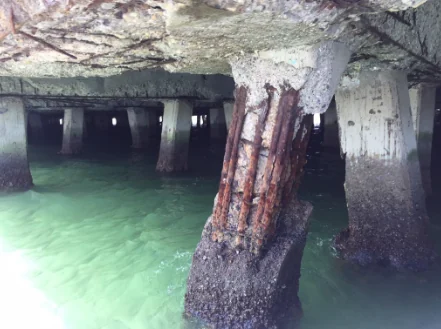
Piles lose capacity from the outside in, and the damage is almost always worst in the splash zone, the length between low and high tide. Wetting, drying and a steady supply of oxygen keep deterioration active there, which is why piers, wharves, bridges and coastal buildings so often show the same band of damage just above the water.
Each pile material fails in its own way:
- Concrete piles: chlorides in seawater reach the reinforcing or prestressing steel, even through high-quality concrete. Rusting steel takes up more room than the original bar, so it cracks and spalls the cover and lets in more seawater. Some piles also crack from within because of alkali-silica reaction (ASR).
- Timber piles: decay fungi attack above the waterline, and marine borers attack in the tidal and submerged zones, often hollowing the pile while the outside still looks sound.
- Steel piles: corrosion thins the flanges of H-piles or the wall of pipe piles until the section can no longer carry its load.
For a closer look at the two most common materials, see timber vs. concrete piles and the advantages and disadvantages of timber piles.
How is pile damage assessed?
An engineer assesses a damaged pile with a visual inspection, non-destructive testing such as ultrasonic testing, measurements of lost section or wall thickness and, where needed, a load test. The goal is two numbers: how much capacity is left, and how long a length of pile needs repair.
For steel piles, the Texas Department of Transportation research gives a practical rule. In small- and full-scale tests on corroded H-piles, the loss of axial capacity tracked the loss of cross-sectional area closely, and removing 82% of the area cut capacity by 80%. Loss of flange thickness mattered more than loss of web thickness, because the flanges keep the pile from buckling.
What are the main pile repair methods?
The most common repair is encasement: the damaged length is enclosed in a shell or jacket, and the space between the jacket and the pile is filled with epoxy grout or underwater cementitious grout. Bars can be added in that space when the pile needs more strength. The table below compares encasement with the other methods engineers use.
| Method | How it works | Best fit | Limits |
|---|---|---|---|
| Structural FRP jacket (PileMedic®) | A thin laminate is wrapped twice around the pile on site, bonded to itself with an epoxy that cures underwater, then filled with grout, concrete or resin, with bars if needed | Concrete, timber and steel piles, in water or dry | Steel piles need a load transfer device such as ShearWrap™ |
| Concrete jacket in formwork | A form is sealed around the damaged length and concrete is pumped in | Enlarging and protecting a damaged section | A Portland, Maine harbor study found damage to the jacket and to the wood above it, and deterioration of the fill |
| Half-shell fiberglass jacket | Two shells are bolted or glued around the pile and filled with grout | Protecting a pile of a known, uniform size | The vertical seam lets in moisture and oxygen, limits confinement, and shells are made to one size |
| Wet layup FRP fabric | Fabric is saturated with resin and bonded to the pile surface | Smooth, dry concrete above water | Needs a smooth, dry surface, so it suits submerged piles and uneven timber poorly |
| Resin or grout injection | Low-viscosity resin or grout fills cracks, voids and cavities | Cracks and small cavities, usually inside a jacket | Resin is costly for large cavities; grout is preferred above about 1 gal of void |
| Posting or splicing (timber) | The decayed section is cut out and replaced or spliced, bonded with epoxy or fasteners | Timber piles with sound wood above and below | One lap splice method restored only 70% of axial capacity; shoring may be needed |
| Welding, plates or steel jacket (steel) | A corroded section is cut out and new steel welded in, or the pile is encased in new steel | Steel piles where hot work is allowed | Underwater welding is costly, and many sites forbid hot work |
| Replacement | A new pile is driven and the load transferred to it | Piles beyond repair | Costs more than rehabilitation and is often impossible under an existing deck or cap |
Sources: TRR 2481 (2015) for concrete jacketing, posting, splicing and fill choice; Ehsani and Tipnis (2011) for wet layup; Ehsani, Day and White (IBC 2016) for half-shell jackets. Your engineer of record chooses and designs the repair.
One point matters more than the label on the method. A repair that encases the pile in a new reinforced shell can restore full capacity even where a length of the original pile is gone, without driving a new pile. Coatings and simple wraps protect a pile, but they do not give back lost section.
Not sure which method fits your piles?
Tell us the pile type, size, condition and water depth. Our team will recommend the right QuakeWrap® system and provide specifications for your engineer.
How are concrete piles repaired?
Concrete piles are repaired by encasing the damaged length in a confining jacket, adding bars where section is lost, and filling the jacket with underwater grout or concrete. The jacket does three jobs: it acts as the ties, it confines the concrete core, and it seals moisture and oxygen away from the steel.
Carbon FRP fabric applied by wet layup is a proven way to strengthen concrete columns on land, but it needs a smooth, dry surface, so it is not effective on piles in the water. For submerged and splash-zone piles, PileMedic® pile jackets use thin, factory-made carbon or glass laminates supplied in 4 ft wide rolls.
- CutA length equal to twice the pile perimeter plus 8 in. (200 mm) is cut from the roll.
- Place barsSpacers are fixed around the pile and longitudinal bars, preferably non-corroding GFRP, snap into them.
- WrapThe laminate is coated with epoxy and wrapped around the spacers into a seamless two-ply shell.
- StackEach 4 ft tall shell overlaps the one below by 4 in. (100 mm) until the damaged height is covered.
- FillThe bottom is sealed and the space between shell and pile is filled with underwater grout or concrete.
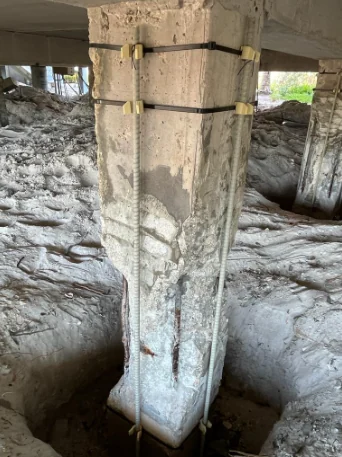
The laminate replaces the hoop ties that would otherwise have to be tied underwater: two plies of PileMedic® PLG14.13 equal No. 4 Grade 40 ties at 3.5 in. on center. Confinement also raises the strength of the core. In QuakeWrap’s test data, a typical 4,000 psi concrete pile reaches over 6,000 psi, and the pile is back to full capacity within 24 hours. In many cases the new reinforced shell can be designed to carry the loads on its own.
At the Port of Seattle’s Terminal 18, for example, 90 octagonal prestressed concrete piles were retrofitted this way with two layers of PileMedic® PLG60.60 laminate and QuakeBond™ underwater grout.
Plays from YouTube
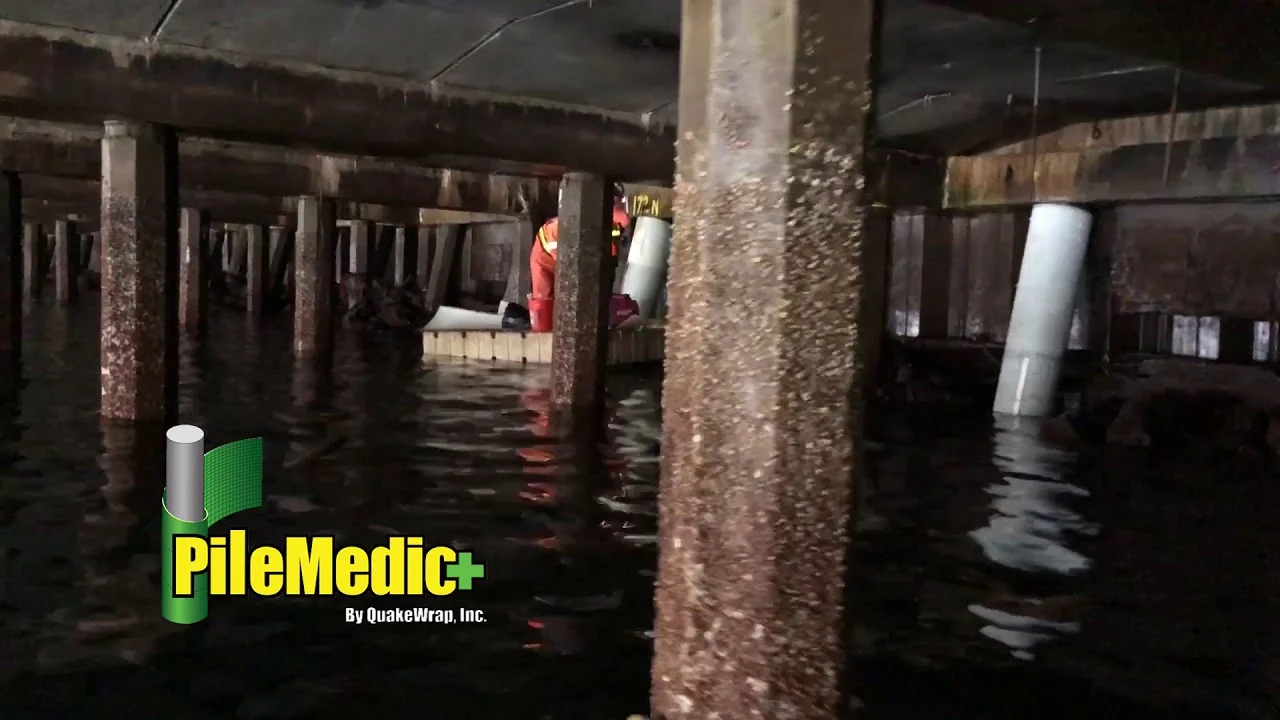
The same approach suits piles cracked by ASR, where the jacket must block water as well as confine the pile. Read how 40 ASR-damaged bridge piles were encased underwater in a crocodile-infested river in Queensland, and how jackets go on without cofferdams in repair of submerged piles.
How are timber piles repaired?
Timber piles are repaired by posting (cutting out and replacing a decayed section), by splicing, by concrete jacketing, or by encasing the damaged length in an FRP shell filled with resin or grout. Preservative treatment used to be the main defense, but environmental limits on treated wood mean many piles now decay faster than they used to.
There are two FRP variants. In the first, the laminate is wrapped snug around the pile, leaving 1 to 2 mm, and a low-viscosity resin fills that gap along with the cracks and borer tunnels in the wood, bonding shell and pile together with almost no increase in size. In the second, spacers hold GFRP bars around the pile, the laminate forms an annulus of up to about 3 in. (75 mm), and grout or concrete fills it to create a new reinforced concrete pile around the old one. The bars span any missing length, and the concrete takes the place of the lost wood.
Testing backs both FRP variants. For the Nebraska Department of Roads, Florida International University repaired five full-scale damaged timber piles with fiberglass laminates filled with resin, grout, or gravel and resin. They failed at 5.3 to 9.9 times their design load. By comparison, one lap splice method tested at Iowa State restored only 70% of axial capacity. The full test table, fill choice and installation steps are in timber pile repair methods.
How are steel piles repaired?
Steel H-piles and pipe piles are repaired by welding in new steel, adding a steel jacket, or encasing the corroded length in a reinforced grout or concrete shell. Welding underwater is costly, and many industrial and port sites forbid hot work because of flammable materials, which is why encasement is so widely used.
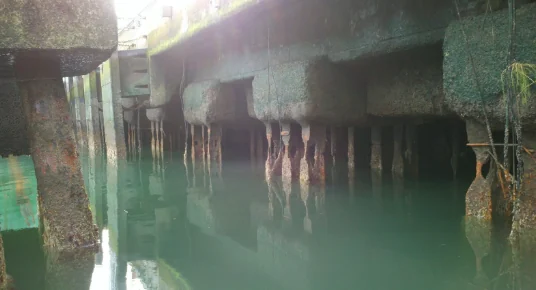
Encasement has one catch on steel. The rough surface of a timber or concrete pile bonds well to new concrete, but a corroded steel pile may not, and the AISC Specification (ANSI/AISC 360) does not allow steel-to-concrete bond to carry load in encased composite members at all. The load needs a mechanical path into the new shell. Welded shear studs can provide it, but welding is often not possible on a corroded pile or not allowed on site.
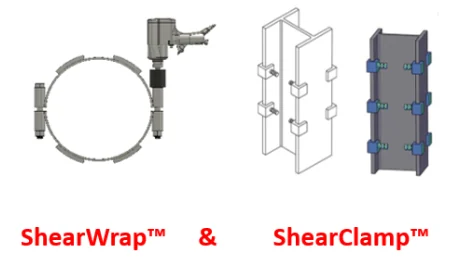
ShearWrap™ and ShearClamp™ solve this without welding or drilling. They are bolt-on steel devices, made for each pile size and torqued to the pile above and below the damage, that carry the load into the new shell by friction and back out again.
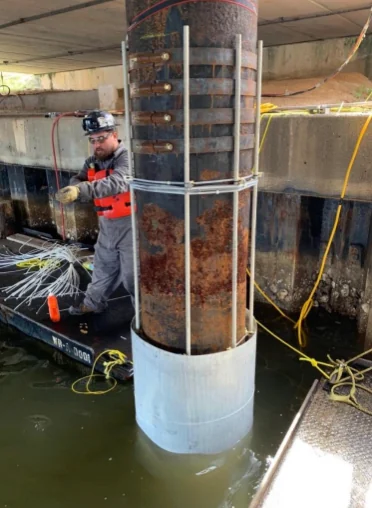
The Texas DOT study supports this. Its goal was a durable repair for steel bridge piles that could go on without dewatering. Fourteen full-scale corroded H-piles were repaired with two grout-filled FRP jacket systems, and capacity returned to the nominal uncorroded value in 13 of them. The exception had been built on purpose without the anchors its design called for. Anchors reduced slip between the steel and the grout, and in accelerated exposure tests the FRP jackets prevented further corrosion of the repaired piles.
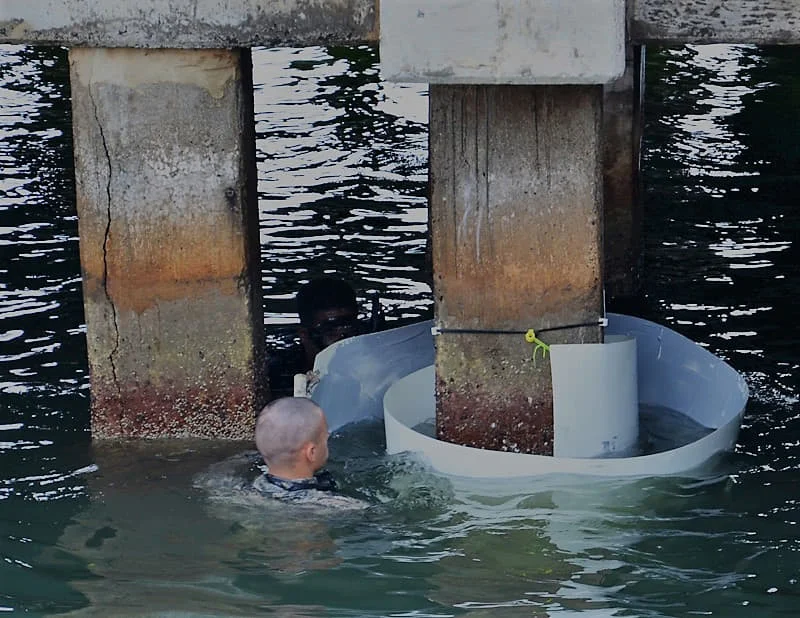
For pipe piles in particular, see steel pipe pile repair, and the Port of Long Beach project, where PileMedic® jackets were used on steel pipe piles and SPiRe®+ panels on the pile caps.
Can piles be repaired underwater and in service?
Yes. PileMedic® laminates are bonded with an epoxy that cures underwater, so jackets go on without cofferdams or dewatering. Jackets are often wrapped at the waterline and slid down the pile, which keeps diving to a minimum. Because encasement works around the pile, the deck or cap stays in place and the structure usually stays in use.
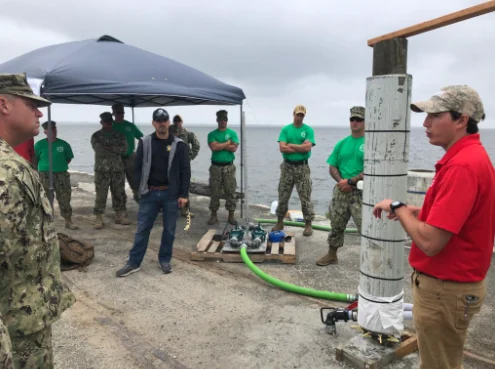
The U.S. Army Corps of Engineers researched and tested commercial pile jackets for rapid port repair under its PIER program and packaged one in modular kits that fit on C-17 aircraft. The aim was the same as on any working pier: restore piles quickly, with small crews and light equipment.
The advantage was that the broken pile could be repaired and reinstated up to the required bearing capacity and strength value, and no additional piles needed to be installed. This reduced cost and timing in repair method.
How do you choose a pile repair method?
Start from the capacity the pile must get back, then pick the lightest method that delivers it under your site conditions. These questions narrow it quickly:
- How much section is lost? Cracks and small voids can be injected inside a jacket. Large cavities or missing lengths need bars and grout or concrete.
- What is the pile made of? Steel needs a load transfer device. Timber may suit a snug resin-filled shell. Concrete needs confinement and a seal against chlorides.
- Is the damage underwater? Methods that need a dry surface or hot work add cofferdams, dewatering or permits.
- Can the structure close? If not, choose a method that works around the pile without removing the deck or cap.
- What is the access? Tight pile spacing, braces and remote sites favor thin laminates cut to fit on site over prefabricated shells.
Beach houses and condos have their own mix of pile types and access limits. See beach house piling types and beach house piling repair.
What does pile repair cost?
Pile repair cost depends on the pile size, the length and depth of damage, the pile type, water depth and diving, access, and the method. Materials, labor, equipment, engineering, permits and inspection all add up. Repair usually costs less than replacement, and under an existing deck or cap a new pile often cannot be driven at all.
For a first look at PileMedic® material cost for your pile size and repair length, use the pile jacket cost estimator. For residential piles, see beach house piling repair cost.
Pile repair method FAQs
What is the most common pile repair method?
Encasement. The damaged length is enclosed in a shell or jacket and the space between the jacket and the pile is filled with epoxy grout or underwater cementitious grout, with reinforcing bars added when the pile needs more strength.
What causes damage to piles?
Chloride corrosion of the steel and ASR cracking in concrete piles, decay and marine borers in timber piles, corrosion in steel piles, and impact from vessels or accidents. Damage is usually worst in the splash zone between low and high tide.
How is pile damage assessed?
With visual inspection, non-destructive tests such as ultrasonic testing, measurement of lost section or wall thickness, and load testing where needed. For corroded steel H-piles, Texas DOT research found that capacity loss tracks the loss of cross-sectional area.
Can a pile with a missing section be repaired without a new pile?
Yes. In an encasement repair, new bars span the missing length and grout or concrete replaces the lost material. At an agricultural port dock, timber piles that were completely detached were restored to their original axial and bending capacity this way.
Can piles be repaired underwater?
Yes. PileMedic® laminates are bonded with an epoxy that cures underwater, so jackets go on without cofferdams or dewatering, and they are often wrapped at the waterline and slid down the pile.
How do you repair a corroded steel pile without welding?
Encase it in a grout-filled FRP jacket and give the load a mechanical path into the new shell. Bolt-on devices such as ShearWrap™ and ShearClamp™ transfer load by friction, with no welding or drilling of the pile.
Can the structure stay in service during pile repair?
Usually. Encasement works around the pile without removing the deck or cap. The agricultural port dock stayed open throughout its repair of more than 500 piles.
Who designs the pile repair?
Your engineer of record. Our team will recommend the right QuakeWrap® system and provide specifications, sample design details and data sheets for your engineer.
Sources
- Dawood, Karagah, Shi, Belarbi, Vipulanandan (University of Houston) and Bae, Lee (Texas Tech), Repair Systems for Deteriorated Bridge Piles: Final Report, Report FHWA/TX-17/0-6731-1, Texas Department of Transportation and FHWA, December 2015, published April 2017.
- Gull, Mohammadi, Taghinezhad and Azizinamini (Florida International University), “Experimental Evaluation of Repair Options for Timber Piles,” Transportation Research Record 2481, Transportation Research Board, 2015. Research for the Nebraska Department of Roads.
- Ehsani and Tipnis, “Miami Building First to Benefit from Innovative PileMedic Jacket,” Concrete Repair Bulletin, July/August 2011.
- Ehsani, Day and White, “Repair of Deteriorated Bridge Piles in a Crocodile-Infested River,” International Bridge Conference, Washington, DC, June 2016 (IBC-16-19).
- Ehsani (QuakeWrap), Gallagher (Stantec) and Herbert (Western Infrastructure Renewal), “Repair of Timber Piles in Rail Bridges: A Canadian Perspective,” IABMAS Conference, Copenhagen, June 2024.
- U.S. Army Corps of Engineers, Engineer Research and Development Center, Port and Harbor Assessment and Repair (PIER) JCTD Spiral 1 fact sheet, February 2017.
- Verstreepen, J., quoted in Pile Buck, Vol. 36 No. 3, 2020.
- QuakeWrap, Inc., PileMedic® product data sheets.
- QuakeWrap, Inc., Agricultural port timber pile project sheet (Perdue AgriBusiness, Chesapeake, Virginia).
Have Piles That Need Repair?
Tell us the pile type, size and site conditions. Our team will recommend the right QuakeWrap® system and provide specifications for your engineer.