
TIMBER PILES · REPAIR GUIDE
Timber Pile Repair Methods: What Works and When
Deteriorated timber piles are repaired in place by posting (cutting out and replacing a section), splicing, concrete jacketing, or encasing the damaged length in an FRP shell filled with resin or grout. In full-scale tests for the Nebraska Department of Roads, damaged timber piles repaired with FRP laminates carried 5.3 to 9.9 times their design load. Compare the methods.
Key takeaways
- Five method families: posting, splicing, steel posting or sistering, concrete jacketing and FRP encasement.
- Splices can lose bending strength: one lap splice restored 70% of axial capacity, and an FRP sheet splice kept only 50% of bending.
- FRP shells tested well: repaired piles carried 5.3 to 9.9 times design load in Nebraska DOR tests.
- Pick the fill by the damage: resin for cracks and small voids, grout for cavities over about 1 gal.
- Works in the field: 135 rail bridge piles in Manitoba at 2 to 3 piles per crew per day.
Why do timber piles deteriorate?
Timber piles deteriorate because decay fungi attack the wood above the waterline and marine borers attack it in the tidal and submerged zones. Fungi need oxygen and wood that stays moist, above about 30% moisture content. Gribbles chew the surface from outside, while shipworms tunnel inside the pile.
The damage is often hidden. Borers usually get in through a small split or bolt hole and reach the untreated heartwood, so the treated outer shell can look sound while the inside is hollowed out. Nobody notices until the shell starts to fail.
Two trends make this worse. Environmental limits on creosote and other treatments, especially at water crossings, leave newer piles less protected. The U.S. EPA notes that creosote may pose risks to fish and invertebrates when treated wood is used in aquatic structures. At the same time, cleaner inland waterways have let shipworms and gribbles return. For the full picture of where timber piles are strong and weak, read advantages and disadvantages of timber piles.
The scale is large. In 2010 the Nebraska Department of Roads counted 131 state and 1,385 non-state bridges on timber piling. Its old policy was to replace bridges whose timber piles were in poor condition. Its newer approach was to repair piles that still carry the cap loads, when the repair extends the life of the structure by 10 to 20 years.
What are the main timber pile repair methods?
There are five families of timber pile repair: posting, splicing, steel posting or sistering, concrete jacketing, and FRP encasement. They differ in how much capacity they restore, how much bending they can carry, and whether the structure has to be shored while the work is done.
| Method | How it works | What testing or field use showed | Watch-outs |
|---|---|---|---|
| Posting | The deteriorated section is cut out and replaced with a new treated section, bonded with epoxy grouting | Axial tests (Avent, 1989) kept the original ultimate strength and axial stiffness | Combined axial and bending loads were not tested; shoring is sometimes needed |
| Lap splice (Method A) | Sections joined with lap splices and long metal screws | Restored 70% of axial capacity (Iowa State, 2007) | Bending capacity was significantly reduced |
| FRP sheet and epoxy splice (Method B) | FRP sheets and a special epoxy connect the sections | Restored 100% of axial and 50% of bending capacity (Iowa State, 2007) | Half the bending capacity is lost |
| Steel splice | Pre-assembled steel splice units bolted on by maintenance crews | Nebraska DOR reported a 25-ton splice capacity, above its 10 to 20 ton design loads, installed under traffic | Nebraska DOR called it a temporary solution |
| Steel posting or sistering | Steel members added in place of or alongside the damaged length | Limited tests; capacity restored was not reported (Iowa State, 2012) | No published capacity to design from |
| Concrete jacket | A form is sealed around the damaged area and concrete is pumped in (NCHRP Synthesis 200) | Used on timber, steel and concrete piles | A Portland, Maine harbor study found damage to the jacket and the wood above, and deterioration of the fill |
| FRP shell with resin | Laminate wrapped snug (1 to 2 mm gap) and filled with low-viscosity resin that soaks into cracks and bonds the shell to the pile | Resin-filled piles reached 9.9 and 5.3 times design load (Nebraska DOR tests) | Resin is costly for large cavities |
| FRP shell with bars and grout | Spacers hold GFRP bars; the laminate forms an annulus up to about 3 in. filled with grout or concrete | Grout-filled piles reached 6.8 and 9.5 times design load; restores piles with missing sections | Larger finished diameter |
Sources: TRR 2481 (2015), which reviews posting, splicing, sistering and NCHRP Synthesis 200; Enchayan, Nebraska DOR (2010) for the steel splice. Results apply to the specimens and projects described.
Posting and splicing work when there is sound wood above and below the damage, but they cut the pile, and some restore far less bending strength than axial strength. Concrete jackets add section but did not hold up well in the Portland, Maine harbor study. FRP encasement keeps the pile whole and builds new capacity around it. For how these methods compare with repairs on concrete and steel piles, see pile repair methods.
Not sure which repair fits your timber piles?
Send the pile size, depth and length of damage, and water conditions. Our team will recommend the right PileMedic® system and provide specifications for your engineer.
How does FRP encasement repair a timber pile?
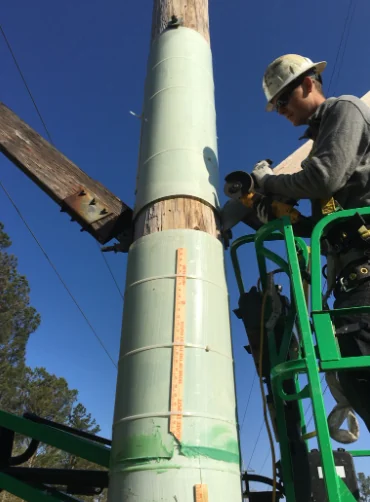
FRP encasement wraps the damaged length in a seamless two-ply shell of thin glass laminate and fills the space between shell and pile with resin or grout. The laminates in PileMedic® pile jackets are about 1.1 mm thick and come in 4 ft (1,200 mm) wide rolls, so one roll is cut on site to fit piles of any size. That matters on bridges, where pile diameters vary from one pile to the next and pre-made jackets end up too big or too small.
There are two variants:
- Snug shell with resin. The laminate is wrapped with a 1 to 2 mm gap. Low-viscosity resin is gravity-fed into it and flows through the cracks and borer tunnels in the wood, bonding shell and pile together. The pile barely grows in size.
- Reinforced shell with grout or concrete. Spacers hold GFRP bars around the pile and the laminate forms an annulus of about 1.5 to 3 in. (40 to 75 mm), filled with non-shrink grout or concrete. The result is a new reinforced concrete pile around the old one. The bars span any missing length.
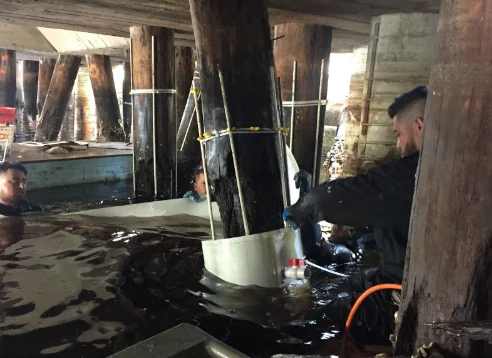
The laminate also replaces the ties a new concrete section would need. Two plies of PileMedic® PLG14.13 equal No. 4 Grade 40 ties at 3.5 in. on center, which saves divers from tying hoops underwater. With a resin fill, the bonded shell adds to the pile’s bending strength. With a cementitious fill, designers conservatively ignore the jacket in bending and add GFRP bars instead. Every epoxy in the system cures underwater, so there is no cofferdam. See repair of submerged piles.
How strong is a repaired timber pile?
In full-scale tests for the Nebraska Department of Roads, five damaged timber piles repaired with FRP laminates carried between 5.3 and 9.9 times their design load, an average of 7.8. Florida International University cut damage 1 to 2 in. deep into southern yellow pine piles, wrapped each a little more than twice in GFRP laminate (about 70 ksi, 0.025 in. thick) sealed with QuakeBond™ J201TC epoxy, and filled it with QuakeBond™ 320LV resin, a non-shrink grout, or gravel and resin. The piles were then loaded in combined axial load and bending.
| Specimen | Average diameter | Damage depth | Fill | Maximum axial load | Times design load (18 kips) |
|---|---|---|---|---|---|
| 1 | 9.0 in. | 1 in. | Resin | 177.7 kips | 9.9 |
| 2 | 9.0 in. | 1.5 in. | Resin | 95.0 kips | 5.3 |
| 3 | 9.6 in. | 2 in. | Grout | 122.5 kips | 6.8 |
| 4 | 9.1 in. | 2 in. | Grout | 171.2 kips | 9.5 |
| 5 | 8.7 in. | 2 in. | Resin and gravel | 133.1 kips | 7.4 |
Design capacity of 18 kips taken from early 1990s plans. Source: Gull, Mohammadi, Taghinezhad and Azizinamini, TRR 2481 (2015).
The researchers also note that replacing a pile costs more than rehabilitating it. The full program is summarized on test results and approvals.
Should you fill the shell with resin or grout?
Use grout to fill large, localized cavities (more than about 1 gal of lost wood) and resin for cracks and small voids. That is the rule the Nebraska tests point to.
The low-viscosity resin flows into fine cracks and saturates damaged wood. At 11.2 ksi compressive strength it is far stronger than the 1.2 ksi nominal strength of southern pine. But it is costly in volume, and the resin-only specimens showed some damage in the repaired zone at failure.
Grout costs less but is too thick to enter fine cracks. Any non-shrink construction grout with a dynamic flow of 9 in. (ASTM C1437) can be used. Filling a large cavity with coarse aggregate before injecting resin also cuts the resin volume sharply. The specimens filled with grout or with gravel and resin showed limited or no damage in the repaired section.
How is a timber pile wrapped and filled?
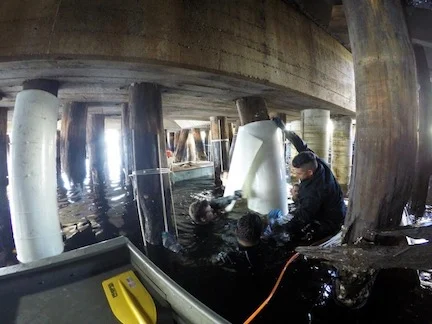
The sequence below was used on Canadian rail bridges and on the Nebraska test piles. Your engineer’s design and the project specifications govern.
- Prepare the pileClean the damaged length. Remove brace bolts and plug each hole with a wooden peg so the brace can go back on later.
- Cut and coatCut the 4 ft wide laminate to twice the shell circumference plus 8 in. and coat the second half with epoxy paste.
- Wrap and stackWrap a seamless two-ply shell, snug or over spacers and bars. Overlap each 4 ft shell by 4 in. to reach the needed height.
- FillGravity-feed low-viscosity resin, or place grout or concrete, into the annular space.
- ReconnectPierce the shell at each peg and reinstall the brace through the original bolt hole.
Plays from YouTube
Where has FRP timber pile repair been used?
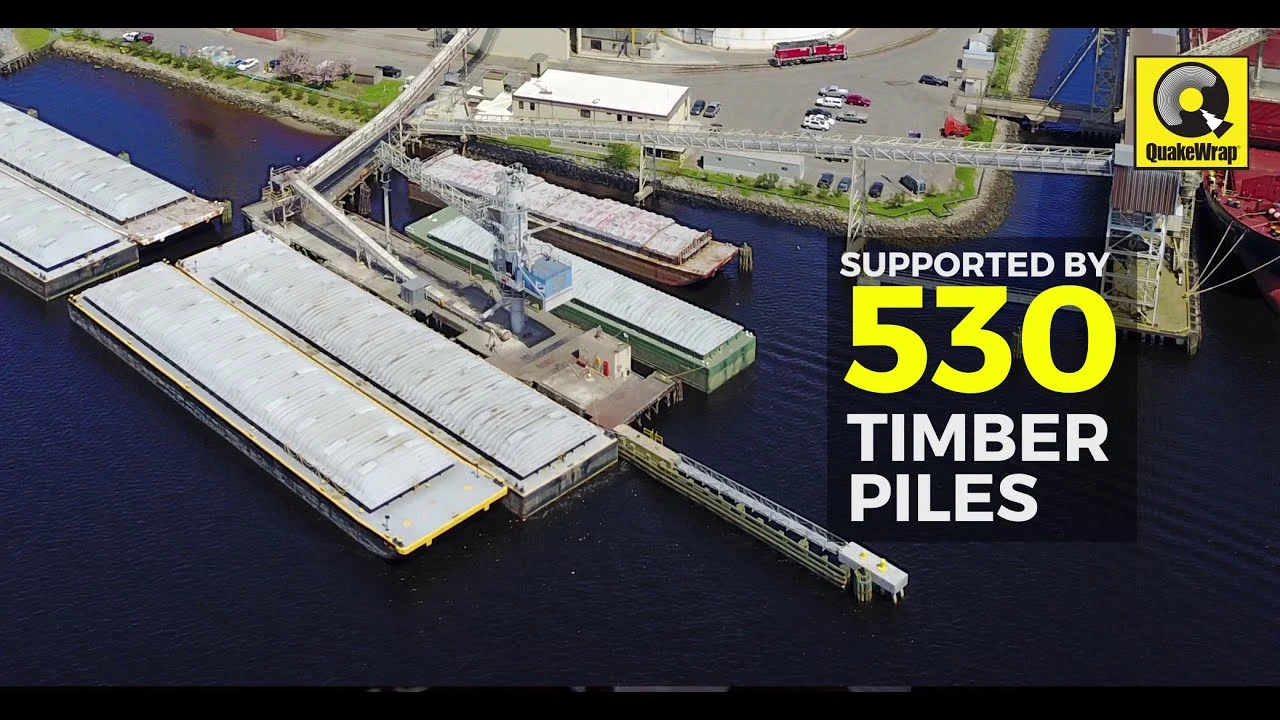
FRP encasement has restored timber piles under ports, highway bridges and remote rail bridges, usually with the structure still in use.
135 piles on remote rail bridges in a Canadian winter
In 2023, Western Infrastructure Renewal repaired 135 timber piles, 16 to 20 in. in diameter, on eight short line rail bridges in northern Manitoba between April and late November. Many piles had rot just above and below the waterline, and eight needed encasement for their full height. Each damaged length got a two-ply PileMedic® shell filled with high-strength, low-viscosity resin.
Many sites could not be reached by car. Crews worked from rafts lowered by high-rail trucks, and because the epoxies must be applied above 45°F (7°C), they built an insulated, heated enclosure on the raft. Each crew finished 2 to 3 piles a day, and all 135 were done in about six months. Several of these bridges had been considered for replacement at costs over $10 million.
Selkirk Trestle, Victoria, British Columbia
On this pedestrian and cycling bridge with marine borer damage, Stantec recommended FRP mainly because the trestle could stay open during repairs. A four-pile trial placed carbon strips in the damaged zone, wrapped a PileMedic® shell around them and filled it with resin that bonds strips, wood and shell together. The trial was successful.
QuakeWrap’s project map also lists 42 timber piles, 24 in. by 15 ft, on the Henderson Bayou Road Bridge (November 2019) and 34 timber piles on the Russell Street Bridge (September 2019). For more bridge work, see bridge piling repair.
What drives timber pile repair cost?
Timber pile repair usually costs less than replacement, and under an existing deck or cap a new pile often cannot be driven at all. Within a repair, cost follows a handful of drivers:
- Repair length, which sets laminate quantity and labor.
- Volume of lost wood, which sets how much resin or grout goes in. Wrapping tightly keeps resin volume down.
- Bars or no bars, depending on how much section and bending strength must be restored.
- Access, water depth and diving, including remote sites and cold-weather enclosures.
- Number of piles and braces to remove and reinstall.
For a first look at material cost for your pile size and repair length, use the PileMedic® cost estimator. Coastal homeowners can also see beach house piling repair.
Timber pile repair FAQs
What is the best way to repair a timber pile?
It depends on the damage. Posting replaces a decayed section and splices join sound sections, while an FRP shell filled with resin suits cracks and small voids, and an FRP shell with GFRP bars and grout suits large cavities and missing sections. Your engineer of record makes the call.
Can a timber pile with a missing section be repaired?
Yes. GFRP bars span the missing length and the grout or concrete fill replaces the lost wood, creating a new reinforced concrete pile around the old one. At an agricultural port dock, piles that were completely detached were restored this way.
Can timber piles be repaired underwater?
Yes. The epoxies in the PileMedic® system cure underwater, so no cofferdam or dewatering is needed.
How long does a timber pile repair take?
On eight Canadian rail bridges in 2023, each crew completed 2 to 3 piles a day, and 135 piles were finished in about six months, including travel between remote sites.
Can timber piles be repaired in cold weather?
Yes, with care. The epoxies are applied above 45°F (7°C), so on the Manitoba rail bridges crews worked inside a heated enclosure on the raft.
Is it cheaper to repair or replace a timber pile?
Repair is usually cheaper. The Nebraska researchers note that replacing a pile costs more than rehabilitating it, and under an existing deck or cap a new pile often cannot be driven at all.
Can I repair timber piles myself?
No. Pile repair is structural work designed by your engineer of record, and the PileMedic® data sheets call for installation by specially trained and approved contractors.
Sources
- Gull, Mohammadi, Taghinezhad and Azizinamini (Florida International University), “Experimental Evaluation of Repair Options for Timber Piles,” Transportation Research Record 2481, Transportation Research Board, 2015. Research for the Nebraska Department of Roads.
- Enchayan, R., PE, “Timber Pile Repair,” Nebraska Department of Roads, Midwest AASHTO Bridge Preservation Conference, Detroit, October 13, 2010.
- Ehsani (QuakeWrap), Gallagher (Stantec) and Herbert (Western Infrastructure Renewal), “Repair of Timber Piles in Rail Bridges: A Canadian Perspective,” IABMAS Conference, Copenhagen, June 2024.
- Lopez-Anido et al., “Assessment of Wood Pile Deterioration due to Marine Organisms,” Journal of Waterway, Port, Coastal and Ocean Engineering, ASCE, March/April 2004.
- U.S. Environmental Protection Agency, Creosote, last updated December 22, 2025.
- QuakeWrap, Inc., PileMedic® product data sheets.
- QuakeWrap, Inc., Agricultural port timber pile project sheet (Perdue AgriBusiness, Chesapeake, Virginia).
Have Timber Piles That Need Repair?
Tell us the pile sizes, damage and site access. Our team will recommend the right PileMedic® system and provide specifications for your engineer.