
PILES · COMPARISON
Timber Piles vs. Concrete Piles: Which Fits Your Project?
Timber piles cost less and are easy to handle and drive, but typically carry 35 to 150 kips and are limited in length by the tree. Precast and prestressed concrete piles typically carry 100 to 250 kips and are made to the length needed, but cost more up front and can be damaged in handling. In salt water, timber is attacked by marine borers, while concrete fails when chlorides corrode the steel inside it. See them side by side.
Key takeaways
- Capacity: timber piles typically carry 35 to 150 kips, precast concrete 100 to 250 kips and cast-in-place concrete 100 to 300 kips.
- Length: timber runs 20 to 75 ft (Douglas fir to 125 ft); prestressed concrete reaches 45 to 120 ft.
- Cost: timber has the lower first cost; precast concrete has high initial cost and handling risk.
- Durability: timber fails to borers and decay, concrete to chloride corrosion of its steel, both worst in the tidal zone.
- Repair: both are routinely repaired in place with grout- or resin-filled jackets, even underwater.
Timber vs. concrete piles at a glance
Choose timber piles for moderate loads and lengths where low first cost matters, and concrete piles for heavier loads, longer lengths and structures that need more capacity per pile. The table uses typical ranges from the Timber Pile Design and Construction Manual, which follows FHWA pile selection guidance. Site soils and loads govern the actual choice.
| Timber | Precast or prestressed concrete | Cast-in-place concrete (driven shell) | |
|---|---|---|---|
| Typical length | 20 to 75 ft (Douglas fir to 125 ft) | 30 to 45 ft precast, 45 to 120 ft prestressed | 10 to 120 ft with a mandrel, 15 to 80 ft without |
| Typical axial design load | 35 to 150 kips | 100 to 250 kips | 100 to 300 kips |
| Advantages | Low cost, renewable, easy to handle and drive, length changes easily absorbed | High load capacity; corrosion resistance obtainable | Initial economy and inspection after driving (with mandrel); shell can be redriven and is not easily damaged (without) |
| Disadvantages | Low axial capacity, difficult to splice | Vulnerable to handling damage, high breakage rate, high initial cost | Difficult to splice after concreting; a thin mandrel-driven shell is vulnerable during driving |
| Main threat in water | Marine borers in the tidal and submerged zones; fungi above water | Chlorides corroding the reinforcing or prestressing steel; ASR cracking | Chlorides corroding the steel; ASR cracking |
| Typical repair | Posting, splices, or an FRP shell filled with resin or grout | Encasement in a jacket filled with grout, with bars if needed | Encasement in a jacket filled with grout, with bars if needed |
Lengths, loads, advantages and disadvantages: AWPI Timber Pile Design and Construction Manual (2002), Table 2-1. Threats and repairs: sources listed below.
How do timber and concrete piles carry load?
Both carry load the same way: skin friction along the sides plus end bearing at the tip. Skin friction comes from contact between the pile and the surrounding soil, so it grows with the pile’s circumference and buried length. End bearing is the area of the tip times the bearing capacity of the soil at that depth. Driving deeper usually raises both, because the contact area grows and soil is usually stronger lower down.
The difference is what limits each one. A timber pile’s size is set by nature: there is a limit to the diameter and length of the trees it comes from, and its tip is its smallest section. Its taper does help in granular soils, where it gives more resistance than a uniform pile. Concrete piles are manufactured, so they can be made to the length and cross section the design needs, usually round, square or octagonal.
When do timber piles make sense?
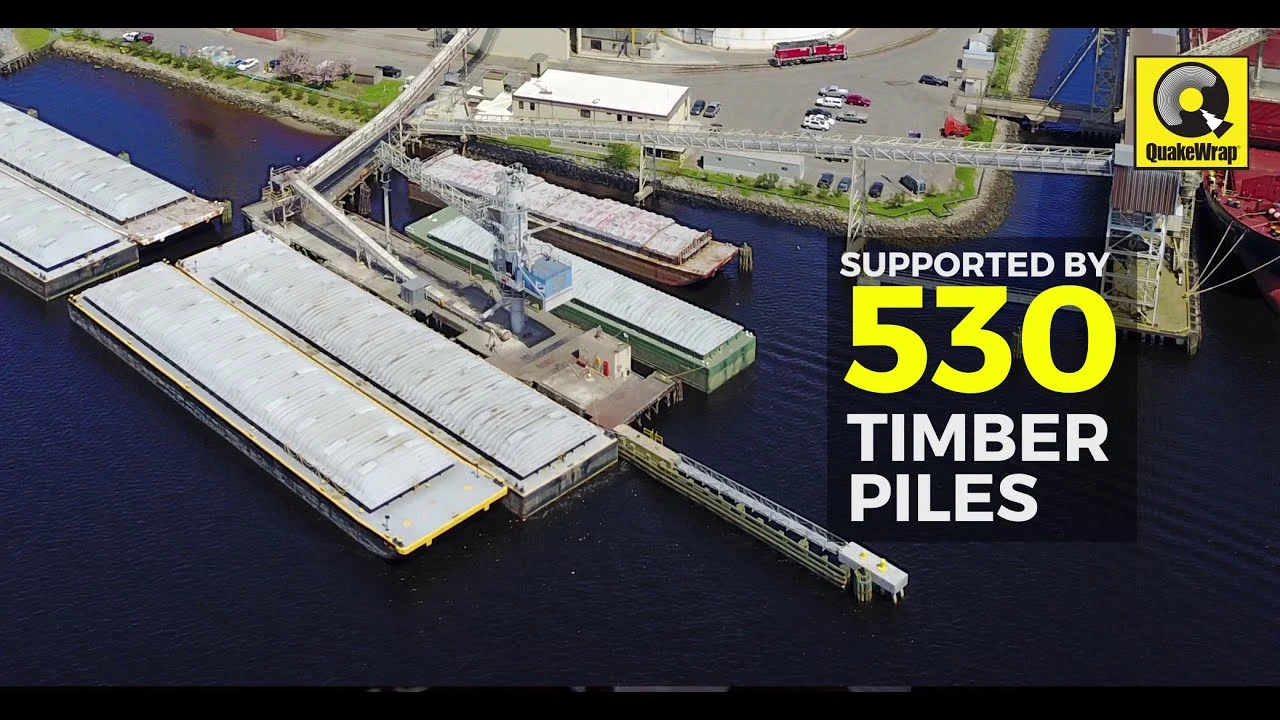
Timber piles make sense when pile loads are about 50 to 150 kips and lengths about 20 to 125 ft, which covers many rail and county bridges, docks and beach houses. A timber foundation pile is normally designed for about 30 tons. Most are southern yellow pine or Douglas fir, sized to ASTM D25 as Class A, Class B or 8 in. minimum tip piles.
Their weak points are capacity, splicing and durability wherever the wood is not permanently wet. Below the groundwater table they last indefinitely. Treated marine piles last about 50 years in northern climates and about 25 years in southern ones, and hard driving through dense soils can split or broom the tip. The full list of trade-offs is in advantages and disadvantages of timber piles.
When do concrete piles make sense?
Concrete piles make sense for heavier, more concentrated loads carried down to stronger soil, and where lateral and uplift forces matter, which is why bridges and heavy structures on weak soil use them. They come in two broad types.
Precast piles
Precast piles are cast before driving, either plain reinforced or prestressed with high-strength steel strands, then driven. They are made under controlled conditions, so quality is consistent, and they can extend above ground or water. Their weight and length make them harder to transport and handle, and the AWPI table lists handling damage, a high breakage rate and high initial cost as their drawbacks.
Cast-in-place piles
Cast-in-place piles are formed in the ground, often by driving a steel shell and filling it with concrete. They can be made to the size and length needed on site and, when driven with a mandrel, inspected after driving. They are difficult to splice once concreted, and a thin shell is vulnerable during driving. Forming and curing also take time and depend on good quality control.
Already have timber or concrete piles that need work?
Both can be repaired in place, even underwater. Our team will recommend the right QuakeWrap® system and provide specifications for your engineer.
How do steel piles compare?
Steel piles carry the most load per pile of the common driven types and are the easiest to splice, but exposed steel corrodes. The same AWPI table puts steel H-piles at 20 to 100 ft and 100 to 400 kips, and steel pipe piles at 30 to 120 ft and 200 to 500 kips.
| Pile type | Typical length | Typical design load | Key trade-off |
|---|---|---|---|
| Timber | 20 to 75 ft | 35 to 150 kips | Lowest cost, lowest capacity |
| Precast or prestressed concrete | 30 to 120 ft | 100 to 250 kips | High capacity, high initial cost, handling damage |
| Steel H-pile | 20 to 100 ft | 100 to 400 kips | Easy to splice, vulnerable to corrosion |
| Steel pipe pile | 30 to 120 ft | 200 to 500 kips | High capacity, open end good against obstructions |
Corroded steel piles have their own repair needs, covered in steel pipe pile repair.
Which lasts longer, timber or concrete piles?
It depends on where the pile sits. Timber below the groundwater table lasts indefinitely, while treated marine timber piles last about 25 to 50 years depending on climate. Concrete piles in salt water last as long as chlorides are kept away from the steel inside. Once that steel corrodes, cracking and spalling follow. In both materials, damage is usually worst in the splash and tidal zone between low and high tide.
How timber piles deteriorate
In brackish and salt water the main threat is marine borers. They usually enter through a small split or bolt hole, reach the untreated heartwood and hollow out the inside of the pile while the treated shell stays intact, so the damage goes unnoticed until the shell begins to fail. Above the water, decay fungi attack wherever the wood stays moist.
How concrete piles deteriorate
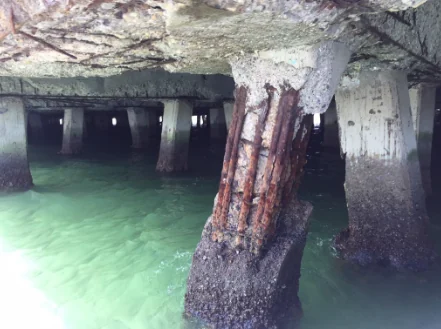
The threat is the steel inside. Seawater chlorides reach the reinforcing or prestressing steel even through high-quality concrete. Corroding steel expands, cracking and spalling the cover, which lets in more water and speeds the corrosion. Some concrete also cracks from alkali-silica reaction (ASR), which needs water to progress, while corrosion needs an electrolyte and oxygen.
Are timber piles cheaper than concrete piles?
Usually, at first. Low cost is the main listed advantage of timber piles, and high initial cost is a listed disadvantage of precast concrete. Over the life of a structure the comparison depends on exposure, since treated timber in salt water has a much shorter service life than timber kept below the water table, and on how many piles each option needs.
The environmental picture has two sides. Timber is a renewable resource. But piles in water need preservative treatment, and the U.S. EPA notes that creosote may pose risks to fish and invertebrates when treated wood is used in aquatic structures. Limits on treated wood at water crossings are one reason newer timber piles decay faster.
Can timber and concrete piles be repaired?
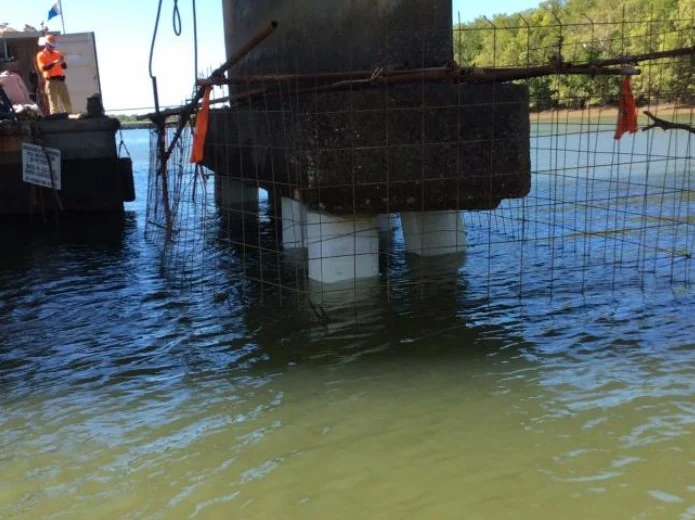
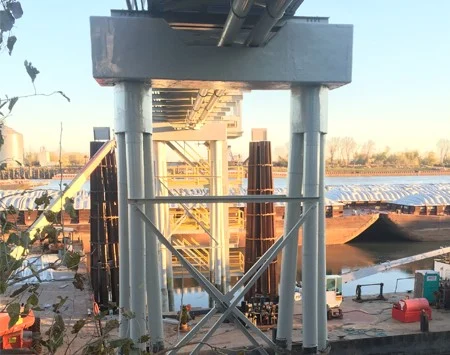
Yes. Both are usually repaired in place by encasing the damaged length in a jacket and filling it, which is often far cheaper than driving a new pile under an existing deck. PileMedic® jackets are bonded with an epoxy that cures underwater and are filled with grout, concrete or resin, so neither needs a cofferdam.
- Timber: a snug shell filled with resin for cracks and small voids, or GFRP bars and grout for large cavities and missing sections. See timber pile repair methods and the 500+ pile agricultural port project.
- Concrete: a confining jacket with bars where section is lost, filled with underwater grout, which also seals moisture and oxygen away from the steel. See 40 ASR-damaged bridge piles repaired underwater.
Plays from YouTube
For every method across all three materials, read pile repair methods.
Timber vs. concrete pile FAQs
Are timber piles cheaper than concrete piles?
Usually, at first. Low cost is the main advantage of timber piles and high initial cost is a listed disadvantage of precast concrete, but life-cycle cost depends on exposure and on how many piles each option needs.
Which is stronger, a timber or a concrete pile?
A concrete pile. Typical design loads are 35 to 150 kips for timber, 100 to 250 kips for precast or prestressed concrete and 100 to 300 kips for cast-in-place concrete.
Which lasts longer, timber or concrete piles?
It depends on where the pile sits. Timber below the groundwater table lasts indefinitely, while treated marine timber piles last about 25 to 50 years; concrete in salt water lasts as long as chlorides are kept from the steel inside.
How is installation different?
Timber and precast concrete piles are both driven. Cast-in-place concrete piles are formed in the ground, often by driving a steel shell and filling it with concrete, and precast piles need heavier handling because of their weight and length.
Can timber piles be used in any soil?
No. They suit moderate loads and soils they can be driven through, since dense soils can split or broom the tip and boulders stop them. Above the water table or in salt water they also need preservative treatment.
Are timber piles better for the environment?
Timber is renewable, but piles in water need preservative treatment. The U.S. EPA notes that creosote may pose risks to fish and invertebrates when treated wood is used in aquatic structures.
Can both be repaired underwater?
Yes. PileMedic® jackets are bonded with an epoxy that cures underwater and are filled with grout, concrete or resin, so timber and concrete piles can both be repaired in place without cofferdams.
Sources
- Collin, J. G., Timber Pile Design and Construction Manual, Timber Piling Council, American Wood Preservers Institute, 2002 (includes FHWA service life conclusions).
- Graham, J. S., Design of Timber Foundation Piling for Highway Bridges and Other Structures, National Timber Piling Council.
- Ehsani and Tipnis, “Miami Building First to Benefit from Innovative PileMedic Jacket,” Concrete Repair Bulletin, July/August 2011.
- Ehsani, Day and White, “Repair of ASR-Damaged Piles,” Concrete International, American Concrete Institute, April 2017.
- Ehsani (QuakeWrap), Gallagher (Stantec) and Herbert (Western Infrastructure Renewal), “Repair of Timber Piles in Rail Bridges: A Canadian Perspective,” IABMAS Conference, Copenhagen, June 2024.
- U.S. Environmental Protection Agency, Creosote, last updated December 22, 2025.
- QuakeWrap, Inc., Agricultural port timber pile project sheet (Perdue AgriBusiness, Chesapeake, Virginia).
Have Timber or Concrete Piles That Need Repair?
Tell us the pile type, size and exposure. Our team will recommend the right QuakeWrap® system and provide specifications for your engineer.