
INDUSTRIAL & UTILITY
Raise Dam Crest Elevation to Protect Earth Dams and Levees
Overtopping is one of the most dangerous ways an earth dam or levee can fail. QuakeWrap® proposes to raise dam crest elevation instead of armoring the slope: SPiRe®+ glass FRP panels set in a narrow trench along the crest and backed with concrete, with no soil hauled in.
- Proposed crest raise of up to 10 ft
- Narrow 4 in. trench, minimal earthwork
- Non-corroding glass FRP panels

THE CHALLENGE
Why Earth Dams and Levees Overtop
Overtopping accounts for about 34% of U.S. dam failures, according to the Association of State Dam Safety Officials. Unlike concrete dams, earthen embankments erode quickly once water flows over the crest.
-
Extreme rainfall
Floods larger than the dam was designed for, as weather extremes and water levels rise.
-
Spillway problems
Spillways that are too small for peak flows or are blocked by debris.
-
A low or settled crest
A crest that has settled holds back less water in an extreme event.
-
Costly conventional fixes
Raising a crest with fill means massive earthmoving, construction traffic on the crest and long schedules.
PROPOSED CONCEPT
Raise the Crest Instead of Armoring the Slope
Traditional mitigation tries to limit erosion after overtopping begins, for example by mixing chemicals or additives into the soil. That takes extensive earthwork and still leaves the dam able to overtop. QuakeWrap® proposes a different approach: prevent overtopping before it starts by building a thin, reinforced wall along the crest.
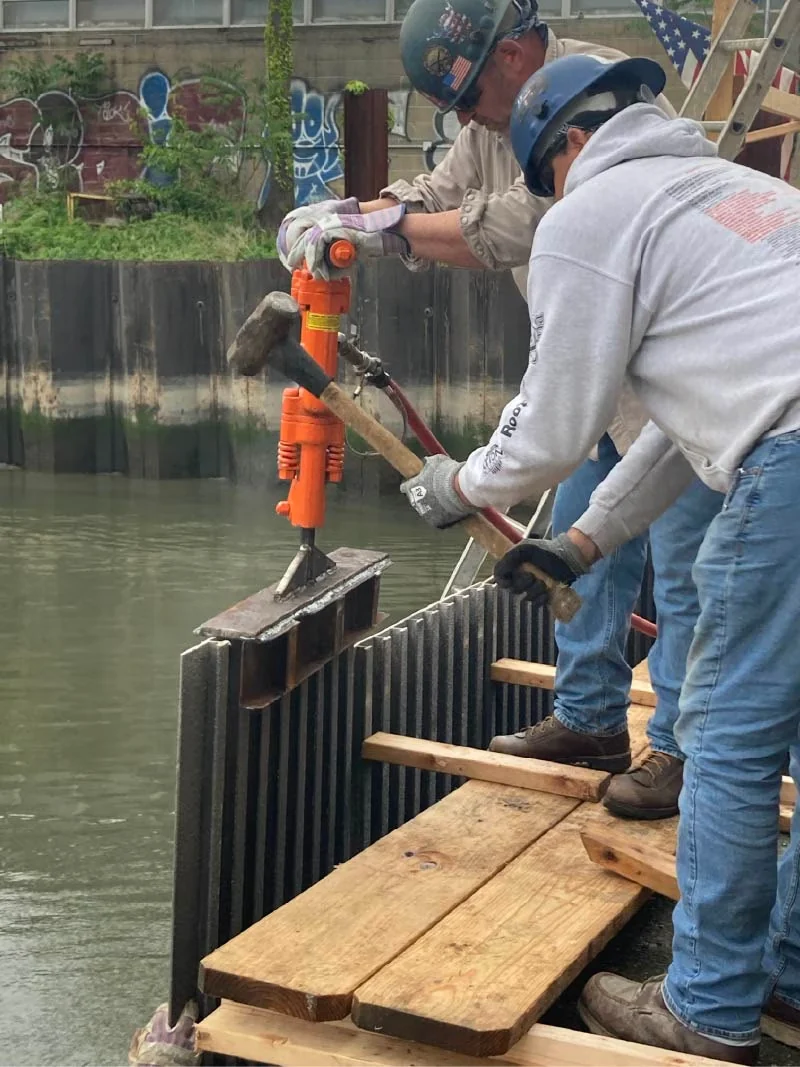
SPiRe®+ is a glass FRP panel system first developed to strengthen and protect marine and civil infrastructure. Each panel does three jobs at once: it is the stay-in-place form, the reinforcement (its T-shaped profiles and grit-coated surfaces bond to the concrete) and the waterproofing and corrosion barrier.
This is a proposed concept, not a completed project: no dam has been raised with SPiRe®+ yet. Prof. Mo Ehsani's concept paper recommends a pilot demonstration on a small dam or test section, backed by project-specific hydrologic, geotechnical, seepage, structural and construction-risk evaluations. The panels are already in use on seawalls, bridge pier walls, corroded steel sheet piles and slabs.
- Stay-in-place form, reinforcement and waterproofing in one
- A 3 to 4 in. thick wall, with #3 GFRP bars as needed
- UV-resistant vinyl ester resin
- No steel to corrode
- panel width (914 mm), lengths to suit
- 3 ft
- flexural capacity with a 3 in. concrete backing
- 25.5 k-ft/ft
- safety factor for a 10 ft / 4 ft crest raise
- 2.4 / 38
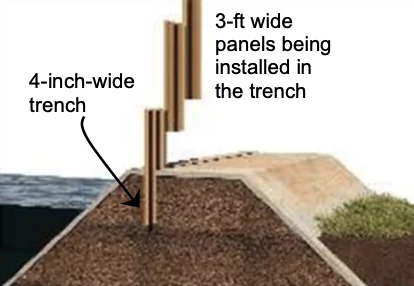
How to Raise Dam Crest Elevation With SPiRe®+ Panels
The proposed installation sequence from the concept paper. Trench depth, wall height and embedment are set by project-specific engineering.
-
Survey and mark
The wall alignment is surveyed and marked on the crest, normally offset from the upstream edge.
-
Cut a narrow trench
A trench about 4 in. wide (allow 4 to 6 in. in practice) is cut to the required depth and cleaned, in a sequence that keeps adequate temporary freeboard.
-
Set the panels
The 3 ft wide panels stand vertically in the trench, with their edges overlapped and sealed into a continuous, watertight face.
-
Cast the foundation
Concrete placed in the trench forms the embedded foundation of the wall.
-
Form and pour the wall
Reusable flat forms are clipped to the downstream face, horizontal GFRP bars are added as needed, concrete is placed, and the forms come off after curing.
DAM SAFETY REVIEW
How the Crest Wall Fits FEMA P-1015 and State Review
FEMA P-1015, the Technical Manual: Overtopping Protection for Dams, recognizes several ways to fix a hydrologic deficiency: improve spillway capacity, add overtopping protection, or raise the dam crest. Because this wall raises the effective crest, the concept paper says it should be presented as a crest-raising, overtopping-prevention alteration, not as downstream-slope armoring.
For a pilot project or regulatory submittal, the design package covers the same issues FEMA and state dam safety offices expect for any dam modification. Our team will recommend the right QuakeWrap® system and provide product data and specifications for the engineer of record who prepares it.
- Flood routing before and after, with maximum water surface and remaining freeboard
- Potential failure modes: seepage, piping, sliding, overturning, flexure, settlement and end-around erosion
- Geotechnical and seepage review of the trench, embedment, filters, phreatic surface and tie-ins
- Construction sequencing, temporary freeboard, reservoir restrictions and quality control
- Long-term inspection of the wall, FRP surface, joints, concrete, crest settlement and seepage
ADVANTAGES
Advantages Over Conventional Dam Raising
-
Rapid installation
A trench, panels and concrete.
-
Minimal earthwork
No large-scale soil transport or heavy compaction.
-
Little crest traffic
Minimal construction traffic on the dam crest.
-
Remote sites
Lightweight panels suit dams with limited access.
-
No steel corrosion
Glass FRP panels do not rust.
-
Impervious barrier
Sealed panel joints form a watertight wall.
-
More storage
A higher crest can increase reservoir storage capacity.
-
Stocked panels
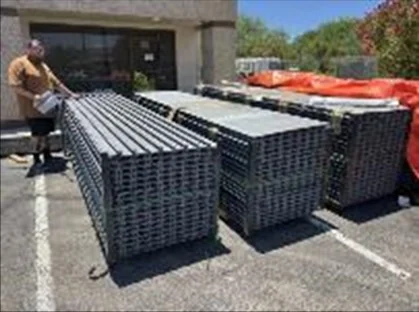
SPiRe®+ panels are stocked in Tucson, Arizona, with custom sizes made to order.
Responsible for a dam or levee?
Tell us about the embankment, its crest and the added freeboard you need. Our team will recommend the right QuakeWrap® system and provide product data and specifications for your engineer.
Concept Paper and Guides
- CONCEPT PAPER Preventing Overtopping of Earth Dams by Increasing Crest Elevation Prof. Mo Ehsani, SPiRe®+ crest-raising concept
- Preventing Failure of Earth Dams by Overtopping Causes, FEMA options and the proposed crest raise
- SPiRe®+ Panels Specs, flexure tests and projects
- SMSB 2026 PAPER Development and Applications of a Multi-Purpose Stay-in-Place FRP Form The flexure tests behind the panel capacity
- Rising Sea Levels and Seawalls Raising seawalls with the same panels
- Product Data Sheets SPiRe®+ Panel PDS, June 2026
Earth Dams & Levees FAQs
Which QuakeWrap® product protects earth dams and levees?
SPiRe®+ glass FRP panels. Set in a narrow trench along the crest and backed with concrete, they are proposed to raise the crest and prevent overtopping.
Has SPiRe®+ been used on a dam yet?
Not yet. Dam crest raising is a proposed concept. The concept paper recommends a pilot demonstration on a small dam or test section, and QuakeWrap® welcomes one with the U.S. Army Corps of Engineers. The panels are in use on seawalls, bridge pier walls, sheet piles and slabs.
How high can the crest be raised?
Flexural tests show panels with a 3 in. concrete backing reach about 25.5 k-ft/ft. Preliminary calculations put that at a crest raise of up to 10 ft with a safety factor of about 2.4, or 4 ft with a safety factor of 38. Final wall height, embedment and details come from project-specific engineering calculations.
What equipment cuts the trench?
Commercially available trenchers: a ride-on chain trencher with a 4 in. chain and 48 to 60 in. depth capacity, a tracked trencher for stability and lower ground pressure, an excavator-mounted trencher where alignment or access is difficult, or a rockwheel or rock saw where the crest is hard, cemented or rocky.
Does this work for levees too?
Levees are earthen embankments that run along rivers and can fail by overtopping in the same way as an earth dam, so the same crest-raising approach applies. Tell us about your levee and our team will review it.
Can you provide specifications and design details for our engineer?
Yes. Our team will recommend the right QuakeWrap® system and provide product data sheets, specifications and sample design details for your engineer of record.
Related FRP Repair Applications
Have a Project That Needs Repair?
Tell us about your structure. Our team will recommend the right QuakeWrap® system and provide specifications for your engineer.