
NEWS
QuakeWrap® News
Project milestones, research grants, patents and awards for QuakeWrap® FRP products, newest first, with the original press releases and articles where they survive. The archive goes back to a 2004 QuakeWrap® e-bulletin.

FEATURED STORY: JULY 2017
Arizona DOT's First CFRP Bridge Repair Restores 12 Collision-Damaged Girders
Trucks had hit the precast prestressed girders of two I-17 bridges in downtown Phoenix many times. One edge girder at the Jefferson Street underpass had severed strands and was assumed to have lost 50% of its flexural strength. Eleven girders at the 19th Avenue overpass had lighter damage, assumed at 20%. With about 100,000 vehicles a day on I-17 (2010 count), replacing girders was not an option.
For its first carbon FRP project, ADOT's Bridge Group wrote a performance-based specification, adapted from Caltrans, and put the work out to open bid. FNF Construction won the contract, FRP Construction LLC installed the system, and QuakeWrap Inc. supplied the QuakeWrap® carbon fabric and epoxy and, under that subcontract, the strengthening design to the AASHTO guide specification ADOT required.
Crews worked nights from 9 p.m. to 5 a.m., starting April 24, 2017. Longitudinal TU27C carbon fabric went on the bottom and lower sides of the girders, with 6 in. U-wrap strips at 12 in. on center to hold any spalled concrete. The 19th Avenue bridge was done in about 15 days against a 20-day schedule, and Jefferson Street over a single weekend in May 2017. According to ADOT, the 19th Avenue overpass is no longer listed as structurally deficient.
- Girders repaired
- 12
- Assumed strength loss
- 20% to 50%
- 19th Ave. installation
- About 15 days
- Work window
- 9 p.m. to 5 a.m.

PROJECT DETAILS
I-17 Jefferson Street and 19th Avenue Bridges
- AGENCY
- Arizona Department of Transportation (ADOT) Bridge Group
- LOCATION
- I-17 at Jefferson Street (underpass) and 19th Avenue (overpass), Phoenix, Arizona
- STRUCTURES
- Precast prestressed AASHTO Type II girder bridges built in 1959 and 1961
- DAMAGE
- Repeated truck collisions: spalls, exposed and severed prestressing strands
- REPAIRED
- 1 girder at Jefferson Street, 11 girders at 19th Avenue, over 40 to 50 ft lengths
- STRENGTH ADDED
- 1,027 k-ft vs 1,000 k-ft required (Jefferson); 392 k-ft vs 360 k-ft (19th Ave.)
- SYSTEM
- Externally bonded QuakeWrap® TU27C unidirectional carbon fabric, plus 6 in. U-wrap strips
- DESIGN BASIS
- AASHTO Guide Specifications for Design of Bonded FRP Systems (1st ed., 2012)
- QUALITY CONTROL
- Unopened packaging, fabric lot and resin batch numbers logged per girder, daily ASTM D3039 witness panels by Western Technologies
- TEAM
- FNF Construction (general contractor), FRP Construction LLC (installer), QuakeWrap Inc. (materials)
- PUBLISHED
- IBC 18-10, 35th International Bridge Conference, by Mo Ehsani, Tadd Johnson and William Downes (ADOT)
Our ADOT Bridge Group focuses on using new and innovative bridge-repair technologies that enhance safety while saving time and taxpayer dollars.
- Bridges
- 2
- Girders
- 12
- Fabric per night
- About 500 sq ft
- Traffic on I-17 (2010)
- 100,000 vehicles a day
FEATURED STORY: USDOT SBIR
A Federal Research Grant for No-Dig Repair of Oil and Gas Pipelines
Most oil and gas transmission pipes are repaired from the outside, which means digging up the line at every damaged spot. In June 2020 the U.S. Department of Transportation's Small Business Innovation Research (SBIR) program awarded QuakeWrap a Phase I contract to repair these pipes from the inside instead, under the topic 'Internal Repair of Steel Transmission Pipelines (20-PH2)'.
The work is funded by the Pipeline and Hazardous Materials Safety Administration (PHMSA). Phase I, worth $150,000 in fiscal 2020, aimed at proof of concept: QuakeWrap's lab tested the repair for high pressure and chemical resistance and developed a design method. QuakeWrap then won the Phase II award, listed in USDOT's fiscal 2021 awards: $1,000,000 to develop the repair method, per QuakeWrap's March 15, 2022 press release.
The repair uses SuperLaminate™, carbon fabric saturated with epoxy and wrapped around a packer. A tethered automated guide vehicle carries the packer from an existing tool launcher to the damaged spot, the packer inflates against the pipe wall and heat cures the laminate, leaving a sleeve inside the pipe like a stent. USDOT's Volpe Center featured the project as an SBIR success story in 2025, noting a current reach of 500 ft from the launch site.
- Agency: U.S. DOT SBIR program, funded by PHMSA
- Project: No-Dig Point Repair Technology for Steel O&G Pipelines
- Phase I: $150,000, fiscal 2020; Phase II: fiscal 2021 award list
- Launched from existing access sites used for pipe cleaning and inspection

READ THE ORIGINALS
Featured Story Documents
- IBC 18-10 PAPER Arizona DOT Performs First CFRP Bridge Repair Ehsani, Johnson and Downes
- JUNE 4, 2020 RELEASE QuakeWrap Wins Federal Research Grant USDOT SBIR Phase I
- USDOT VOLPE CENTER Using Innovative Technology to Repair Pipelines from the Inside SBIR success story
- PRODUCT SuperLaminate™ Internal point repair of pipes
News Archive
Showing 51 stories
-
Corroded Steel Seawall Repair Begins at a Fort Lauderdale Boathouse
February 2023
Work begins on 530 ft (161 m) by 13 ft (4 m) of corroded steel sheet pile at a boathouse in Fort Lauderdale, Florida, using the SPiRe® system. FRP Construction, LLC and Matrix Marine, LLC share the field installation.
Read more -
PileMedic® Selected to Repair 63 Steel Piles in Mexico
December 10, 2022
No Leaks S.A. de C.V./TPO is awarded a contract to repair 63 steel piles, 14 in. in diameter and 40 ft tall, for Innophos in Coatzacoalcos, Veracruz. Some piles have 100% section loss, so the repair uses patented ShearWrap™ bands to restore capacity. Phase I is expected to take 5 months.
Read more -
First Use of SPiRe® Shells to Repair a Deck, Port of Galveston
August 12, 2022
Custom SPiRe® shells, made to the shape and size of the beams, will repair a severely corroded deck and beams at the Port of Galveston, Texas. FRP Construction LLC is awarded the $1.8M design-build contract. The shells stay in place as corrosion protection after the annular space is filled with concrete or grout.
Read more -
QuakeWrap Announces a $1M Federal Research Grant for Pipeline Repair
June 10, 2022
PipeMedic.com posts the U.S. DOT SBIR news on QuakeWrap's no-dig internal repair of steel oil and gas pipelines with SuperLaminate™. See the featured story above for the agency, program and phases.
Read more -
U.S. Patent 11,286,632: Shear Transfer Ring and Clamp
March 29, 2022
The patent behind ShearWrap™, a steel band torqued around a steel pile to transfer load to a new concrete jacket by friction, without welded shear studs. A similar device, ShearClamp, is offered for steel H-piles.
Read more -
U.S. Patent 10,968,631: Structure Reinforcement Partial Shell (SPiRe®)
April 6, 2021
The patent behind the SPiRe® system for seawalls and for bridge and pier decks that cannot be reached all the way around. Custom shells are secured to the structure, reinforcing bars can be placed in the annular space, and the space is filled with grout or resin.
Read more -
Pile Repair Spacers Awarded a U.S. Patent
January 22, 2021
U.S. Patent 10,808,412, Spacers for Repair of Columns and Piles, issued October 20, 2020, covers the spacers used to install PileMedic®. They set an exact annular space thickness and support reinforcing bars inside the jacket.
Read more -
Memphis Area Transit Authority Deploys CFRP Service Ramps
December 9, 2020
MATA puts carbon fiber service ramps on its rail trolley cars. The ramps bridge the gap between trolley and boarding platform and are more than 60% lighter and three times stronger than metal ramps, as reported by CompositesWorld.
Read more -
QuakeWrap Wins a U.S. DOT SBIR Phase I Grant for Pipeline Repair
June 12, 2020
'No-Dig Point Repair Technology for Steel O&G Pipelines' receives a U.S. DOT SBIR Phase I award of $150,000 under topic 20-PH2, Internal Repair of Steel Transmission Pipelines. It is QuakeWrap's first SBIR award from the U.S. DOT, after earlier awards from NSF, U.S. EPA and USDA.
Read more -
Penstock Repair at CEATI Hydropower 2020
March 3, 2020
Prof. Mo Ehsani presents repair techniques for riveted steel and concrete penstocks at CEATI Hydropower 2020 in Palm Springs, California.
Read more -
U.S. EPA Funds SuperLaminate™ Water Main Point Repairs
August 2, 2019
The U.S. EPA approves a $100,000, 6-month Phase I SBIR for 'Trenchless Water Main Point Repairs with SuperLaminate', to stop leaks in city water mains without excavation.
Read more -
SuperLaminate™ Point Repair 392 ft Down at an Arizona Solution Mining Site
2019
A SuperLaminate™ wrapped on a packer with a tack coat is lowered 392 ft down a hole and pressed into place. SuperLaminate™ can take 600 psi of internal pressure, and more holes are point repaired the same way.
Read more -
Repair of a 12 ft Concrete Tunnel in Minneapolis, Minnesota
2019
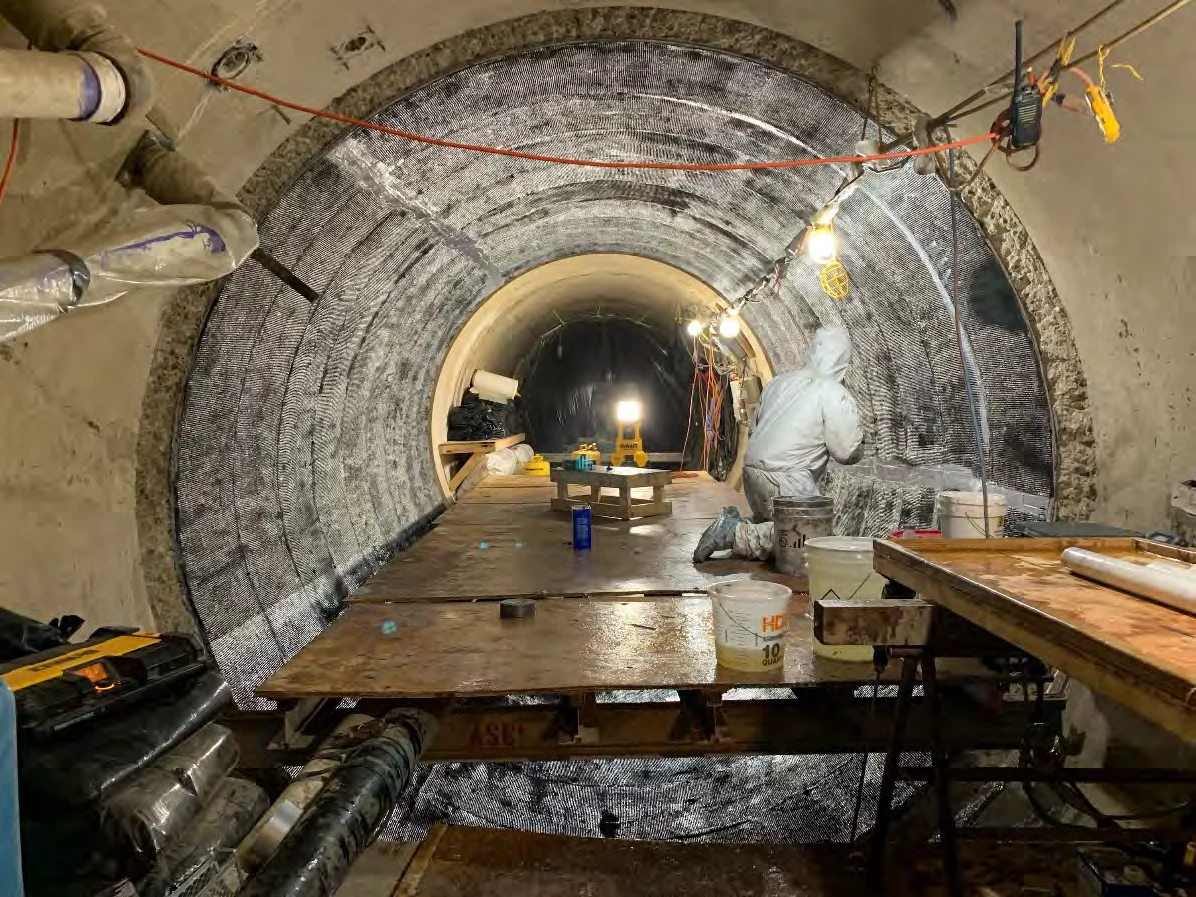
A fully structural retrofit of a 20 ft section of reinforced concrete tunnel, designed for 100 psi of external hydrostatic pressure, uses layers of StifPipe® installed inside the tunnel by wet layup.
Read more -
Prof. Mo Ehsani Awarded ASCE Life Member Status
May 24, 2019
The American Society of Civil Engineers recognizes Prof. Ehsani, a member since his student days at the University of Michigan and through his years on the University of Arizona faculty.
Read more -
SuperLaminate™ Helps Win Trenchless Technology Project of the Year
November 4, 2018
A large gas pipe repair in New Jersey using PipeMedic® carbon FRP laminate, also known as SuperLaminate™, wins Project of the Year, Rehabilitation, from Trenchless Technology magazine. The laminate is 0.024 in. thick.
Read more -
InfinitPipe® Wins a $100,000 USDA Research Grant
April 17, 2018
'InfinitPipe: An Economical Sustainable Pipe for Agricultural Use' wins a grant from the USDA National Institute of Food and Agriculture (NIFA). QuakeWrap is the only Arizona company to win the grant.
Read more -
FRP Construction Reaches 4,000 Days Without a Lost-Time Accident
December 19, 2017
FRP Construction, LLC, a specialty FRP installer founded in 2006 that uses products from several manufacturers including QuakeWrap, reaches 4,000 days with no lost-time accidents.
Archive entry -
Arizona DOT Uses QuakeWrap® CFRP to Strengthen Two Phoenix Bridges
July 19, 2017
ADOT announces the CFRP repair of girders on the I-17 bridges at Jefferson Street and 19th Avenue. According to ADOT, the 19th Avenue overpass is no longer listed as structurally deficient. See the featured story above.
Read more -
Mormon Flat Dam Penstock Repair Featured at HydroVision 2017
June 22, 2017
Prof. Ehsani presents 'Repair of Riveted Steel Penstock in Mormon Flat Dam with Carbon FRP' at HydroVision International 2017 in Denver, on the 90-year-old steel penstock of a hydroelectric dam in Central Arizona.
Read more -
PileMedic® and SPiRe® in Marine News Magazine
May 2017
Marine News covers QuakeWrap's rapid marine pile repair systems in its Inland Infrastructure Renewal coverage.
Read more -
Army and Navy Divers Use PileMedic® at a Pearl Harbor Demonstration
March 24, 2017
In a Joint Capability Technology Demonstration with U.S. Transportation Command and U.S. Pacific Command, Army and Navy divers repair pier piles with PileMedic® under the U.S. Army Corps of Engineers PIER program.
Read more -
SPiRe® Sheet Pile Repair System Debuts at Underwater Intervention 2017
February 22, 2017
QuakeWrap introduces SPiRe® for repair of corroded steel sheet piles and seawalls at Underwater Intervention 2017.
Read more -
Underwater Repair with FRP Presented at UI 2017
February 15, 2017
Prof. Ehsani presents 'New Innovative Carbon FRP Solutions for Repair of Underwater Infrastructure' on February 23, covering PileMedic® laminates, SPiRe® panels, PipeMedic® wraps and InfinitPipe® for subsea pipelines.
Archive entry -
Prof. Ehsani Joins ACMA Infrastructure Day in Washington, DC
February 6, 2017
Prof. Ehsani takes part in the NIST/ACMA Workshop and ACMA Infrastructure Day, February 7 to 9, 2017, on standards for composites in U.S. infrastructure.
Archive entry -
StifPipe® Receives the ASCE 2016 Innovation Award
March 14, 2016
StifPipe® receives the 2016 ASCE Innovation Award in the Green Engineering category, recognized as the world's first green and sustainable pipe.
Read more -
QuakeWrap at World of Concrete 2016
February 8, 2016
Ten QuakeWrap staff, including Prof. Ehsani, exhibit at World of Concrete 2016 in Las Vegas.
Archive entry -
Energy Infrastructure for the 21st Century
March 25, 2014
The U.S. Capitol Hill blog publishes an article by Prof. Ehsani on pipelines and innovation in U.S. and international energy development.
Archive entry -
United Nations Building in Beirut Hardened Against Blast
November 12, 2013
Walls of the newly built United Nations building in Beirut, Lebanon are reinforced against blast loads with FRP.
Read more -
NSF SBIR Grant for InfinitPipe®
June 15, 2013
The U.S. National Science Foundation awards QuakeWrap a $150,000 SBIR grant for initial tests of InfinitPipe®. The Trenchless Technology Center at Louisiana Tech University runs some of the tests as a subcontractor.
Read more -
Structure Magazine: Repair of Columns with FRP Laminates
January 2012
Structure magazine covers the repair of seventy corrosion-damaged steel structures at Tucson Electric Power Company substations with PileMedic® jackets.
Read more -
ASME: SuperLaminates Bolster Broken Pipe
November 2011
The American Society of Mechanical Engineers publishes a story on repairing deteriorated steel gas pipes with PipeMedic® laminates.
Archive entry -
Trenchless Technology 2011 Rehab Project of the Year
October 2011
The first field application of PipeMedic®, the repair of a leaking high-pressure cast iron main, wins Trenchless Technology's 2011 Rehabilitation Project of the Year.
Read more -
University of Arizona: PipeMedic® Industrial Surgery for Failing Infrastructure
September 15, 2011
A University of Arizona story on how PipeMedic® can help prevent failures in natural gas pipes.
Archive entry -
Modern Contractor Solution: PileMedic® on Missouri DOT Bridge Pilings
July 2011
A two-part article on repairing some 50 bridge pilings in the St. Louis area with PileMedic®.
Read more -
ICRI Concrete Repair Bulletin: Underwater Pile Repair in Miami
July 2011
The July/August issue describes the first project to repair underwater piles with PileMedic®, in Miami, and the structural advantages of PileMedic® laminates over standard pile jackets.
Read more -
GTI Completes Its Evaluation of PipeMedic® Laminates
June 22, 2011
The Gas Technology Institute evaluates PipeMedic® laminates for strengthening pressurized steel gas pipelines, with tests at pressures up to 250 psi.
Read more -
ICRI Cover Story: Seismic Retrofit of the Los Angeles County Museum of Natural History
May 2011
The May/June Concrete Repair Bulletin cover story covers the seismic retrofit of the Los Angeles County Museum of Natural History with QuakeWrap® FRP.
Archive entry -
Texas DOT Research on Repair of Corroded Steel H-Piles
Undated
Research funded by Texas DOT at the University of Houston tests PileMedic® on corroded steel H-piles, including sections that had lost as much as 80% of their steel. The report found capacity restored in 13 of 14 H-piles.
Read more -
Repairing Earthquake-Damaged Concrete Bridge Columns in California
Undated
Tests funded by Caltrans and the USDOT National University Transportation Center show how a severely damaged bridge pier can be quickly repaired and returned to service with PileMedic® carbon laminates.
Read more -
PileMedic® Compared for Timber Bridge Pile Repair
Undated
A Transportation Research Board paper by Florida International University, supported by the Nebraska Department of Roads, compares FRP methods for repairing timber bridge piles.
Read more -
Strengthening Timber Utility Poles in Arizona
Undated
With Tucson Electric Power Company, QuakeWrap tests a technique to repair broken timber utility poles while they stay in service.
Read more -
PileMedic® in the FEMA Urban Search & Rescue Field Operations Guide
Undated
Instructions for installing PileMedic® carbon laminates to quickly repair columns and piles damaged in a disaster appear on pages 4-4 and 4-5 of the 7th edition of the Field Operations Guide used by the U.S. Army Corps of Engineers and FEMA's Urban Search & Rescue Program.
Read more -
New York State DOT Approves PileMedic® Jackets
Undated
After several months of testing and evaluation, NYSDOT approves PileMedic® jackets for repair of piles in New York State.
Read more -
Structure Magazine: Strengthening a Concrete Cell Tower
Undated
Structure magazine covers the strengthening of a concrete cell tower with the PileMedic® FRP system.
Read more -
Demonstration Repairs for Missouri DOT and in Brooklyn
Undated
Two concrete bridge piles on Highway 62 at the Missouri and Arkansas border are repaired with PileMedic® for Missouri DOT, and two waterfront timber piles in Brooklyn, New York are to be retrofitted in a demonstration project.
Read more -
NASSCO Releases an FRP Sewer Rehabilitation Guideline
Undated
NASSCO publishes 'Rehabilitation of Sewers Using Fiber Reinforced Polymers', guidance for sewer owners and engineers on high performance composites.
Read more -
E-Bulletin: Comparison of Techniques for Repair of Cracks in Concrete
September 2006
The quarterly QuakeWrap® e-bulletin compares methods for repairing cracks in concrete. The original issue was an image and its full text is not preserved.
Archive entry -
E-Bulletin: Repairing Corrosion-Damaged Structures
June 2006
The June 2006 issue on repair of corrosion-damaged structures. The original issue was a single image and its text is not preserved.
Archive entry -
E-Bulletin: Will Your Building Survive the Next Natural Disaster?
March 2006
Features McKinley Tower in Anchorage, Alaska, a 14-story building damaged in the 1964 Good Friday earthquake and vacant for more than 20 years. Some 55,000 sq ft (5,000 m²) of carbon and glass fabric strengthened more than 120 columns and 400 beams and shear walls before it reopened.
Archive entry -
E-Bulletin: National TV Program Will Highlight Strengthening with Fiber Composites
March 2005
The History Channel's Back to the Blueprint, airing March 26, 2005, covers the rehabilitation of the historic Fox Tucson Theatre, where host Marty Dunham strengthens part of an old masonry wall with QuakeWrap® fabric.
Archive entry -
E-Bulletin: Award-Winning Strengthening of Glulam Beams with FRP
July 2004
The earliest e-bulletin in the archive features FRP strengthening of glulam beams in a high school gymnasium for more live load. The project won the Structural Engineers Association of Arizona 2004 Award for Outstanding Retrofit Project and was covered in the February 2004 issue of Structure magazine.
Archive entry
No stories match these filters.
STAY INFORMED
Get QuakeWrap® News by Email
Subscribe to hear about new podcast episodes, case studies and speaking events.
-
Product news
The latest on QuakeWrap® FRP products for infrastructure repair.
-
Case studies
New case studies as projects are completed.
-
Podcast and speaking events
Upcoming podcast episodes and conference talks.
Have a structure to repair now?
Skip the newsletter and talk to our team about your project.
MORE FROM QUAKEWRAP
Media, Awards and Podcast
Working on a Repair Like These?
Tell us about the structure. Our team will recommend the right QuakeWrap® system and provide specifications for your engineer.