
CASE STUDY
Port of Galveston Pier Beam Repair With Stay-in-Place FRP Shells
At a cargo pier in the Port of Galveston, 30 corroded beams that had lost up to 50% of their reinforcing steel, plus 6 piles, were repaired in the first application of the SPiRe® system as a custom-made stay-in-place form. This pier beam repair replaced temporary timber formwork with FRP shells that stay on as permanent protection.

Project Details
- LOCATION
- CHS terminal cargo pier, Port of Galveston, Texas
- STRUCTURE
- Concrete pier: marine deck, beams, girders and piles
- SCOPE
- 30 corroded beams and 6 piles
- QUAKEWRAP® SYSTEM
- SPiRe® custom-molded sandwich FRP shells, made in two matching halves, as stay-in-place forms
- SHELLS
- 3/8 in. thick, 2.2 lb per sq ft, rigid core with glass FRP skins, vinyl ester resin
- ORIGINAL DESIGN
- Conventional repair with timber and plywood formwork beneath the beams
- FILL AND REINFORCEMENT
- High-strength non-shrink grout with supplemental GFRP bars
- CONTRACTOR
- FRP Construction LLC ($1.8M contract, announced August 2022)
- YEARS
- 2024-25
PROJECT VIDEO
Port of Galveston Deck and Pile Repair
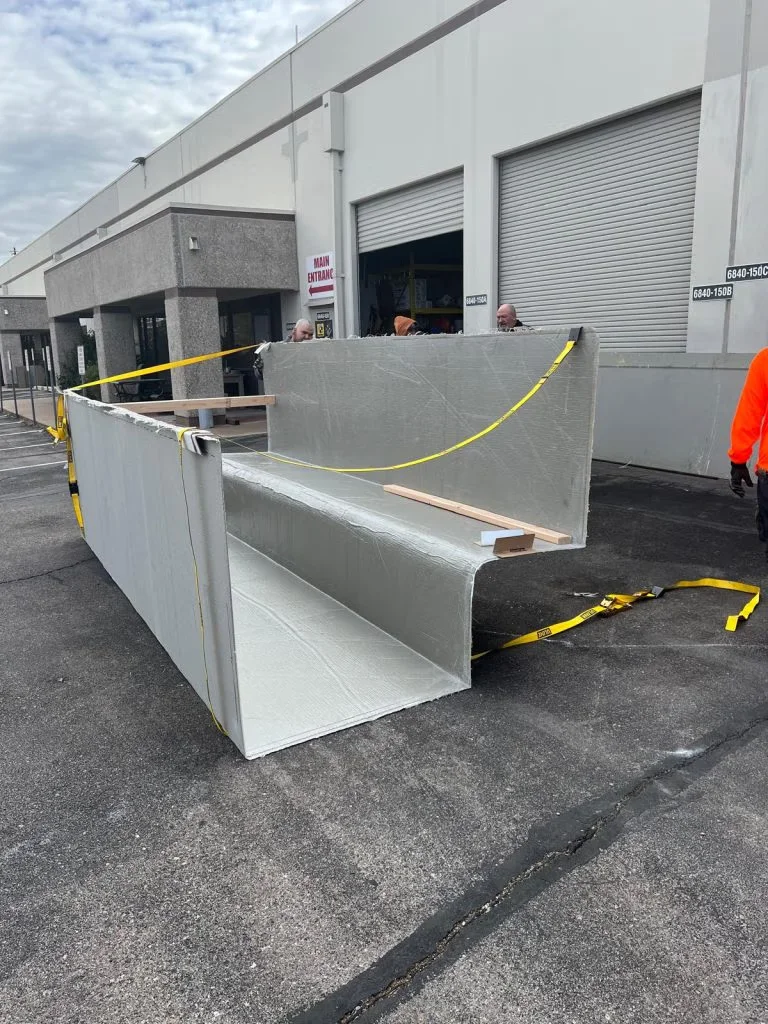
Plays from YouTube
01 · THE CHALLENGE
Corroded Beams Under a Low, Confined Pier Deck
Years of salt-laden air and moisture had badly corroded the beams and deck of the concrete cargo pier at the CHS terminal in the Port of Galveston. Chlorides had corroded the reinforcing steel, cracking and spalling the concrete. Structural inspections found that up to 50% of the steel reinforcement had deteriorated in several elements, so the pier needed repair right away.
The owner's original design was a conventional repair: remove the deteriorated concrete, add reinforcement, build timber and plywood forms beneath each beam, place repair concrete and strip the forms. Beneath an operating terminal, every form had to be built over water in a confined space, held while the concrete cured, then taken apart, and by the time estimates were done the temporary formwork was one of the largest costs on the job. Gunite was not practical this close to the water either.

WHY THE DESIGN CHANGED
Pier Beam Repair Without Temporary Formwork
The conventional design was sound engineering. The difference was in how each repair had to be built beneath an active cargo terminal.
| Conventional repair (original design) | SPiRe® shell repair (as built) | |
|---|---|---|
| Forms | Timber and plywood built beneath each beam, over water | Custom FRP shells made in a plant in two matching halves |
| During placement | Forms supported while the repair concrete cures | Shells anchored to the beam and sealed along the bottom seam |
| Fill | Repair concrete | High-strength non-shrink grout pumped through built-in ports |
| Added reinforcement | Supplemental reinforcement | Supplemental GFRP bars, with no new steel to corrode |
| After curing | Forms dismantled and removed | Nothing to remove: the shells stay on |
| Long-term surface | Repaired concrete exposed to salt spray | Permanent FRP skin against chloride intrusion |
Have pier beams with the same problem?
Send us the beam sizes, clearance and condition. Our team will recommend the right QuakeWrap® system and provide specifications for your engineer.
02 · THE SHELLS
Split SPiRe® Shells Built for Tight Clearance
The approach came from the patented SPiRe® seawall system, where only one face of the wall can be reached: composite panels are anchored to that face, grout fills the gap, and the panel stays as permanent protection. At Galveston the idea was adapted to pier beams. Molds replicated the exact geometry of the deteriorated beams and girders, including the annular space to be grouted.
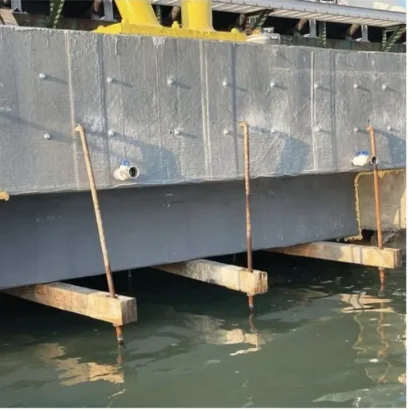
The first design called for one-piece shells, but the low clearance under the girders made them hard to maneuver into place. Each shell was instead made in two matching halves joined by an overlapping longitudinal seam along the bottom of the beam, which also absorbed the dimensional variations of an old structure. The shells were made in a plant from fiberglass composites and vinyl ester resin, with a rigid core between glass FRP skins, only 3/8 in. thick and 2.2 lb per sq ft. Grout ports and attachment details were built in before shipment.
- Two-piece shells sized for low clearance
- Grout ports and attachments built in at the plant
- No timber formwork under the deck

03 · INSTALLATION
Installed and Grouted Under an Active Cargo Pier
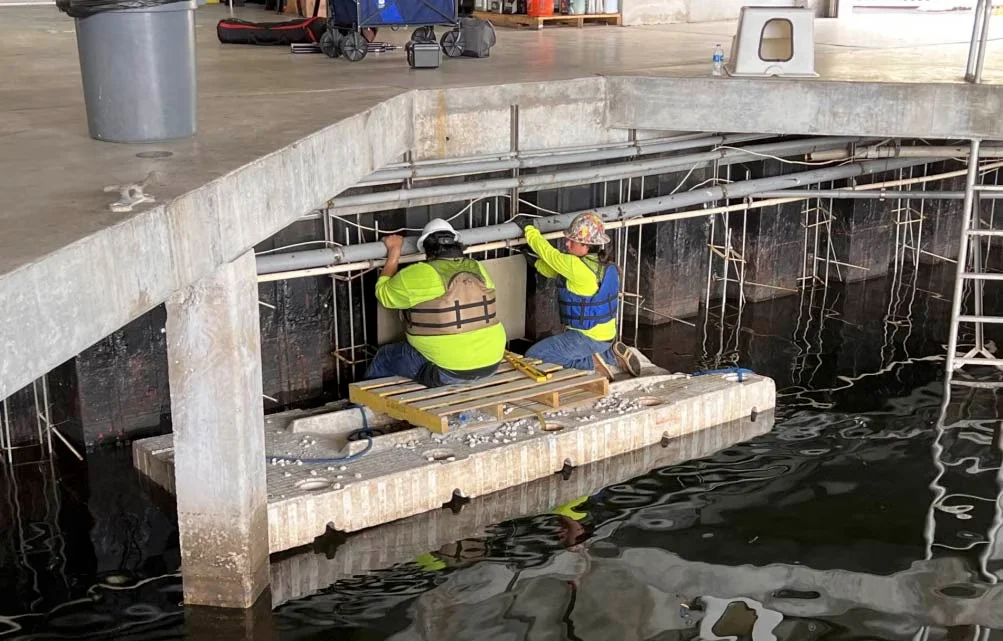
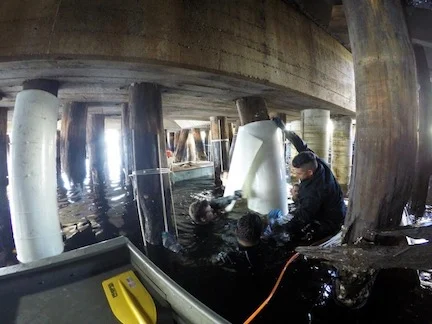
Deteriorated concrete was removed and the beams were prepared. Spacers were bonded to the shells and supplemental nonmetallic GFRP bars were placed where needed to restore capacity. The light shell halves were moved under the deck with minimal equipment, lifted into place, aligned with the existing members, secured with all-thread anchor bolts into the host concrete and sealed along the longitudinal joint.
High-strength non-shrink grout was then pumped through the built-in ports into the cavity between shell and beam, bonding the parts into one composite member. Bolt ends were trimmed and capped with epoxy paste and a plastic cap. Once the grout cured, there was no formwork to strip.
- Shells lifted and placed without heavy equipment
- Nonmetallic GFRP bars inside the shell
- Grouted through ports built into each shell

INSTALLATION
How the Custom Shells Were Installed
-
Make the shells
Mold FRP shells to match the beams and girders, in two matching halves with grout ports built in.
-
Prepare and fit out
Remove deteriorated concrete, bond spacers to the shells and place GFRP bars where needed.
-
Lift and anchor
Lift the halves from below, anchor them with all-thread bolts and seal the bottom seam.
-
Grout the annulus
Pump non-shrink grout through the built-in ports to fill the space between shell and beam.
-
Seal the bolts
Trim bolt ends and encapsulate them in epoxy paste and a plastic cap.
04 · THE RESULT
Capacity Restored, Steel Sealed From Salt Spray
The completed repair restored the load-carrying capacity of the pier. The shells that served as forms are now permanent parts of the repaired beams, an impermeable skin against salt spray and chloride intrusion. In the design, the bond between the shells and the grout was assumed to be negligible, so the shells' structural contribution was conservatively not counted.
The procedure saved considerable time and cost during construction, because the effort went into permanent components rather than temporary works that would be thrown away. The bonded composite structure has a projected service life of more than 50 years with minimal maintenance. Prof. Ehsani's article on the project was the cover story of the September/October 2025 Concrete Repair Bulletin.
- steel reinforcement lost
- Up to 50%
- shell thickness
- 3/8 in.
- shell weight
- 2.2 lb/sq ft
- projected service life
- 50+ yrs

Products & Applications Used
-
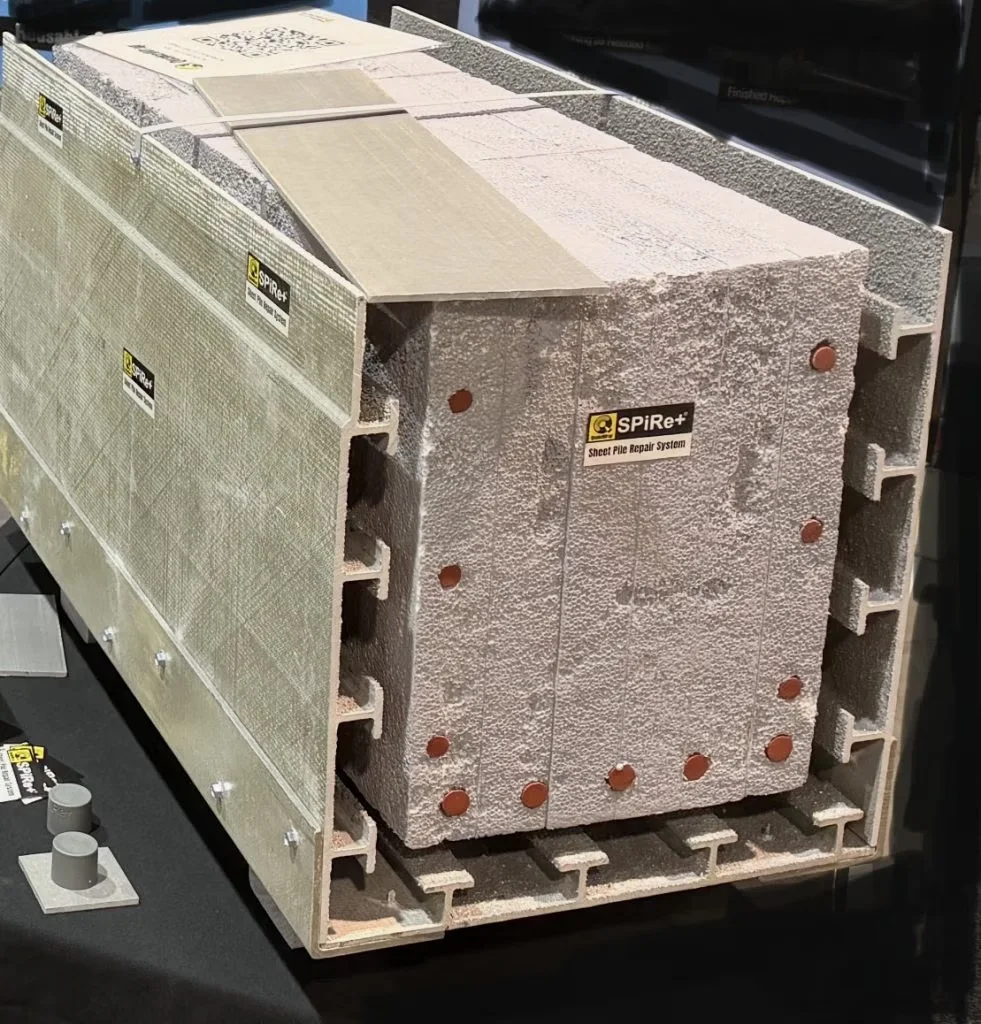
SPiRe®+
Stay-in-place FRP panels for seawalls, piles, beams and girders.
Explore SPiRe®+ -
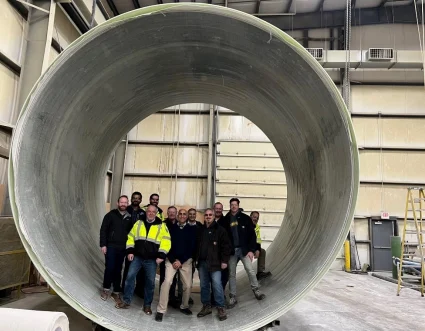
Custom FRP Shapes
Shells, forms and components built to fit.
Explore Custom FRP Shapes -
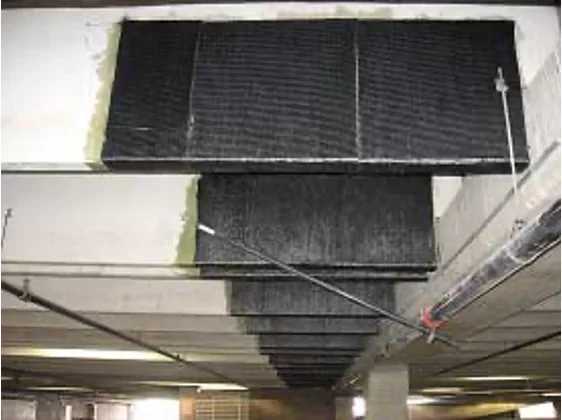
Beams & Girders
Restore and strengthen corroded beams and girders.
Explore Beams & Girders -
Slabs & Decks
Floor slabs and marine decks.
Explore Slabs & Decks -
Seawalls & Bulkheads
Where the SPiRe® stay-in-place approach began.
Explore Seawalls & Bulkheads -
Marine Infrastructure
Ports, wharves and piers kept in service.
Explore Marine Infrastructure


MORE PROJECTS
Related Projects
-
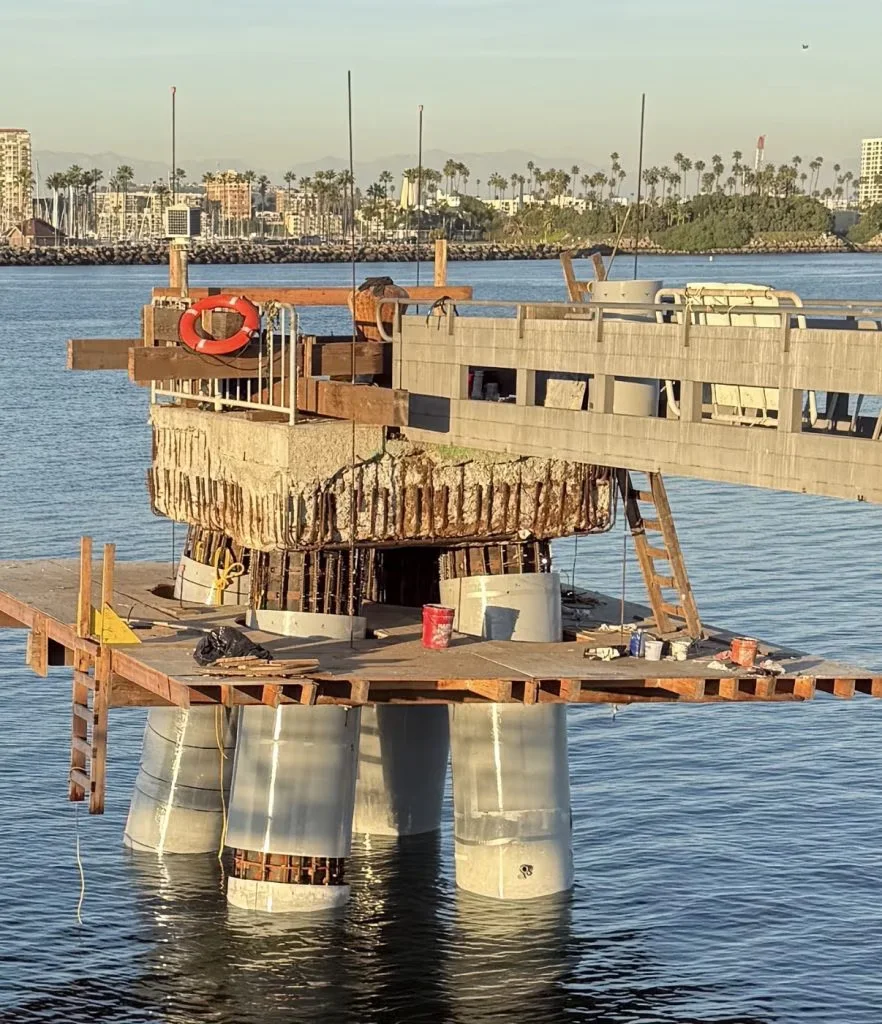
Port of Long Beach, California
Piles and pile caps of two cruise terminal dolphins repaired.
View case study -
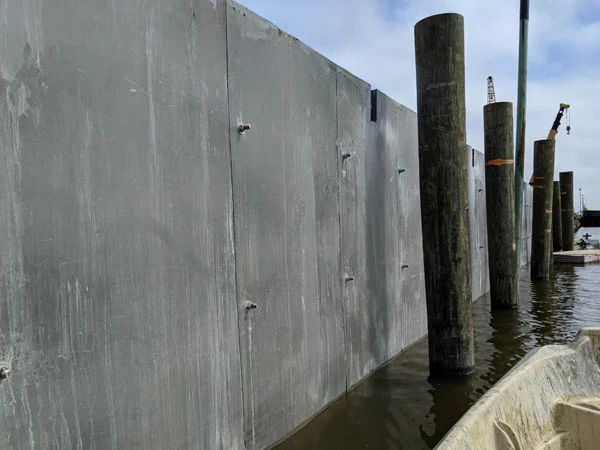
Port of West St. Mary, Louisiana
145 ft of steel sheet pile bulkhead protected with 42 SPiRe® panels.
View case study -
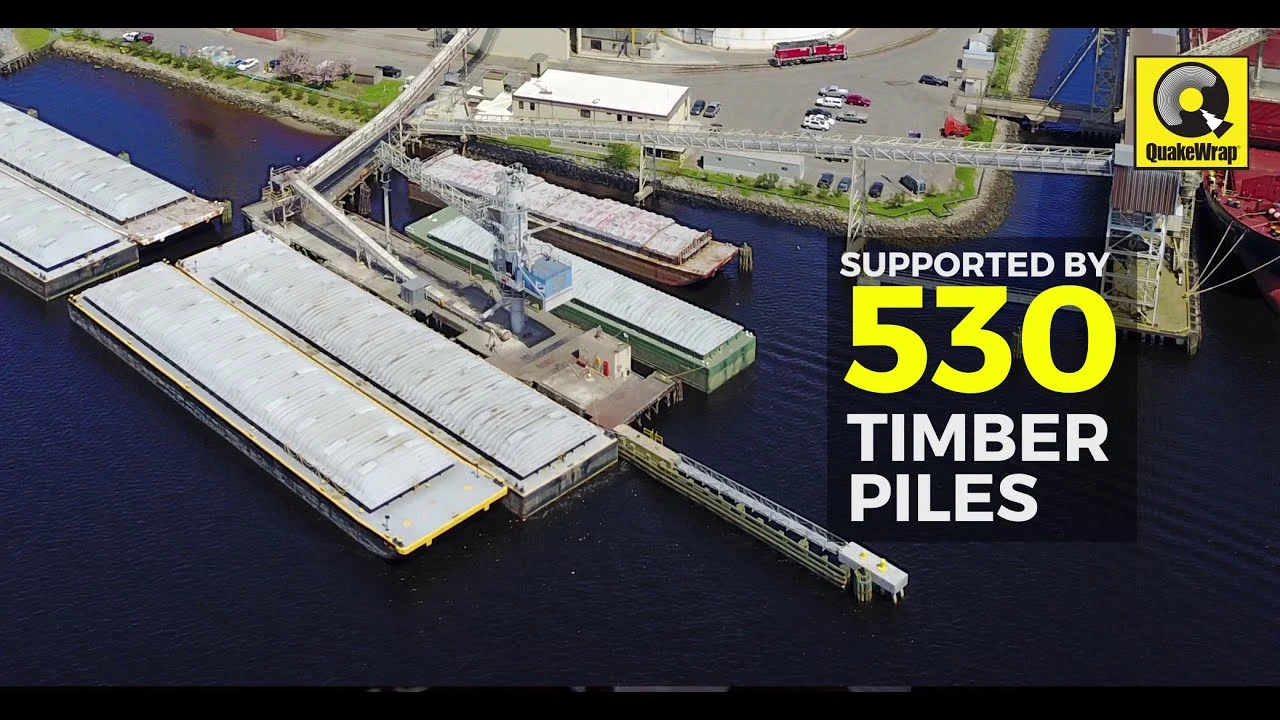
Agricultural Port, Chesapeake, Virginia
500+ timber piles restored with PileMedic® while the dock stayed open.
View case study


More Resources for Engineers
Have a Seawall or Deck That Needs Repair?
Tell us about the structure and site conditions. Our team will recommend the right QuakeWrap® system and provide specifications for your engineer.