
BEAM & GIRDER REPAIR
FRP Beam & Girder Repair and Strengthening
Corrosion, freeze-thaw damage, higher load demands and impacts all erode the capacity of beams and girders. QuakeWrap® FRP systems restore strength and extend service life, often with minimal disruption to your facility.
- Increase flexural & shear capacity
- Systems for dry, wet or submerged beams
- Concrete, steel & timber beams

Why Beams and Girders Lose Capacity
Deterioration of beams and girders is one of the most common problems in aging buildings, bridges and parking structures. Four causes account for most of the damage we see:
-
Corrosion of reinforcing steel
Rusting rebar expands, cracks the concrete and cuts load capacity.
-
Freeze-thaw damage
Repeated cycles spall and weaken exposed concrete members.
-
Increased load demands
New equipment, occupancy changes or code updates exceed original design.
-
Accidental impacts
Vehicle and equipment strikes damage girders in garages and bridges.
CHOOSE YOUR SYSTEM
Two FRP Systems for Beam and Girder Repair
The right system depends on the beam's condition and its environment. Wet layup is ideal for dry, accessible members. SPiRe®+ is built for wet or submerged conditions where surface preparation is difficult.

Wet Layup FRP
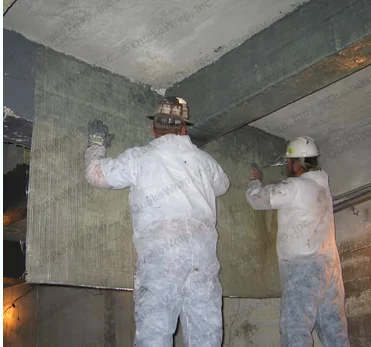
Thin FRP fabric is saturated with resin and bonded to the beam like wallpaper. Flexible enough to wrap AASHTO girders, T-beams and complex profiles.
- Increases flexural capacity
- Improves shear strength
- Controls cracking and adds durability

SPiRe®+ Panel System
Patented rigid fiberglass panels wrap the beam, then the gap is filled with high-strength grout to form a new composite section.
- Minimal surface preparation
- Installs in wet environments or underwater
- Permanent corrosion protection
| Wet Layup FRP | SPiRe®+ Panels | |
|---|---|---|
| Environment | Dry conditions only | Wet, splash zone or underwater |
| Surface preparation | Repaired, patched and ground smooth | Minimal |
| What it does | Adds flexural and shear strength, controls cracking | Formwork, reinforcement and corrosion protection in one |
| Material | FRP fabric about 0.04 in. (1 mm) thick | Pultruded fiberglass panels, about 3 ft wide, grout-filled |
| Best fit | AASHTO girders, T-beams, irregular shapes | Badly deteriorated members needing a new shell |
Not sure which system fits your beam?
Tell us about the member and conditions. Our team will recommend the right QuakeWrap® system.
How SPiRe®+ Beam Repair Works
-
Position & anchor
Panels are placed around the beam and anchored with bolts or fasteners.
-
Form the shell
Built-in T-shaped ribs act as rebar, with a grit coat for bond.
-
Fill with grout
High-strength grout or concrete fills the gap, creating a composite section.
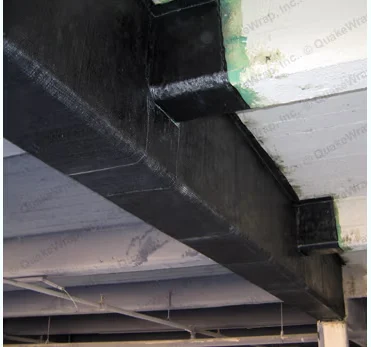
Concrete, Steel and Timber Beams
From glulam roof beams in school gyms to prestressed double tees in parking garages, QuakeWrap® FRP strengthens beams across building types and materials.
- Reinforced and prestressed concrete
- Double tee and AASHTO girders
- Glulam and wooden beams
- Corbels and concrete frames
STEEL GIRDERS
Carbon FRP on Steel Girders: University of Arizona Tests
Carbon FRP strengthens steel beams and girders as well as concrete and timber. Its use on steel bridge girders was demonstrated in an extensive research study at the University of Arizona, on girders built from W14x30 steel sections spanning 16 ft (4.8 m).
To simulate prior damage, the area of the tension flange was reduced by 25%. The tension flange of a similar companion beam was strengthened with 3 strips of carbon FRP. The retrofitted girder was significantly stronger, with a large increase in stiffness in the plastic region.
Carbon FRP also improved fatigue behavior: the retrofitted beams resisted 2½ to 3½ times more load cycles than cracked girders that were not retrofitted.
- Restores capacity lost when corrosion reduces the tension flange
- More flexural strength in positive and negative moment regions
- Added stiffness in elastic and plastic response
- Better fatigue behavior after retrofit
- Test section
- W14x30
- Span
- 16 ft (4.8 m)
- Simulated flange loss
- 25%
- Load cycles vs. unretrofitted
- 2½ to 3½×
PROVEN RESULTS
Beam Repair Projects
-
HIGHWAY BRIDGE
Arizona DOT I-17 Bridges
Phoenix, AZ
Carbon FRP strengthening of 12 truck-damaged prestressed girders, ADOT's first carbon FRP repair on state highway bridges.
PROJECT SHEET (PDF) -
PARKING STRUCTURE
Martini Park Parking Garage
Scottsdale, AZ
Carbon FRP repair of double tee beams.
PROJECT SHEET (PDF) -
SCHOOL
Coolidge High School Gymnasium
Coolidge, AZ
FRP strengthening of glulam beams in a school gym.
PROJECT SHEET (PDF) -
HISTORIC BUILDING
Art Gallery
Phoenix, AZ
FRP retrofit of reinforced concrete beams in a historic building.
PROJECT SHEET (PDF) -
CONDOMINIUM
Oceans One Condominium
Daytona, FL
FRP repair of concrete beams in a coastal condominium.
PROJECT SHEET (PDF) -
INDUSTRIAL
Kinder Morgan Plant
Tampa, FL
Carbon FRP repair of a glulam beam at an industrial plant.
PROJECT SHEET (PDF) -
PARKING STRUCTURE
Panorama Condominiums
Las Vegas, NV
FRP repair of prestressed concrete beams in a parking structure.
PROJECT SHEET (PDF) -
CABLE-STAYED BRIDGE
Tran Thi Ly Bridge
Da Nang, Vietnam
Several girders of the 731 m concrete cable-stayed bridge over the Han River were strengthened for flexure and shear with unidirectional carbon FRP by wet layup.
PROJECT SHEET (PDF) -
BRIDGE GIRDERS
Lan Thap Bridge
Quang Ninh Province, Vietnam
QuakeWrap® carbon fabric and QuakeBond™ resin applied by wet layup to all of the prestressed girders for shear and bending strengthening.
PROJECT SHEET (PDF) -
PEDESTRIAN BRIDGE
Challenger Middle School
Tucson, AZ
Six pedestrian bridge beams with shear cracking near the supports repaired with glass fabric U-wraps in three days over the Christmas break.
PROJECT SHEET (PDF) -
SCHOOL
Oran M. Roberts Elementary School
Dallas, TX
Seven 40 ft prestressed double tees strengthened for flexure and shear in one application of biaxial glass fabric to carry a new rooftop air handler, then given a fire-resistant coating.
PROJECT SHEET (PDF) -
WOOD BEAMS
Tucson Police Substation
Tucson, AZ
About 160 glulam and sawn lumber roof beams in a 55,000 sq ft store converted to a police substation strengthened with carbon and glass fabric for the new use.
PROJECT SHEET (PDF) -
CONDOMINIUM
Dunes Condominiums
Charlevoix, MI
Seven overstressed 26 ft wood beams, deflecting 1½ to 2 in., wrapped in place with carbon fabric while the building stayed occupied.
PROJECT SHEET (PDF)
Your beam could be the next project sheet
Share the member type, span and damage. Our team will recommend the right QuakeWrap® system and provide specifications for your engineer.
Beam Repair FAQs
How does FRP strengthen a concrete beam?
FRP fabric is saturated with resin and bonded to the beam's surface. Once cured, it forms a reinforcing layer with about two to three times the tensile strength of steel, adding flexural and shear capacity with almost no added thickness.
Can beams be repaired in wet or underwater conditions?
Yes. SPiRe®+ is built for wet or submerged conditions where surface preparation is difficult. Rigid fiberglass panels wrap the beam, then the gap is filled with high-strength grout to form a new composite section.
Can FRP strengthen timber and glulam beams?
Yes. QuakeWrap® FRP strengthens glulam and wooden beams, from glulam roof beams in school gyms to a glulam beam at an industrial plant.
Which is better for my project, wet layup or SPiRe®+?
Wet layup is ideal for dry, accessible beams and adds flexural and shear strength. SPiRe®+ fits wet or submerged beams and badly deteriorated members that need a new shell. Our team will recommend the right system for your beam.
Can you provide specifications and design details for our engineer?
Yes. Our team will recommend the right QuakeWrap® system and provide product data sheets, specifications and sample design details for your engineer of record.
Related FRP Repair Applications
Have a Beam That Needs Strengthening?
Tell us about your beam. Our team will recommend the right QuakeWrap® system and provide specifications for your engineer.