
BUILDINGS & BRIDGES
FRP Column Strengthening and Repair
Increase both flexural and axial capacity of corroded concrete columns. Fully wrapping columns with FRP increases axial capacity and ductility with almost no added size.
- Confinement & axial strengthening
- Typically less than ½ in. added size
- Concrete & steel columns

MATCHING PRODUCTS
QuakeWrap® Systems for Columns
-
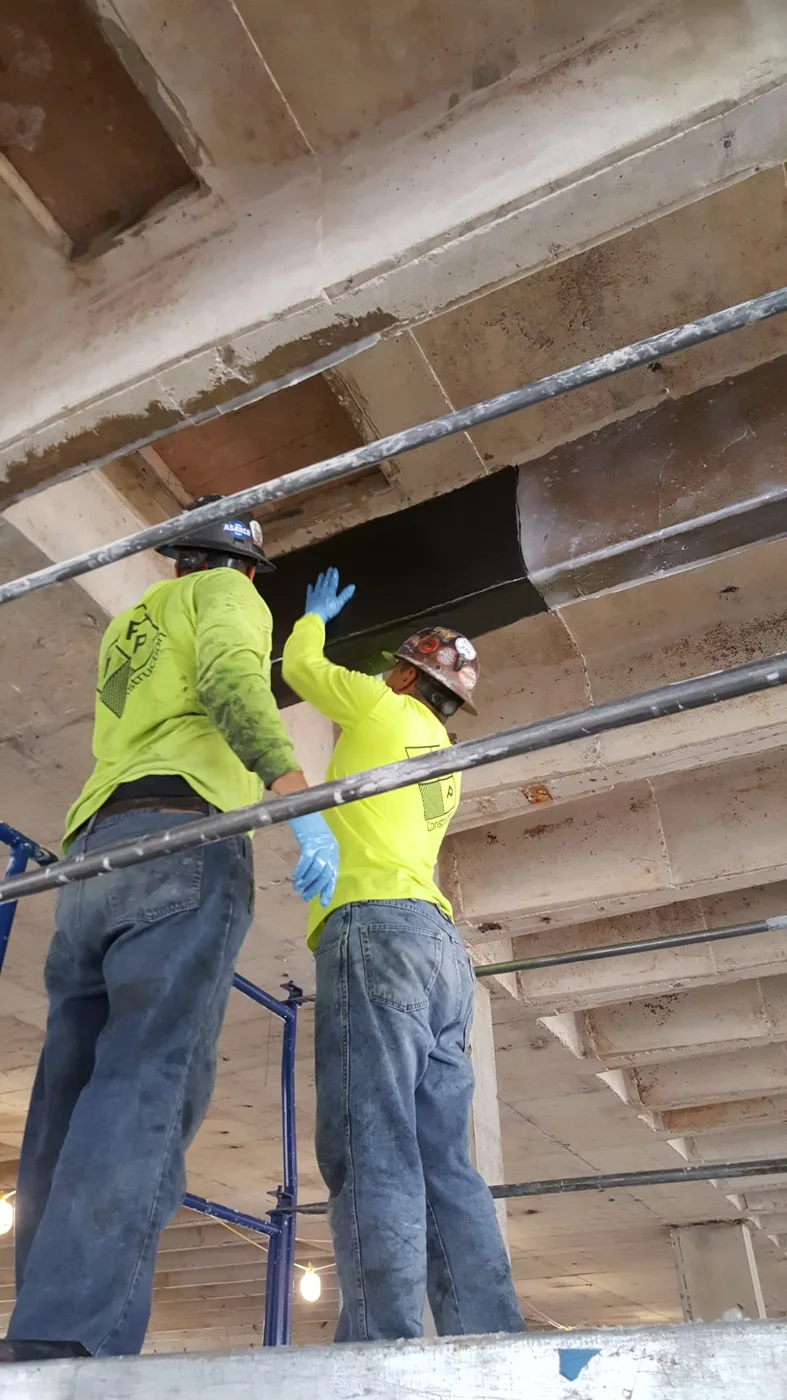
Wet & Dry Layup FRP
Carbon and glass fabric systems for beams, columns, slabs and walls.
Explore Wet & Dry Layup FRP -
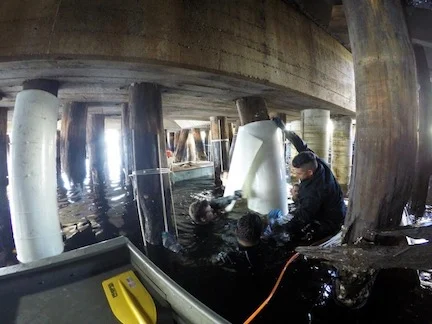
PileMedic®
Laminate jackets for piles and columns, even underwater.
Explore PileMedic®

Not sure which system fits?
Tell us about the structure and conditions. Our team will recommend the right QuakeWrap® system.
WHY COLUMNS LOSE CAPACITY
Why Columns Lose Capacity
Column projects on the old QuakeWrap® pages started with one of these four problems.
-
Corrosion and impact
Columns in buildings and bridges corrode with age, and vehicle strikes break off the cover concrete and expose the bars.
-
Construction errors
Concrete below its design strength or columns built without enough hoop and longitudinal steel.
-
New loads
Added stories, heavier roofs or new shear walls that tie into existing columns.
-
Seismic deficiency
Pre-1970s columns are poorly confined, often with No. 3 or 4 ties at 12 in. that are not anchored in the core. In an earthquake the ties open and the bars buckle.
HOW IT WORKS
How FRP Confinement Strengthens a Column
Fully wrapping a column with glass or carbon FRP confines the concrete. Confinement raises the concrete’s strength and, more importantly for seismic work, the strain it can reach before failing, which is its ductility. Fibers oriented around the column can stand in for missing ties.
In cyclic tests published by QuakeWrap’s principals, columns carried a constant 100 kip axial load while their tops were pushed back and forth to simulate an earthquake. The retrofitted specimens kept resisting more lateral load cycle after cycle, and testing usually stopped only because the equipment reached its maximum displacement.
For columns that need more capacity than a wrap can give, PileMedic® laminates form a grout-filled shell around the column, with new bars inside if needed. Our team will recommend the right QuakeWrap® system and provide specifications for your engineer of record, who sets the number and orientation of the layers.
- Increases ductility and shear strength
- Improves bond of starter bars
- Conforms to round, square and rectangular sections
- Needs minimal access around the column

CHOOSE YOUR METHOD
FRP Wrap or Laminate Shell?
| Wet layup FRP wrap | PileMedic® laminate shell | |
|---|---|---|
| How it works | Fabric is saturated with resin and bonded around the column, fibers in the hoop direction | Laminate is wrapped into a shell around the column, with spacers and new bars if needed, and the gap is filled with grout |
| Added size | Typically less than ½ in.; the I-40 piers grew less than ¼ in. | Enlarges the section, for example an 18 in. square column inside a 21 in. square shell |
| Best fit | Confinement, ductility, under-strength concrete, seismic retrofit | Heavily corroded or under-designed columns that need a large capacity increase |
| Example result | Cabana Hotel: 2 to 8 layers of carbon fabric per column for two added stories | Design example: 1.5 to 1.8 times the axial capacity and more than twice the flexural capacity |
| Read more | Wet & Dry Layup FRP | Strengthening concrete columns |
Not sure which method fits your column?
Share the column size, loads and condition. Our team will recommend the right QuakeWrap® system and provide specifications for your engineer.
PROJECT VIDEO
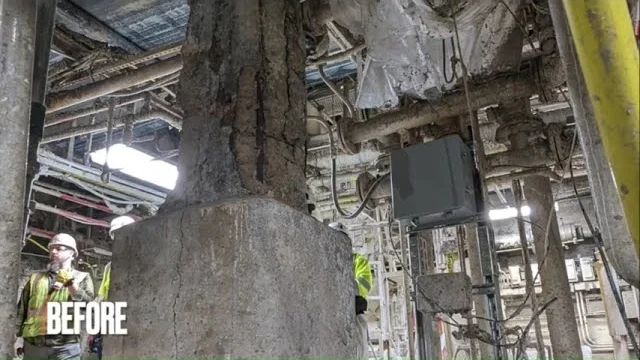
Repairing a Corroded Concrete Column in an Industrial Plant
A severely corroded concrete column with limited access, repaired quickly with PileMedic® laminates and minimal disruption of service.
Plays from YouTube
PROVEN RESULTS
Column Repair Projects
-
HISTORIC HOTEL
Cabana Hotel
Miami Beach, FL
183 columns with low-strength concrete strengthened for two added stories with 2 to 8 layers of carbon fabric: 35,000 sq ft in 8 weeks. Fifteen years later the building, now a Hilton, shows no sign of damage.
PROJECT SHEET (PDF) -
CONDOMINIUM TOWER
Plaza in Clayton
St. Louis, MO
60 columns, 28 in. square, in the lower 15 floors of a 26-story tower lacked hoop and longitudinal steel. Two layers of carbon fabric were installed while residents stayed in their units.
PROJECT SHEET (PDF) -
AIRPORT
Ted Stevens International Airport
Anchorage, AK
35 columns tied to new shear walls in a seismic retrofit received two to three wraps of carbon fabric, 6,500 sq ft in all.
PROJECT SHEET (PDF) -
PARKING GARAGE
Port Clinton Garage
Port Clinton, OH
Six 18 in. round, 18 ft columns needed more capacity for added roof loads. Two wraps of glass fabric, 1,400 sq ft, by a 2-person crew in 5 days.
PROJECT SHEET (PDF) -
COLD WEATHER
Rocky Mountain Hardware
Hailey, ID
Basement columns poured below design strength were saved from demolition with 5 layers of carbon fabric, installed under heaters in two days.
PROJECT SHEET (PDF) -
BRIDGE PIERS
I-40 Bridge
Oklahoma City, OK
13 corroded piers, 3 ft in diameter and 35 ft high, wrapped with 9,000 sq ft of glass fabric in three days. The repair added less than ¼ in. and kept clear of the railroad right-of-way.
PROJECT SHEET (PDF) -
BRIDGE PIERS
I-94 at S.R. 49
Chesterton, IN
10 circular piers with corroded spirals were wrapped in two layers of glass fabric while the bridge stayed open. Each took 2 hours with a 4-person crew.
PROJECT SHEET (PDF) -
BRIDGE PIERS
I-90 at Cline Ave.
Gary, IN
Rectangular piers with erosion damage and corroded main bars were patched and wrapped with two layers of glass fabric while the bridges stayed open. Each 32 ft column took 5 hours with a 4-person crew.
PROJECT SHEET (PDF) -
IMPACT DAMAGE
I-70 Overpass
Kansas City, MO
A pier hit by a truck was patched and wrapped with two layers of glass fabric in 4 hours, with the traffic barriers left in place.
PROJECT SHEET (PDF) -
EMERGENCY REPAIR
McKale Center, University of Arizona
Tucson, AZ
Two corrosion-damaged concrete columns next to the ticket booth were repaired on an emergency basis in August 2023.
WATCH THE VIDEO
Your column could be the next project sheet
Share the column type, size and damage. Our team will recommend the right QuakeWrap® system and provide specifications for your engineer.
Columns FAQs
Should I use carbon or glass FRP?
Carbon has the highest strength and stiffness and is common for flexural and shear strengthening of beams, slabs and girders. Glass costs less, is non-conductive and is common for column confinement, masonry walls, blast and seismic retrofit.
How much does an FRP wrap add to a column?
Typically less than ½ in. On the I-40 bridge in Oklahoma City, glass fabric added less than ¼ in. to 3 ft piers, so the repair stayed clear of the railroad right-of-way next to them.
Can columns be strengthened while a building is occupied?
Yes. At Plaza in Clayton, 60 columns were wrapped in occupied condominium units. The fabric was saturated in the garage and carried up in passenger elevators, and the nearly odorless resins kept disturbance to residents low.
Can FRP fix columns poured with low-strength concrete?
Yes. Confinement raises the strength of the concrete. At Rocky Mountain Hardware, basement columns poured below design strength were brought back to their design value with 5 layers of carbon fabric instead of being demolished.
Can FRP be installed in cold weather?
Yes, with heat. On the Rocky Mountain Hardware job in Idaho, gas heaters raised the installation temperature to above 60 °F so the system could cure.
Can you provide specifications and design details for our engineer?
Yes. Our team will recommend the right QuakeWrap® system and provide product data sheets, specifications and sample design details for your engineer of record.
Related FRP Repair Applications
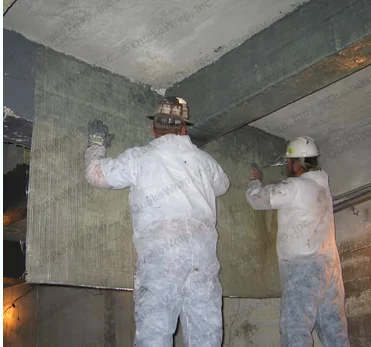
Have a Project That Needs Repair?
Tell us about your structure. Our team will recommend the right QuakeWrap® system and provide specifications for your engineer.