StifPipe®: Structural Slip-Lining Pipe for Pipes and Culverts
A lightweight sandwich-wall FRP pipe that resists internal pressure and external soil and traffic loads on its own. Slip-lined in segments, or built layer by layer inside the host pipe.
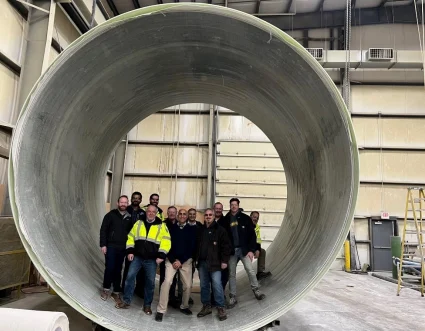
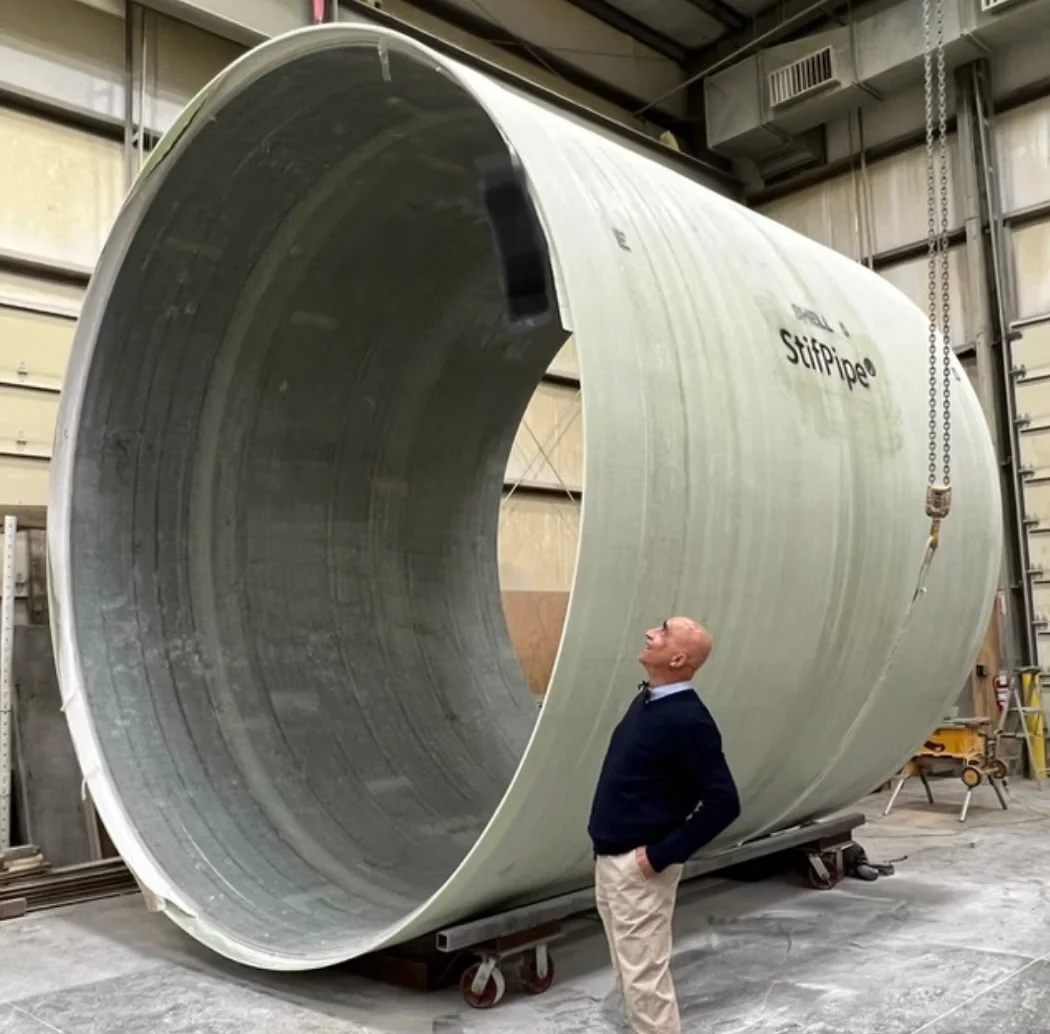
16 ftdiameter StifPipe® slipliner made for a Detroit sewer interceptor
typical pipe stiffness (ASTM D2412)
50 to 100
typical 36-in. StifPipe®
30 to 35 lb/ft
stiffness gain from the sandwich core, in tests
30×+
design service life
50+ yrs
WHAT IT IS
Sandwich Construction: Stiffness Without 10 Layers of Carbon
For pressure pipes such as PCCP, two or three layers of carbon FRP are often enough to carry the internal pressure after the host pipe loses its steel to corrosion. More owners now ask for a liner that also stands alone if the host pipe or culvert fails completely, carrying soil pressure and traffic loads by itself.
That design is controlled by ring stiffness, not tensile strength, so wall thickness governs. A liner ½ in. or thicker takes 10 or more layers of carbon fabric, which makes it slow and costly to install.
StifPipe®, developed by Prof. Mo Ehsani, borrows sandwich construction from aerospace. Two strong FRP skins of carbon or glass are separated by a lightweight core of honeycomb or 3D fabric, the same principle that makes an I-beam stiff. Tests have shown the core can raise stiffness more than 30 times while adding little weight.
For pressure pipes, the carbon layers on the inside are sized for the internal pressure only, while the whole sandwich wall carries gravity and traffic loads.
FRP skinCarbon or glass fiber composite
Lightweight coreHoneycomb or 3D polymeric fabric
FRP skinCarbon or glass fiber composite
METHOD 1: SLIP-LINING
How StifPipe® Is Slip-Lined
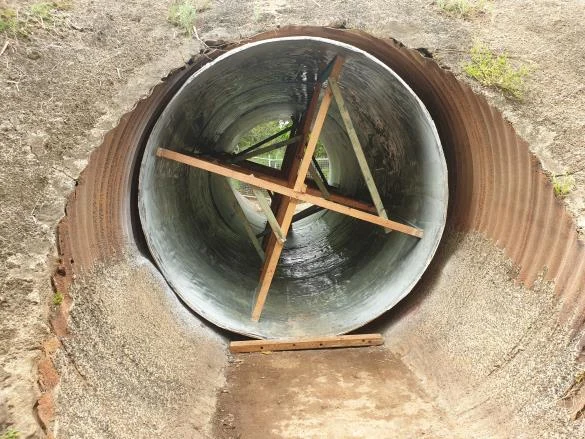
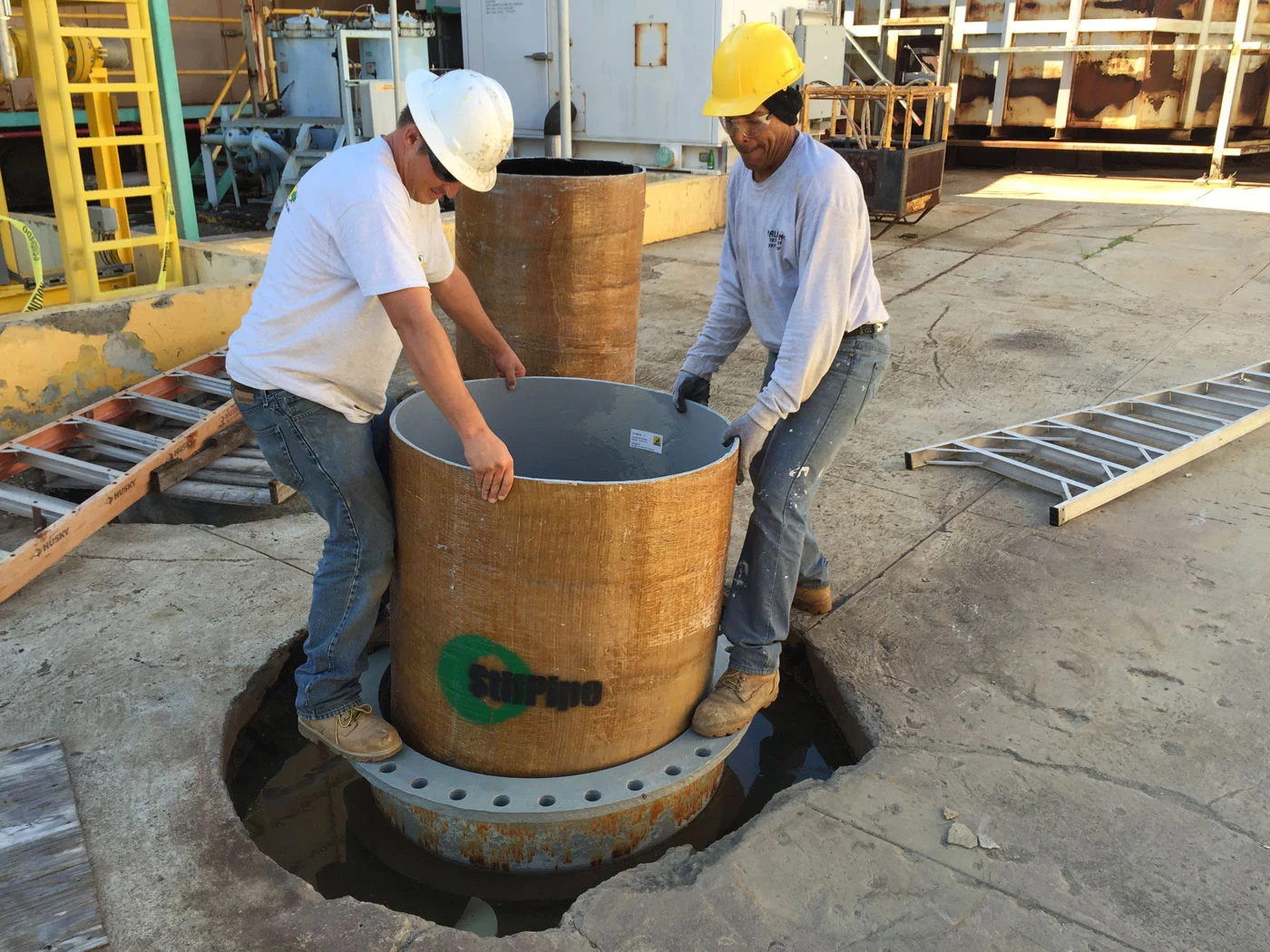
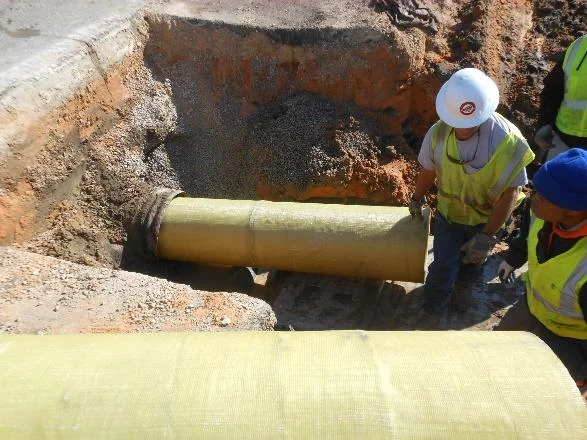
Segments are made in advance, shipped to the site and pushed into the host pipe or tunnel. Basic steps are below. Refer to the technical specification for details.
01
Inspect and smooth
Inspect the host pipe and smooth out protrusions or joint offsets greater than 3% of its internal diameter.
02
Make the segments
Glass, carbon and 3D core layers are wrapped on a mandrel at the plant or near the site and cure for 12 hours at room temperature, faster with heat.
03
Push into place
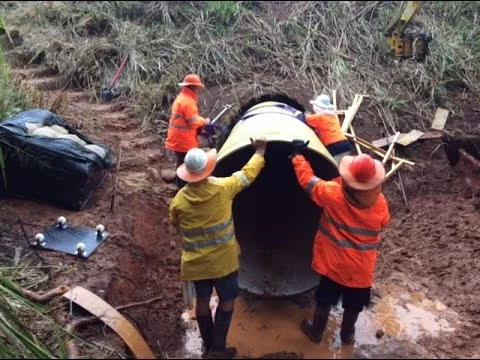
Push segments in by hand, pull them with straps, or use a jack or pipe carrier. StifPipe® can take over 10,000 psi (70 MPa) of axial compressive stress during installation.
04
Join and grout
Join butt ends with cured-in-place FRP strips, or use bell and spigot ends with a gasket. Then fill the annular space with epoxy, polyurethane or cementitious grout.
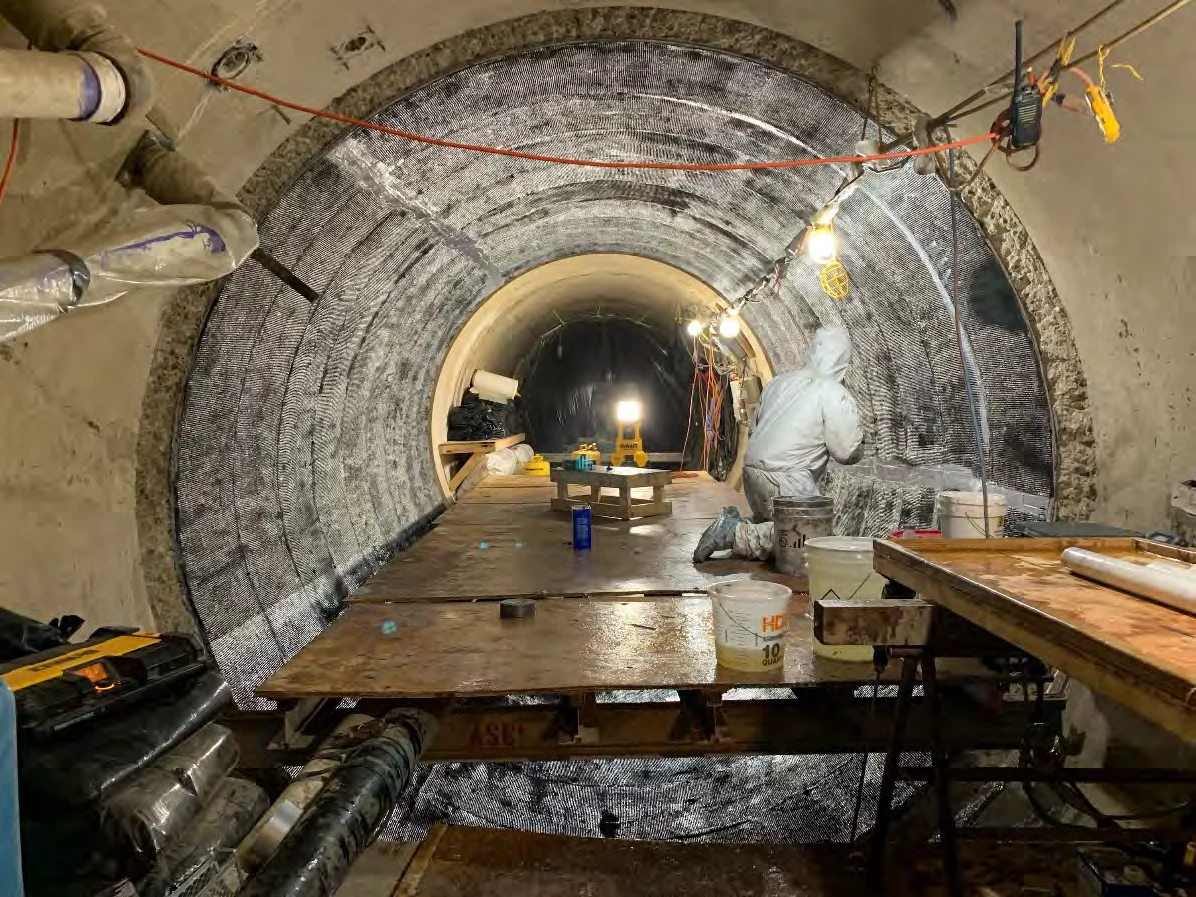
When access is limited or the repair is short, StifPipe® can be built inside the pipe using the wet layup method. The raw materials go into the pipe and are applied layer by layer to the host pipe surface, which acts as the mold. There is no annular space to grout.
The wet layup method needs surface preparation and environmental controls. With a heated cure, the pipe can go back into service in 12 hours or less.
Remove sharp protrusions, then smooth or abrade the surface for bond
Pressure wash away debris, sediment, roots, oil and grease
Apply a primer, then an epoxy tack coat
Apply resin-saturated StifPipe® layers per the design
Finish with an abrasion-resistant top coat and let it cure
StifPipe® at a Glance
CONSTRUCTION
Carbon and glass FRP skins on a 3D fabric or honeycomb core
PIPE STIFFNESS
Typically 50 to 100 (ASTM D2412)
COMBINED MODULUS
About 9,000,000 psi (62,000 MPa), parallel plate test
DIMENSION RATIO
50 to 100
WEIGHT
30 to 35 lb/ft for a typical 36-in. pipe
CHEMICAL RESISTANCE
Inert to sulfuric acid and other chemicals listed in ASTM D543
JOINTS
Butt joints with FRP strips, or bell and spigot with gasket
HOST PIPES
All host pipe materials, circular or non-circular
SHELF LIFE
Unlimited, stored dry at 30 to 120°F (0 to 50°C)
Typical Properties of a 54-in. StifPipe®
Each StifPipe® is designed for its project's internal and external loads. These values are for one sample 54-in. pipe, with dual-layer glass fiber (with chopped mat for impermeability), carbon fiber and a 3D polymeric core. Properties vary with size and design loads.
Sample 54-in. StifPipe® properties
Property
Test
Imperial
SI
Inside diameter
54 in.
1,370 mm
Wall thickness
0.56 in.
14 mm
Weight
50 lb/ft
74 kg/m
Pipe stiffness
ASTM D2412
43
43
Modulus of elasticity
ASTM D2412
8,124,000 psi
56,000 MPa
Flexural strength
ASTM D790
22,287 psi
154 MPa
Maximum deflection
6%
6%
Axial compressive strength
11,000 psi
76 MPa
Abrasion wear index
ASTM D4060
0.016 oz
457 mg
Chemical resistance
<1% weight gain in 10% sulfuric acid
<1% weight gain in 10% sulfuric acid
Minimum Wall Thickness by Diameter and External Pressure
Minimum StifPipe® wall thickness, in inches (mm), for nominal external pressures from 10 to 110 psi. Use it for early sizing only. The final wall is set by the project design.
StifPipe® minimum wall thickness, in. (mm)
Diameter, in. (mm)
10 psi (69 kPa)
30 psi (207 kPa)
50 psi (345 kPa)
70 psi (483 kPa)
90 psi (621 kPa)
110 psi (758 kPa)
18 (460)
0.33 (8)
0.33 (8)
0.33 (8)
0.33 (8)
0.33 (8)
0.33 (8)
24 (610)
0.3 (8)
0.33 (8)
0.33 (8)
0.33 (8)
0.36 (9)
0.39 (10)
30 (760)
0.5 (13)
0.5 (13)
0.52 (13)
0.52 (13)
0.6 (15)
0.9 (23)
36 (910)
0.50 (13)
0.5 (13)
0.52 (13)
0.6 (15)
0.65 (17)
0.9 (23)
48 (1,220)
0.5 (13)
0.5 (13)
0.9 (23)
0.9 (23)
0.9 (23)
0.9 (23)
54 (1,370)
0.54 (14)
0.6 (15)
0.9 (23)
0.9 (23)
0.9 (23)
1.0 (25)
60 (1,520)
0.6 (15)
0.65 (17)
0.9 (23)
0.9 (23)
0.9 (23)
1.0 (25)
66 (1,680)
0.7 (18)
0.9 (23)
0.9 (23)
0.9 (23)
1.0 (25)
1.3 (33)
72 (1,830)
0.7 (18)
0.9 (23)
0.9 (23)
1.0 (25)
1.1 (28)
1.3 (33)
78 (1,980)
0.9 (23)
0.9 (23)
0.9 (23)
1.0 (25)
1.3 (33)
1.3 (33)
84 (2,130)
0.9 (23)
0.9 (23)
1.0 (25)
1.1 (28)
1.3 (33)
1.3 (33)
96 (2,440)
1.0 (25)
1.0 (25)
1.1 (28)
1.3 (33)
1.3 (33)
1.3 (33)
120 (3,050)
1.2 (31)
1.2 (31)
1.3 (33)
1.3 (33)
1.4 (36)
1.5 (38)
144 (3,660)
1.3 (33)
1.3 (33)
1.3 (33)
1.4 (36)
1.5 (38)
1.6 (41)
168 (4,270)
1.30 (33)
1.30 (33)
1.34 (34)
1.57 (40)
1.73 (44)
1.89 (48)
192 (4,880)
1.34 (34)
1.34 (34)
1.57 (40)
1.81 (46)
2.12 (54)
2.20 (56)
MANUFACTURING
Made on a Collapsible Mandrel, Close to the Job
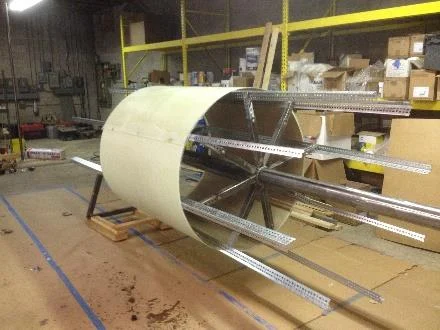
StifPipe® is made on a collapsible steel mandrel with adjustable arms, so one setup produces pipe in virtually any diameter. Resin-saturated FRP fabric is wrapped on the mandrel, the core goes on, more FRP layers follow and the pipe cures. The mandrel then collapses slightly so the finished pipe slides off.
Pipe can be made at the plant, on site, or near the project with a mobile production unit, which cuts trucking and handling. Non-circular StifPipe® can be made to fit the profile of the host pipe or culvert.
Why Engineers Specify StifPipe®
Extremely lightweight
About 10 to 15% the weight of conventional fiberglass pipe.
Fully structural
Resists internal pressure and external soil and traffic loads.
Usually no jacking
Segments are light enough to push into place by hand.
Flow can stay on
Slip-lining can proceed without bypassing the flow.
Custom diameter and shape
Made to fit the host pipe, which keeps flow capacity high.
Better hydraulics
Smooth surface, low Manning's n and a thin wall.
Corrosion resistant
Inert to sulfuric acid and other aggressive chemicals.
Long service life
Designed for 50 years or more with minimal maintenance.
TESTS & RECOGNITION
Tested in Parallel Plate Loading. Recognized by ASCE.
ASTM D2412 parallel plate tests
Linear elastic, consistent stiffness. Tests run at the University of Arizona.
TRI deflection test
A 46-in. StifPipe® tested by Texas Research Institute, with a response acceptable for slip-lining.
NSF/ANSI 61 listing
Listed for new pipes 6 in. and larger in cold water. Active, checked October 20, 2026 (N-11990, NSF/ANSI/CAN 61-2023).
ASCE Innovation Award
2016 award recognizing the world's first green and sustainable pipe.
Have a culvert or pipe that must carry its loads alone?
Send us the host pipe size, shape, condition and loads. Our team will recommend the right QuakeWrap® system and provide specifications for your engineer.
StifPipe® is an FRP composite pipe with carbon and glass skins on a lightweight core. The sandwich wall makes it very stiff for its weight, so it can resist heavy external loads and internal pressure as a stand-alone pipe.
Should StifPipe® be slip-lined or applied by wet layup?
Slip-lining suits longer runs where segments can be pushed into the host pipe, with the annulus grouted afterward. Wet layup suits limited access or short repairs, and builds the pipe directly on the host pipe wall with no annulus.
Does slip-lining StifPipe® need jacking equipment?
Usually not. Segments are light enough to push in by hand, pull with straps or move with a pipe carrier. A jack can be used, and StifPipe® can take over 10,000 psi of axial compressive stress during installation.
What sizes and shapes can StifPipe® be made in?
Each pipe is made for its project on an adjustable mandrel, in virtually any diameter, and in non-circular shapes to fit the host pipe. A 16-ft StifPipe® was made for a Detroit sewer interceptor.
Can the flow stay on during installation?
Yes. StifPipe® can be slip-lined without bypassing the flow. In Detroit, pipes were installed by shutting off the pump station each day instead of building a bypass.
How long does StifPipe® last?
StifPipe® systems are designed for 50 years or more of service life with minimal maintenance.
Tell us about the host pipe or culvert, its size, shape, condition and loads. Our team will recommend the right QuakeWrap® system and provide specifications for your engineer.