
SUPPORT FOR THE ENGINEER OF RECORD
FRP Design Support for Engineers of Record
QuakeWrap® makes the products. Your engineer of record designs the repair. Our team recommends the right QuakeWrap® system and provides the specifications, sample design details, data sheets, test reports and design guidance your engineer needs.
- System recommendation for your structure
- Guide specifications in PDF and Word
- Sample design details, data sheets and test reports

WHAT YOU GET
What Your Engineer Gets From QuakeWrap®
Support starts with the product and ends with the paperwork your engineer, contractor and building official need. None of it replaces the engineer of record's design.
-
A system recommendation
We review the structure, the damage and the goal, then recommend the product: PileMedic®, SPiRe®+, PipeMedic®, QuakeWrap® wet or dry layup fabrics, or a custom shape.
-
Guide specifications
Editable specifications in PDF and Word, including SPiRe®+ Section 03 10 00.01, grout Section 03 30 12 and a generic PileMedic® specification.
-
Sample design details
Typical details for timber, concrete and steel piles, H-piles, seawalls, beams and retaining walls. They are marked Not for Construction, so your engineer adapts them to the project.
-
Data sheets and test reports
Product data sheets, the NSF/ANSI 61 listing, IAPMO UES ER-828 and full-scale test reports from the U.S. Army Corps of Engineers and state DOT studies.
-
Design guidance
Answers on design values, code basis and detailing. ER-828 ties design to IBC Chapter 19 (ACI 318) and the QuakeWrap Design Manual, Version 1.0_1. [Confirm with QuakeWrap: can engineers request the Design Manual? It is not posted on any QuakeWrap site]
-
Installation support
Installation instructions for the contractor, hands-on installer training, including training on site, and site visits during installation. In August 2026, for example, a QuakeWrap® instructor spent two days training a PileMedic® installation crew at Prudhoe Bay, Alaska. [Confirm with QuakeWrap: the current class schedule, and whether on-site training and site visits are included or quoted separately. The last published class dates are November 2022]
Have drawings or photos already?
Send them with your request. Our team will recommend the right QuakeWrap® system and provide specifications for your engineer.
CLEAR ROLES
Who Does What on a QuakeWrap® Project
IAPMO UES ER-828 puts the design with the owner and the registered design professional. QuakeWrap® supplies the products and the information behind them.
| Engineer of record | QuakeWrap® | Contractor | |
|---|---|---|---|
| Evaluate the structure | Determines capacities and demands by analysis | Provides product data, design values and test reports | Provides access and field measurements |
| Design the repair | Designs the repair and seals drawings where the jurisdiction requires | Recommends the system and provides sample details and design guidance | Not involved |
| Specifications | Edits and issues the project specification | Provides guide specifications in PDF and Word | Follows the issued specification |
| Submittals | Reviews and approves | Supplies data sheets, test reports and material certifications | Prepares and submits per the specification |
| Installation | Observes as the project requires | Supplies materials, installation instructions and training | Installs the system |
| Inspection | Defines inspection requirements | Explains product-specific checks | Supports special inspection per IBC 1704 and 1705 and AC178 |
HOW TO REQUEST
How to Request Specifications & Design Support
-
Send the Project
Use the consultation form or call. Tell us the structure, the problem and what the repair must achieve.
-
Review With Our Team
Our engineers review the drawings, photos and data with you and recommend the right QuakeWrap® system.
-
Get the Package
Guide specifications, sample design details, data sheets and test reports for your engineer of record. [Confirm with QuakeWrap: typical turnaround for a project package. No QuakeWrap page states one]
-
Specify and Install
Your engineer issues the design. We supply the materials, installation instructions and training for the contractor.
WHAT TO SEND
What to Send With Your Request
The more we know about the structure, the faster we can recommend a system and send the right documents.
-
Structure and material
Pile, column, beam, slab, wall, seawall, pipe, culvert or tank, and whether it is concrete, steel, timber or masonry.
-
Size and drawings
Dimensions, pile diameters or pipe sizes, lengths and any existing drawings.
-
Condition
Photos, inspection reports and measured section loss, cracking or decay.
-
The goal
Restore capacity, add load capacity, seismic upgrade, corrosion protection or drinking water service.
-
Loads and pressures
Design loads, and for pipes the operating pressure, soil cover and traffic loads.
-
Site conditions
Submerged or tidal, in service or shut down, and how crews reach the work, such as through manholes.
-
Codes and owner rules
Building code, DOT or agency requirements, and any NSF/ANSI 61 or special inspection requirements.
-
Schedule
When the design is due and when the work needs to be done.
WHO WE SUPPORT
Support for Engineers, Contractors and DOTs
-
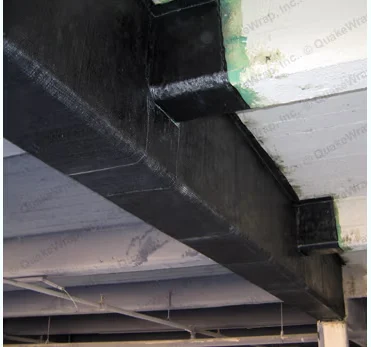
Specify the Repair
Guide specifications, sample details, data sheets, test reports and answers on design values, so you can design and specify the repair.
Specifications & details -
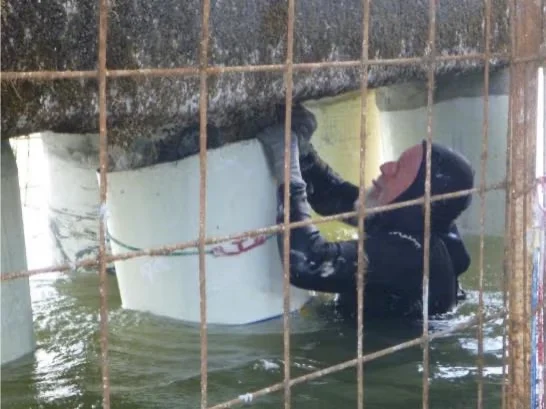
Install It Right
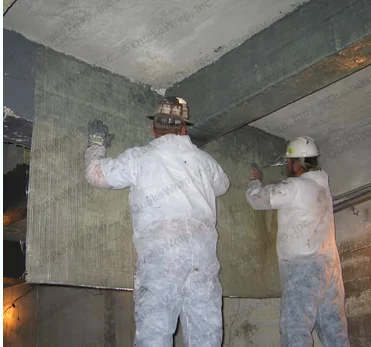
QuakeWrap® products work on concrete, masonry, steel and timber with light equipment. You get installation instructions, the submittal documents the specification calls for, and installer training.
Installation videos -
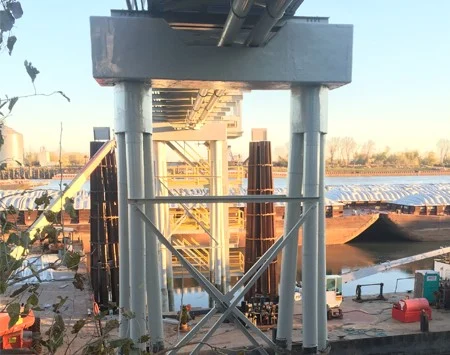
Bridge, Culvert and Seawall Repairs
Decks, girders, columns, timber and steel piles, culverts, abutments and seawalls, plus seismic and live load upgrades. Several state DOTs have tested QuakeWrap® systems, and we have trained DOT crews on some projects.
DOT test results

See on-site installer training in practice
Two days of PileMedic® installation training for a timber pile repair crew in Prudhoe Bay, Alaska, from surface preparation and epoxy mixing to a cold-weather cure test.
ADVANCED ANALYSIS
When Standard Design Equations Don't Apply
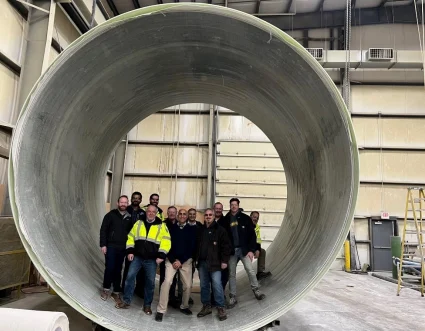
Some repairs have geometric anomalies, non-linear materials or loads, or a host pipe whose remaining strength should count. For these, QuakeWrap® can model the QuakeWrap® system with finite element analysis (FEA) to show stresses, strains and deformations, including how a host pipe and an FRP liner act together. One example is the FEA model of a 16-ft diameter StifPipe®.
Our team has also used non-destructive testing on concrete columns in a nuclear power plant cooling tower and on StifPipe® samples. For pipelines, condition data comes from man-entry inspection of large pipes, external inspection where the pipe is accessible and ultrasonic testing on concrete.
That analysis and data support your engineer's evaluation. The engineer of record decides whether a pipe can stay as is, needs a semi-structural liner that shares load with the host pipe, or needs a fully structural liner that carries the loads on its own. [Confirm with QuakeWrap: the current scope of FEA and inspection support for pipes, and how it is quoted]
- FEA for non-standard geometry and loads
- Non-destructive testing data
- Pipeline condition data to inform semi- or fully structural lining
DESIGN BASICS
How FRP Adds Capacity
A quick reference on how bonded FRP works in each mode. Your engineer designs to the governing code and the QuakeWrap® Design Manual.
-
Flexural strength
FRP bonded to the tension face carries tension alongside the existing steel. Moment capacity counts both the steel and the FRP.
-
Shear strength
FRP on the sides of a beam resists diagonal tension. Design guides limit FRP strain in shear to keep cracks tight and aggregate interlock in place.
-
Axial strength
FRP is not counted for direct compression. Wrapping a column confines the concrete, which raises both its strength and its failure strain.
-
Deflection
FRP reduces deflection under service loads. Tests, including at the University of Arizona, measured stiffness gains above transformed-section estimates.
-
Ductility
Confinement greatly improves column ductility. In beams, added strength can reduce ductility, so design should make the steel yield before failure.
-
Corrosion
Fully encasing a member in FRP cuts off the oxygen that drives corrosion, while the FRP replaces strength lost with corroded steel.
Who designs and seals the repair?
Your engineer of record. QuakeWrap® recommends the system and provides specifications, sample design details, data sheets, test reports and design guidance. Under IAPMO UES ER-828, plans, specifications and calculations are prepared by a registered design professional where the jurisdiction requires it.
Can we use the typical details as drawings?
Not as issued. The sample details are marked Not for Construction and leave the Designed and Approved By block blank. They show typical layouts, layers, spacers and terminations for your engineer to adapt to the project.
What design basis applies to QuakeWrap® FRP?
For concrete strengthening under IAPMO UES ER-828, design follows IBC Chapter 19 (ACI 318), IBC Section 1605 load combinations and the QuakeWrap Design Manual, Version 1.0_1. The FRP is not relied on to resist compression, and special inspection follows IBC Sections 1704 and 1705, AC178 and ACI 440.2.
Can QuakeWrap analyze an unusual structure?
Yes. For non-standard geometry, materials or loads, our team can run finite element analysis of the QuakeWrap® system to support your engineer's design. [Confirm with QuakeWrap: what this analysis includes and whether it carries a separate fee]
Do you train installers?
Yes. QuakeWrap® has run hands-on certification classes in Tucson for wet layup and pipe repair, and for PileMedic® and SPiRe®+, and has trained DOT crews on some projects. We also train crews on site: in August 2026 a QuakeWrap® instructor trained the crew for a PileMedic® timber pile repair at Prudhoe Bay, Alaska, from pile preparation to a cold-weather cure test and a demonstration pile. [Confirm with QuakeWrap: dates of the next class. The last published schedule was November 7 to 9, 2022]
How fast can we get a specification package?
Standard guide specifications and sample details can be downloaded today from the Specifications page. Project-specific support depends on the structure. [Confirm with QuakeWrap: typical turnaround for project-specific support]
DESIGN SUPPORT QUESTIONS
Design Support Questions
 Prof. Mo Ehsani, P.E.Founder, QuakeWrap®
Working on a specification or an unusual repair? Send your question to Prof. Ehsani and the QuakeWrap engineering team.
ASK A QUESTIONQuakeWrap® Products We Support
Specifying an FRP Repair?
Tell us about the structure. Our team will recommend the right QuakeWrap® system and provide specifications for your engineer.