
IN DEVELOPMENT · PIPEMEDIC® R&D
SuperLaminate™: No-Dig Point Repair for Pressure Pipes
A carbon and glass FRP laminate, wrapped on an inflatable packer and cured against the pipe wall from inside. For water, sewer, oil and gas pipes, with no excavation.
- Fits through access ports as small as 6 in.
- Typical installation under 4 hours
- Type A and Type B repairs per ASME PCC-2
In development SuperLaminate™ is a research and development system and is not currently available for purchase. For pipe repair today, see PipeMedic®.

WHAT IT IS
A Factory-Made Laminate That Becomes a New Pipe Inside the Old One
SuperLaminate™ is a carbon and glass fiber reinforced polymer (FRP) segmental lining system developed by Prof. Mo Ehsani. It is made mainly of carbon FRP, with a tensile modulus of elasticity up to 20 × 10⁶ psi, so it is very strong for its weight and easy to handle.
The laminate is made in QuakeWrap's plant, where layers of carbon or glass fabric are saturated with resin and passed through equipment that applies uniform heat and pressure, forming a thin, solid sheet. Moving most of the work from the field to the plant saves time on site, and the laminate's strength can be tested before it is installed.
Its strength and stiffness let it span gaps where corrosion has eaten through the host pipe. A precured laminate option is available to span any gap. It repairs steel, cast iron, corrugated metal, clay, brick, concrete, PCCP and wood pipes and culverts, and steel and concrete storage tanks.
- Rolls up to 60 in. (1.5 m) wide, typically 300 ft (90 m) long
- Inserted through access ports as small as 6 in. (150 mm)
- Applied internally or externally
- Can be installed without interrupting service
INTERNAL INSTALLATION
How SuperLaminate™ Is Installed From Inside the Pipe
Basic steps are below. Refer to the technical specification for details.
-
Stop leaks
Stop any active leaks by chemical grout injection.
-
Saturate and wrap
Saturate the laminate layers with high-strength epoxy, wrap them on the inflatable packer and tie them in place with thin ropes.
-
Deploy
Move the packer to the repair location. For oil and gas lines, an automated guide vehicle (AGV) can carry it through bends and slopes.
-
Inflate and cure
Inflate the packer to 15 to 20 psi and let the system cure for eight hours, or less with heat.
-
Return to service
Deflate and remove the packer. The laminate stays as a permanent structural liner.
EXTERNAL INSTALLATION
The Same Laminate Wraps the Outside of a Pipe
Where the outside of the pipe can be reached, SuperLaminate™ layers are bonded to the exterior with the wet layup method. Leaking pipes are sealed first, which makes a Type B repair under ASME PCC-2.
- Stop leaks with a hydrophobic sealant (Type B repairs)
- Remove sharp protrusions and other irregularities
- Clean off debris, sediment, dust, roots, oil and grease
- Smooth or abrade the surface for bond, then apply a primer and epoxy tack coat
- Apply resin-saturated SuperLaminate™ layers per the design
- Finish with a UV-resistant top coat where needed

SuperLaminate™ at a Glance
- MATERIAL
- Carbon and glass FRP laminate, mainly carbon
- TENSILE MODULUS
- Up to 20 × 10⁶ psi (carbon FRP)
- ROLLS
- Up to 60 in. (1.5 m) wide, typically 300 ft (90 m)
- ACCESS
- Ports as small as 6 in. (150 mm)
- PACKER PRESSURE
- 15 to 20 psi
- CURE
- Heat or ambient; eight hours or less in the inflated position
- REPAIR TYPES
- Type A (non-leaking) and Type B (leaking) per ASME PCC-2 Part 4
- STANDARDS
- Manufactured to NSF-61, ICC and IAPMO R&T NSF-372, per QuakeWrap® [Confirm with QuakeWrap: supply the certificate that names SuperLaminate™. IAPMO R&T N-11990 names only the wet layup system and StifPipe™, and no QuakeWrap NSF/ANSI 372 or ICC-ES listing was found]
- SERVICE LIFE
- 50+ years expected
OIL & GAS
Repairing Steel Transmission Lines From the Inside
Most oil and gas transmission pipe is repaired by digging around the damage and clamping or wrapping the outside. QuakeWrap® extended SuperLaminate™ to steel transmission pipelines through the U.S. DOT Small Business Innovation Research (SBIR) program, with the Pipeline and Hazardous Materials Safety Administration (PHMSA).
The repair goes in from existing launch stations and access points, the ones used for cleaning and inspection. An automated guide vehicle carries the laminate through bends and slopes to the damaged area, where it is expanded and cured in place, much like a stent.
Phase I, Internal Repair of Steel Transmission Pipelines, was awarded $150,000 for fiscal 2020. After the Phase I proof of concept, Phase II was awarded $1,000,000 in March 2022, and USDOT PHMSA later featured the project as a successful SBIR initiative.
- No trenching at river crossings, highways or urban sites
- Installed from existing access points
- Travels through bends and slopes inside the pipe
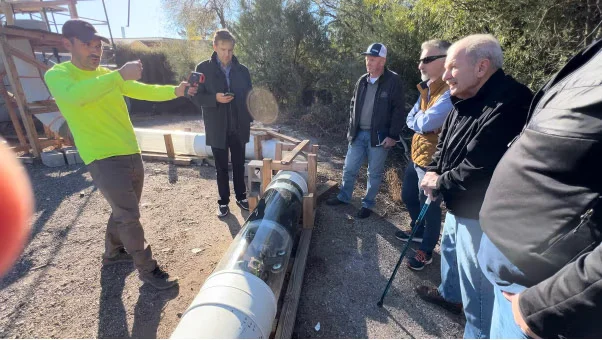
What SuperLaminate™ Is Designed to Do
-
No excavation
Installed into buried pipe with an inflatable packer.
-
Designed to any pressure
Layers and fiber orientation set for the pipe.
-
Fast
A typical installation takes less than 4 hours.
-
Service can stay on
Can be applied without interrupting service.
-
Any host pipe shape
Accommodates essentially any host pipe shape.
-
Ultra-high strength
Carbon and glass FRP layers, with few layers needed.
-
Corrosion resistant
Excellent resistance to many chemicals.
-
Quality checked first
Made in the plant, so strength is tested before install.
APPLICATIONS
Where SuperLaminate™ Is Designed to Be Used
-
Water systems
Drinking water pipelines and sewer force mains.
-
Oil and gas pipelines
Transmission lines, leak and corrosion repair, hard-to-reach segments.
-
Industrial facilities
Chemical and process piping, including hot process water.
-
Storage structures
Steel and concrete tanks for water, oil and chemicals.
-
Well casings
Deep well casing repair at a large solution mine.
-
Gas mains with fittings
Spanning drip pots and abandoned tees so CIP liners can pass.
TESTS
GTI Hydrostatic Tests on PipeMedic® Laminates for Gas Mains
For PSE&G, the Gas Technology Institute (GTI Project 21068) tested PipeMedic® laminates spanning a 24-in. free gap in steel pipe, lined with a cured-in-place liner. Pressure rose in 50 psig steps every 2 hours to 250 psig. No section leaked, meeting the ASTM F2207 requirement of at least twice the MAOP for one hour.
| Steel pipe | Laminate | Test pressure | Result |
|---|---|---|---|
| 16 in. | Carbon FRP, 3 layers (PC26.16) | 250 psig | No leakage; hoop stress under 25% of tensile strength |
| 12 in. | Glass FRP, 2 layers (PG16.15) | 250 psig | No leakage; hoop stress about 46% of tensile strength |
| 6 in. | Glass FRP | 250 psig | No leakage |
Four times the operating pressure of a 60 psig gas main
Ask for the full GTI report and the specifications for your engineer.
PROVEN RESULTS
SuperLaminate™ Projects
PSE&G has used the first, precured version of SuperLaminate™ in many gas distribution pipe repairs, reported in 2020 as eight years without significant issues. QuakeWrap® has also completed deep well casing repairs at a large solution mine with SuperLaminate™.
-
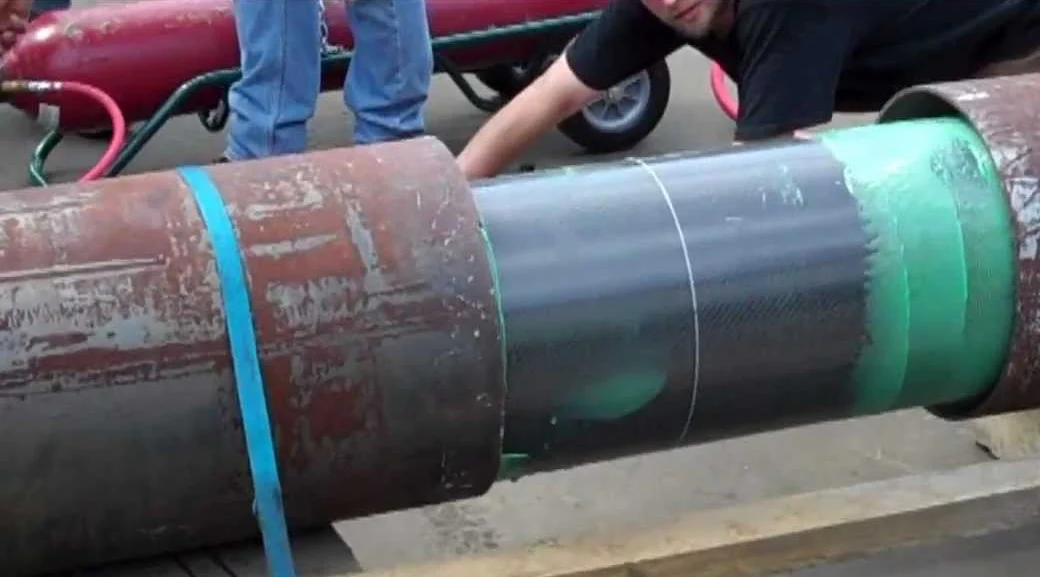
16-in. Cast Iron Gas Main, Paterson, N.J.
For PSE&G, a robot cut out an old drip pot standpipe and set a PipeMedic® carbon laminate across the 24-in. gap, so the whole 700-ft main could be lined. Trenchless Technology's 2011 Project of the Year.
Read the article -

36-in. Cast Iron Gas Main, South Orange, N.J.
A four-layer prefabricated PipeMedic® patch reinforced a 4-in. tap so the cured-in-place liner could bridge it on 2,000 ft of PSE&G feeder main. Trenchless Technology's 2018 Project of the Year.
Read the article -
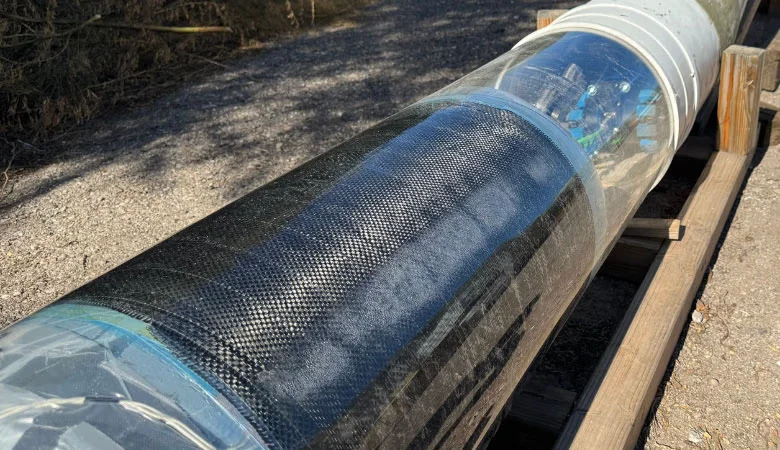
Internal Repair of Steel Transmission Pipelines
A guide vehicle carries the packer from an existing pigging access point through 90-degree bends to the repair. Tests showed full capacity restored in pipes 12 in. and larger from a single entry point.
Watch the video


Have a pressure pipe that needs a point repair?
Send us the pipe material, diameter, pressure and access points. Our team will recommend the right QuakeWrap® system and provide specifications for your engineer.
SuperLaminate™ FAQs
Can I buy SuperLaminate™ today?
Not yet. SuperLaminate™ is a research and development system and is not currently available for purchase. For pipe repair today, our engineers can recommend a PipeMedic® system.
What is SuperLaminate™?
A carbon and glass FRP laminate made in QuakeWrap's plant and installed with an inflatable packer as a segmental pipe lining. It is used for point repairs of pressure and gravity pipes without excavation.
What pipes can SuperLaminate™ repair?
Pipes carrying water, sewer, storm water, oil, gas and other chemicals, in steel, cast iron, corrugated metal, clay, brick, concrete, PCCP or wood. Steel and concrete storage tanks can also be repaired.
How small an access point does it need?
Rolled SuperLaminate™ can be inserted into pipes from access ports as small as 6 in. (150 mm) in diameter.
How long does a repair take?
A typical installation is completed in less than 4 hours. The packer stays inflated while the system cures, eight hours or less if heat cured. Overall repair time can drop by as much as 80%.
Can it repair a leaking pipe?
Yes. Leaks are stopped first, by chemical grout injection inside the pipe or a hydrophobic sealant outside. That is a Type B repair under ASME PCC-2.
Is it approved for drinking water?
SuperLaminate™ is manufactured to NSF-61, ICC and IAPMO R&T NSF-372 for potable water, and the water main version uses NSF-61 certified resin. [Confirm with QuakeWrap: supply the certificate that names SuperLaminate™. IAPMO R&T N-11990 names only the wet layup system and StifPipe™, and no QuakeWrap NSF/ANSI 372 or ICC-ES listing was found.]
Related Pipe Repair Systems and Applications
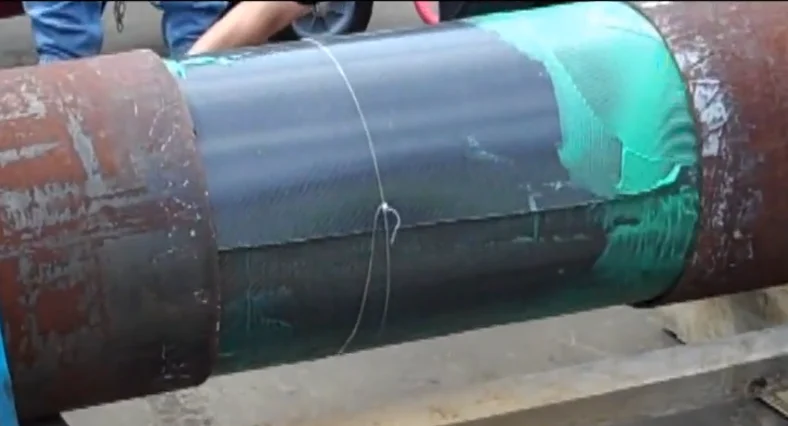
Interested in SuperLaminate™?
SuperLaminate™ is still in development. Tell us about your pipeline and our engineers will talk through research partnerships or the PipeMedic® systems available today.