
PILES · SELECTION GUIDE
Beach House Piling Types: Wood, Concrete, Steel and More
Most beach houses stand on preservative-treated wood piles, the type FEMA says coastal builders typically choose. Concrete piles carry heavier loads and come in longer lengths, while steel is rarely used for homes because salt air and water corrode it. Below: how each type compares, how deep piles go, how engineers choose, and the signs your piles need attention. Compare the types.
Key takeaways
- Treated wood is the default: FEMA says coastal builders typically choose preservative-treated wood piles.
- Concrete for bigger loads: longer lengths and higher strength, but rebar corrodes once salt water gets in.
- Steel is rare for homes: FEMA cites corrosion, worst within about 3,000 ft of the ocean.
- Depth is engineered: in FEMA’s example, 10 ft of embedment failed almost every time; 15 to 20 ft with 10 to 12 in. piles worked.
- Damage can be repaired: sloping floors and soft spots at the waterline mean it is time to call an engineer.
What types of pilings are used for beach houses?
Beach houses and condos are usually built on treated wood, concrete or steel piles, driven or jetted into the ground or set in drilled holes. According to FEMA’s Home Builder’s Guide to Coastal Construction, contractors in coastal areas typically pick preservative-treated wood. Concrete is chosen when the design needs more capacity or longer piles. Steel is rarely used for homes because of corrosion.
Two other options come up on some sites. Composite piles combine materials to resist corrosion. Aggregate piers, such as vibro stone columns and rammed aggregate piers, are a ground improvement method: they firm up soft soil under a foundation instead of holding a house up in the air.
| Piling type | Strengths | Watch for | Typical use |
|---|---|---|---|
| Treated wood (timber) | Low cost, easy to cut and adjust in the field, works underwater | Rot where the pile cycles wet and dry, marine borers, termites | Most elevated homes, docks and piers |
| Concrete (precast or reinforced) | Higher strength, longer lengths, durable in coastal exposure when properly designed | Cracks, spalling and rust stains once salt water reaches the rebar | Heavier or taller buildings, condos |
| Steel (pipe or H-pile) | High load capacity, adapts to many soil conditions | Corrosion, especially near salt water; needs coatings | Commercial and marine structures, rarely homes |
| Composite | Combines materials to resist corrosion with less weight | Performance depends on the materials combined | Marine sites where corrosion drives the choice |
| Aggregate piers | Stiffen soft or loose soil | Ground improvement only, not exposed posts | Soft soil under a foundation |
Sources: FEMA’s Home Builder’s Guide to Coastal Construction, Fact Sheet 3.2 (December 2010), and the 2024 version of this guide. Your engineer and local code make the final call.
Wood pilings: the most common choice for beach houses
Treated timber is the default for elevated coastal homes because it is affordable, easy to handle and simple to cut to height on site. In North America, Southern Pine and Douglas Fir make up about 90% of timber pile use, according to a 2019 Pile Buck review of timber piles. Round timber piles are specified to ASTM D25, which sets straightness and minimum tip and butt sizes.
Coastal piles must be pressure treated. The American Wood Protection Association (AWPA) lists foundation piles on land or in fresh water under Use Category UC4C and saltwater piles under UC5A, UC5B or UC5C, depending on the region. Common preservatives are creosote, CCA and ACZA.
| Exposure | AWPA use category | Why it matters |
|---|---|---|
| Foundation piles on land or in fresh water | UC4C | Ground contact and fresh water decay hazard |
| Piles in salt or brackish water | UC5A, UC5B or UC5C | Adds protection against marine borers, by region |
Source: Pile Buck, Vol. 35 No. 4, 2019. Ask your supplier for the treatment tag on every pile.
Treatment usually forms a protective shell around the outside of the pile rather than soaking all the way through. Every cut or drilled hole breaks that shell. FEMA’s guide says to brush preservative onto field cuts and holes until no more is drawn into the wood, and AWPA Standard M4 covers field treatment.
Where wood piles rot
Decay fungi need oxygen and a wood moisture content of about 22% or more. Wood that stays fully underwater gets too little oxygen, so it does not decay. That is why rot shows up in the zone that keeps getting wet and drying out, at the waterline or ground line, and why that zone should be inspected first and most often. Fungi cause over 82% of timber pile and bridge degradation, per Pile Buck.
Already seeing soft spots or cracks?
Tell us the pile type, size and condition. Our team will recommend the right QuakeWrap® repair system and give your engineer the specifications.
Concrete pilings: strength and long lengths
Concrete piles are precast or cast in place with steel reinforcement, and they are usually driven. FEMA notes they come in longer lengths and have higher strength than wood, which suits taller beach houses and condo buildings. Properly designed and detailed, they hold up well in coastal exposure.
Their weak point is the steel inside. Once salt water works through cracks and reaches the rebar, the rebar rusts and expands, which cracks and spalls the concrete around it. Rust stains and cracks running along the pile are the early warning. See timber vs. concrete piles for a side-by-side.
Steel pilings: high capacity, high upkeep near salt water
Steel pipe and H-piles carry the highest loads and can be driven through difficult soils, which is why ports and docks use them. For homes, FEMA says steel piles are rarely used because of potential corrosion problems. FEMA also notes that metal corrosion is most pronounced within about 3,000 ft of the ocean.
Where steel is used, it needs protective coatings, and in salt water sometimes cathodic protection, to control corrosion. Section loss is the main thing to inspect for. Our guide to steel pipe pile repair covers how corroded steel piles are restored.
Composite piles and aggregate piers
Composite piles combine materials, for example concrete and steel, to resist corrosion with less weight and more design flexibility. They are most common in marine settings where corrosion drives the choice.
Aggregate piers, such as vibro stone columns and rammed aggregate piers, are columns of compacted stone that stiffen soft or loose soil. They improve the ground under a foundation. They are not the exposed posts that hold an elevated beach house above flood water.
How deep do beach house pilings need to be?
There is no single depth. The foundation engineer sets pile size and length from the building code (IBC Section 1810 on deep foundations), the required bearing and penetration, expected erosion and scour, the design flood elevation and an allowance for cutting the pile to height, according to FEMA. FEMA calls the goal a “deeply embedded” pile: one that stays in the ground deep enough to survive storm scour and still carry all the design loads.
FEMA’s guide includes an example that shows why depth and size go together. For a two-story house on timber piles in medium dense sand, set back from the shoreline, it checked three embedment depths and three pile sizes:
| Embedment before erosion and scour | 8 in. pile | 10 in. pile | 12 in. pile |
|---|---|---|---|
| 10 ft | Fails (bending and embedment) | Fails (embedment) | Fails (embedment) |
| 15 ft | Fails (bending) | Works | Works |
| 20 ft | Fails (bending) | Works | Works |
Source: FEMA’s Home Builder’s Guide to Coastal Construction, Fact Sheet 3.2, Table 1 (December 2010), the case with erosion = 1 and scour of 2.5 pile diameters. With deeper scour (4 diameters), every 15 ft case failed and only the 12 in. pile worked at 20 ft. An example only: your engineer runs the numbers for your site.
Two takeaways for owners. First, 10 ft of embedment was not enough in almost every case. Second, a bigger pile helps as much as a deeper one: FEMA’s minimum is an 8 in. tip for round piles, and it says moving to 12 in. substantially improves foundation performance.
How to choose the right piling for your beach house or condo
The choice starts with the site, not the material. Your engineer will work through these steps, and knowing them helps you ask the right questions.
- Find your flood zoneFEMA requires deeply embedded pile or column foundations in V Zones and recommends them in Coastal A Zones. Slabs and crawlspaces are prohibited in V Zones.
- Get the soil testedA geotechnical report shows how sandy or loose the soil is and what bearing the piles can reach.
- Account for erosion and scourErosion lowers the whole beach; scour digs out soil around each pile. Both reduce the embedded length in a storm.
- Pick the installation methodPiles can be driven, jetted or set in augered holes. A common method is to jet a pile to a few feet short of depth, then drive it the rest of the way.
- Choose material and sizeWeigh capacity, corrosion and decay resistance and cost: treated wood, concrete, steel or composite.
- Engineer the connectionsPile-to-beam connections should be designed by an engineer and built with corrosion-resistant hardware.
Signs your beach house pilings are damaged
Catching damage early keeps a repair small. Watch for these signs inside the house and under it, and have a structural engineer look at the piles if you see them.
- Sloping floors. Often the first sign that a pile below is sinking or losing section.
- Sticking doors and windows. Foundation movement racks the frames.
- Cracks in drywall or the foundation, especially above windows, and gaps showing under carpets.
- Walls and fixtures separating. Cabinets pulling away from walls, or exterior walls leaning or bowing.
- Rot in wood piles. Soft spots and discoloration, mostly where the pile cycles wet and dry.
- Corrosion on steel piles. Rust and section loss that reduce capacity.
- Damaged connections. Loose or corroded brackets and bolts at the pile tops.
- More pests. More termites or carpenter ants can point to decay and cracks. FEMA notes termite attack is most frequent along the southeastern Atlantic and Gulf coasts, California and Hawaii.
Can damaged pilings be repaired instead of replaced?
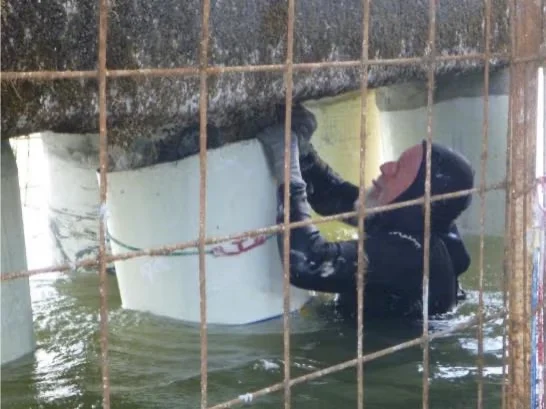
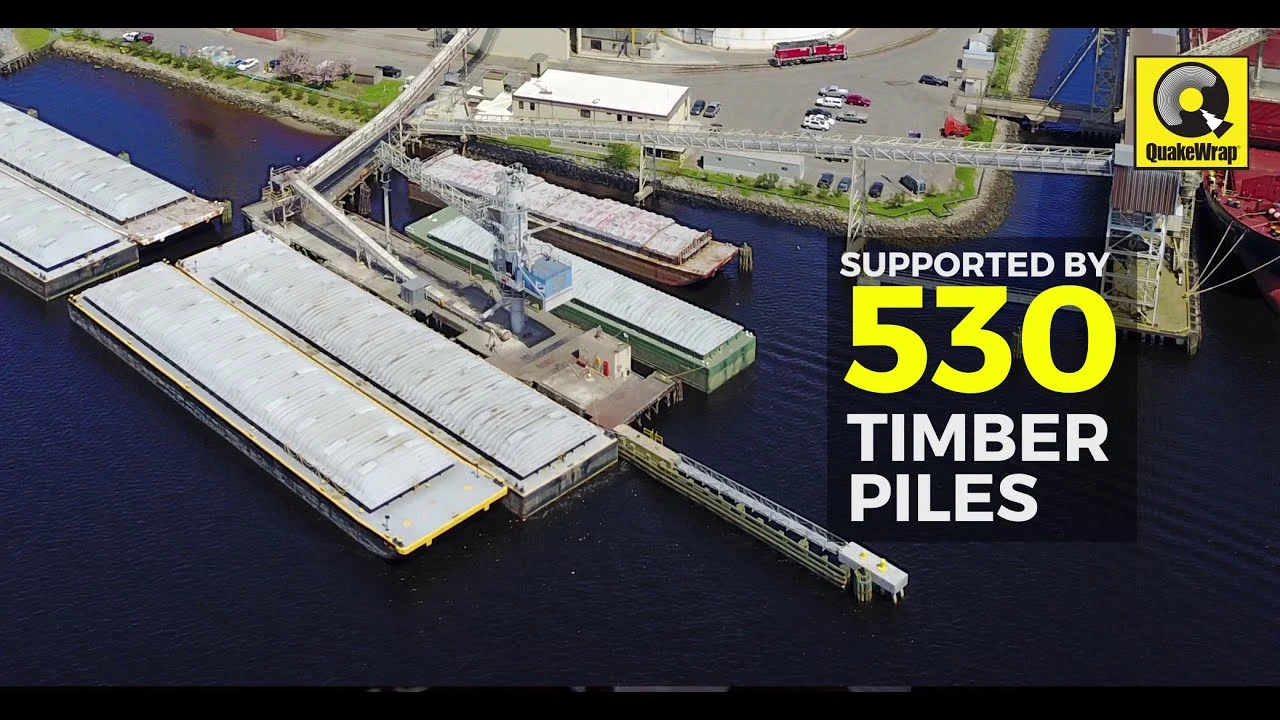
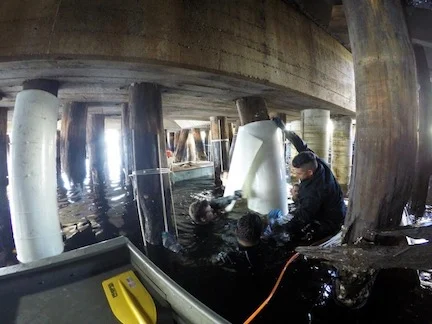
Often, yes. Driving new piles under an existing house means shoring the structure and bringing in heavy equipment. A structural jacket restores the damaged length in place. PileMedic® jackets are wrapped from a roll of FRP laminate around the pile, then filled with grout. They repair timber, steel and concrete piles, even underwater without cofferdams, and reach full pile capacity within 24 hours. See how PileMedic® pile jackets are built.
The approach has been tested on wood. In a study for the Nebraska Department of Roads, five damaged timber piles repaired with PileMedic® failed at 5.3 to 9.9 times their design capacity. For basic repairs on docks and small structures, Form-A-Tube® PVC forms let owners encase a pile in concrete themselves, though they do not add structural FRP strength.
Plays from YouTube
For step-by-step methods for each pile type, read our beach house piling repair guide. To price a repair, try the piling repair cost calculator.
Beach house piling FAQs
What type of foundation is best for a beachfront home?
A deeply embedded pile foundation. FEMA requires pile or column foundations in V Zones and recommends them in Coastal A Zones, because they raise the house above flood water and stay put when storms scour the sand.
How deep do pilings need to be for a beach house?
Your engineer sets the depth from soil, erosion, scour and code. In a FEMA example for a two-story house in medium dense sand, 10 ft of embedment failed in nearly every case, while 15 to 20 ft worked with 10 to 12 in. piles under moderate scour.
What wood is used for beach house pilings?
Mostly Southern Pine and Douglas Fir, which make up about 90% of timber pile use. Saltwater piles are pressure treated to AWPA Use Category UC5A, UC5B or UC5C, and round piles are specified to ASTM D25.
Do wood pilings rot underwater?
Not when fully submerged. Decay fungi need oxygen and about 22% moisture, and wood that stays underwater gets too little oxygen. Rot is worst at the waterline or ground line, where the pile cycles wet and dry.
Are steel pilings good for beach houses?
They carry high loads, but FEMA says steel piles are rarely used for homes because of corrosion, which is most pronounced within about 3,000 ft of the ocean. Steel piles near salt water need coatings and regular inspection.
How long do beach house pilings last?
It depends on the material, the treatment, the exposure and how quickly damage is caught. For wood, the wet and dry zone, marine borers and untreated field cuts shorten life the most, so regular inspection matters more than any rule of thumb.
Can damaged pilings be repaired?
Often, yes. Structural FRP jackets such as PileMedic® restore timber, steel and concrete piles in place, even underwater, and reach full capacity within 24 hours. Your engineer decides whether a pile can be saved.
Sources
- FEMA, Home Builder’s Guide to Coastal Construction, FEMA P-499, Technical Fact Sheets 1.7 (Coastal Building Materials), 3.1 (Foundations in Coastal Areas), 3.2 (Pile Design and Installation) and 9.1 (Repairs, Remodeling, Additions and Retrofitting), December 2010.
- Tingley, Keller and La Spina, “Timber Pile Bridges,” Pile Buck Magazine, Vol. 35 No. 4, July/August 2019 (see Technical Papers).
- Florida International University for the Nebraska Department of Roads, Assessment and Evaluation of Timber Piles Used in Nebraska for Retrofit and Rating, draft final report, April 2014 (see Test Results).
- QuakeWrap, Inc., Perdue AgriBusiness timber pile repair project sheet.
- QuakeWrap, Inc., Types of Piling for Beach Houses and Condos, October 2024 (original version of this guide).
Have Piles That Need Attention?
Tell us about the piles under your home or building. Our team will recommend the right QuakeWrap® system and give your engineer the specifications.