
PILES · REPAIR GUIDE
Beach House Piling Repair: Signs, Methods and Costs
Damaged piles under a beach house or condo can often be repaired in place instead of replaced: the damaged length is cleaned, wrapped in a jacket and filled with grout, which restores the section and seals it from water. The right method depends on the pile material, how bad the damage is and whether the work is in water. Start with the warning signs.
Key takeaways
- Repair in place: most damaged piles are jacketed and grouted, not replaced.
- Fix piles before cracks: sealing a slab crack will not hold if the pile below keeps moving.
- Method follows material: jackets for wood, FRP or concrete jackets for concrete, encapsulation and load transfer for steel.
- DIY has limits: Form-A-Tube® suits basic dock repairs; piles under a house need an engineer.
- Check the 50% rule: large flood-zone repairs can trigger current code requirements.
Can beach house pilings be repaired?
Yes, in most cases where the pile still has sound material above and below the damage. A jacket is built around the damaged length and filled with grout or concrete. That replaces the lost section and shuts out the water and oxygen that caused the damage. Replacing a pile under an existing house is a much bigger job, because the structure usually has to be shored while a new pile is driven or drilled.
PileMedic® is the structural option: an FRP laminate jacket wrapped on the pile and filled with grout. Form-A-Tube® is the simpler option for basic repairs, a PVC form owners can install themselves. Your structural engineer decides which one a pile needs.
Signs your beach house piles need repair
Coastal piles take constant wear from salt water, waves and weather. These are the early warnings, inside the house and under it.
- Cracks in the slab or footings. They often trace back to deteriorating piles below.
- Sloping floors. Tilted furniture, doors and windows that stick, gaps between the floor and baseboards, and dips or humps in the floor.
- Soft or discolored wood piles. Rot, mostly at the waterline or ground line where the pile cycles wet and dry.
- Cracks and rust stains on concrete piles. Water has reached the rebar, and spalling will follow.
- Rust and thinning on steel piles. Section loss reduces what the pile can carry.
- Loose or corroded connections at the pile tops, and more termites or carpenter ants than usual.
Who should inspect beach house pilings?
A structural engineer, ideally one with coastal or marine experience. The engineer assesses the damage and the load each pile carries, then specifies the repair. For a condo or HOA, that is usually the association’s engineer, working from a pile-by-pile survey.
For wood piles, a 2019 Pile Buck review of timber pile inspection lists the standard tools: a visual check for color changes, splits and crumbling wood; probing with an awl for soft spots; a pick test; a moisture meter, since decay starts above about 22% moisture; and sounding with a hammer, where a hollow sound means a pocket of decay. Steel piles are checked for section loss, often with ultrasonic thickness readings. Experience matters: the review notes that the inspector’s skill drives both the cost and the accuracy of the assessment.
Have an inspection report?
Send the pile count, types and findings. Our team will recommend the right QuakeWrap® system and give your engineer the specifications.
How timber piles are repaired
Wood piles are repaired with a jacket over the damaged zone, filled with grout or concrete. With PileMedic®, the patented jacket is assembled around the pile on site from a high-strength thin flat roll of laminate, so there is no seam to leak and no need to wait for shells made to each pile size. A typical sequence, which your engineer’s specification governs:
- Expose sound woodExcavate around the pile, including the seabed if needed, to expose at least 1 ft of sound pile below the damage.
- Clean the pileRemove debris, marine growth and loose wood so the grout bonds to sound material.
- Set spacers and rebarBand spacers around the pile every 2 to 3 ft to hold the jacket off it, and snap in non-metallic GFRP bars if the design calls for them.
- Wrap the jacketWrap the PileMedic® laminate twice around the spacers plus an 8 in. overlap, bonded with epoxy. Stacked jackets overlap by 4 in.
- Seal and groutEmbed the jacket 6 to 12 in. into the seabed or close it with a bottom seal, then pump grout into the gap, keeping the hose in the grout so it does not mix with water.
- Finish and maintainSlope the top so it sheds water, let the grout cure, inspect the repair and keep marine growth off it.
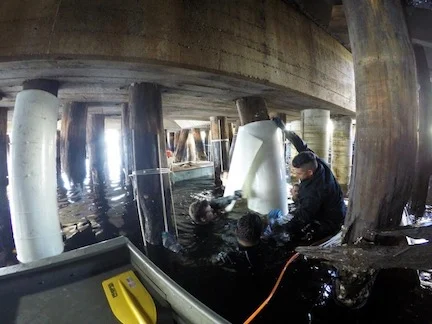
Field cuts matter too. If a wood pile is cut or drilled during the repair, FEMA’s coastal construction guide says to brush preservative onto the cut until no more is drawn in. For more methods, see timber pile repair methods.
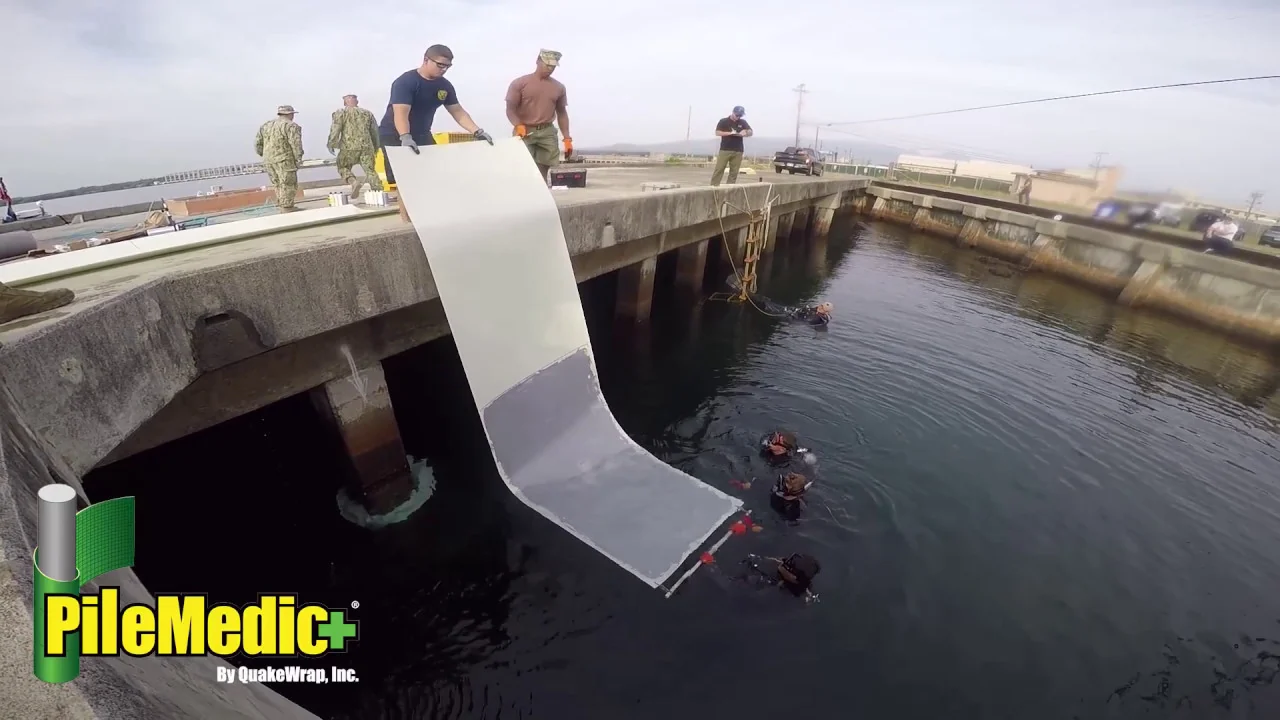
Plays from YouTube
How concrete piles are repaired
Concrete piles are repaired by removing the damaged concrete and encasing the pile, chosen by how much damage there is. Start with a visual inspection for cracks, spalling and rust, then have a structural engineer assess the damage and the load on each pile. If the piles are carrying the building, shore it before work begins.
| Damage | Common repair | What it does |
|---|---|---|
| Minor cracks | Carbon FRP wrap | Adds strength with little added weight |
| Extensive cracking or spalling | Pile jacket filled with grout | Restores section and seals the pile from water |
| Significant section loss | Concrete jacket | Encases the pile in new reinforced concrete |
After any repair: let the material cure fully, inspect it, and set up periodic inspections. Protective coatings help slow new corrosion.
A PileMedic® jacket on a concrete pile does more than cover it. Because the laminate wraps continuously around the pile, it confines the concrete, which raises its axial capacity. See how PileMedic® pile jackets work.
How steel piles are repaired
Corroded steel piles are repaired by encasing the damaged length so water and oxygen cannot reach the steel, and by transferring load past the section loss. The engineer starts by measuring how much steel is left, often with ultrasonic testing. Options include:
- Welding or epoxy injection for small cracks.
- Steel jacketing: a steel casing around the damaged area, filled with grout.
- Encapsulation: an FRP jacket filled with grout or resin, which seals out the water that drives corrosion.
- Weld-free load transfer: PileMedic® jackets paired with ShearWrap™ and ShearClamp™ devices that move load into the jacket without welding.
- Cathodic protection with sacrificial anodes or impressed current, to slow future corrosion.
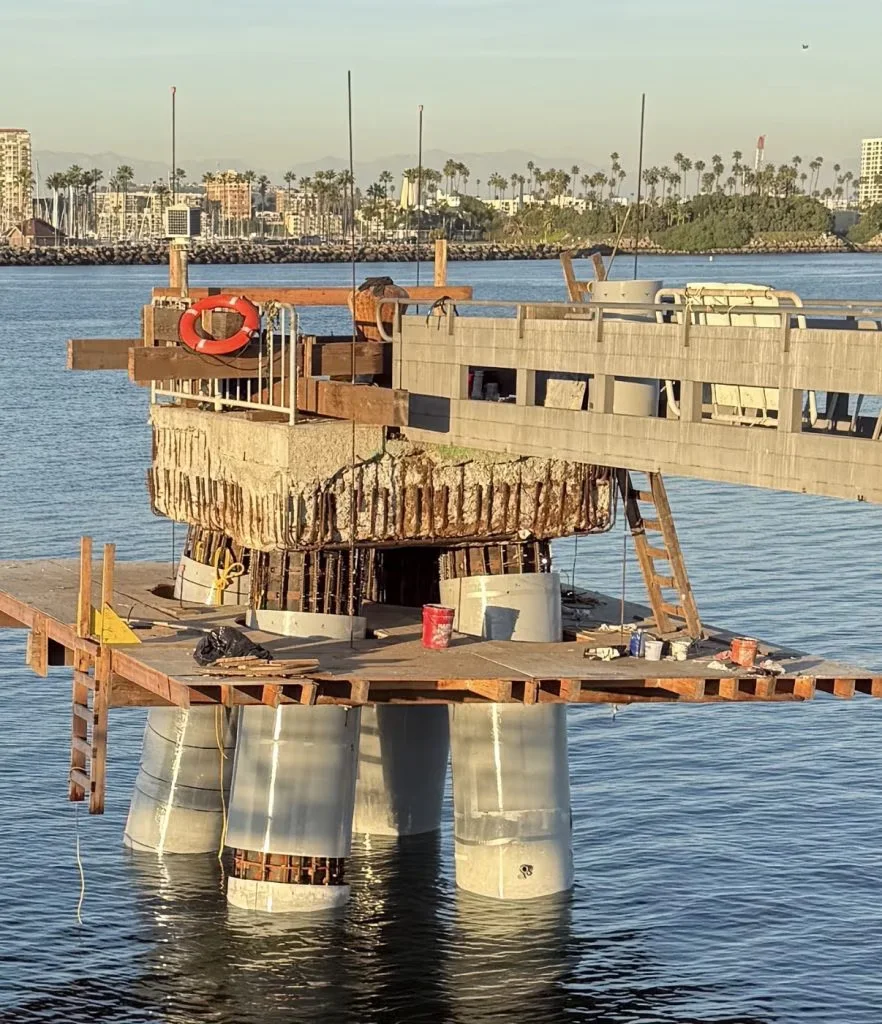
Can I repair my own dock or beach house piles?
For basic repairs, yes. Form-A-Tube® is made for contractors and do-it-yourself dock and marina owners. PVC strips snap together on site into a tube around the pile with no epoxy, bolts or hardware. With the ribbed face inward it stays on as a durable shell after the concrete is poured; with the smooth face inward it comes off and can be reused.
Know the limit. Form-A-Tube® protects and encases a pile but does not add as much strength as PileMedic®. If the piles hold up your house, have an engineer specify the repair.
How much does beach house piling repair cost?
It depends mostly on how many piles are damaged, how long the damaged section is, the pile size and how hard the piles are to reach. Minor surface repairs cost far less than restoring a pile’s structural capacity, and work in water costs more than work in the dry.
- Extent of damage: number of piles and the damaged length on each.
- Pile material and size: material scales with diameter and repair height; steel may need load transfer devices.
- Access and water depth: dry, tidal or submerged work changes the crew, equipment and need for divers.
- Labor and permits: local labor rates and coastal permit requirements.
For an approximate PileMedic® material cost per pile, use our piling repair cost calculator, or the PileMedic® cost estimator.
Does insurance cover beach house piling repair?
Sometimes, but read the policy before work starts. FEMA states that most homeowners insurance does not cover flood damage, and many standard policies exclude foundation problems caused by settling or poor construction. Check:
- Whether the policy names piling or foundation damage.
- Whether it covers hurricanes, floods and erosion, and through which policy.
- Whether it pays for repair or full replacement, and its exclusions and limits.
- For a condo, what the association maintains and what its master policy covers.
If a flood leaves a building substantially damaged, NFIP flood insurance policyholders in high-risk flood areas may receive up to $30,000 of Increased Cost of Compliance coverage to help meet current floodplain rules. FEMA says the community makes that determination when you apply for a building permit.
Do you need a permit to repair beach house pilings?
Usually, yes. Coastal piling repairs typically need a building permit, and work in or near water may need environmental permits as well. Check with your local building department before work starts, and see environmental permitting for marine repairs.
The advantage was that the broken pile could be repaired and reinstated up to the required bearing capacity and strength value, and no additional piles needed to be installed. This reduced cost and timing in repair method.
Beach house piling repair FAQs
Can beach house piles be repaired instead of replaced?
Often, yes. A jacket filled with grout or concrete restores the damaged section in place. PileMedic® repairs timber, steel and concrete piles, even underwater, and reaches full pile capacity within 24 hours.
How do I know if my pilings are bad?
Inside, look for sloping floors, sticking doors and new cracks. Under the house, look for soft or discolored wood at the waterline, cracks and rust stains on concrete, and rust or thinning on steel. A structural engineer should confirm.
Are permits required for piling repair in coastal areas?
Usually, yes, for local building and environmental rules. Check with your local building department before work starts.
Does homeowners insurance cover piling damage?
It depends on the cause and the policy. FEMA says most homeowners insurance does not cover flood damage, and many policies exclude settling. Flood policyholders with substantial flood damage may qualify for up to $30,000 of Increased Cost of Compliance coverage.
Can I repair my piles myself?
For basic repairs, homeowners and dock owners can install Form-A-Tube® PVC forms and fill them with concrete. Piles that hold up a house need an engineer’s specification, and PileMedic® jackets are installed by contractors.
Who designs the repair?
Your engineer of record. Our team will recommend the right QuakeWrap® system and provide product data sheets, specifications and sample design details for your engineer.
Sources
- FEMA, Home Builder’s Guide to Coastal Construction, FEMA P-499, Technical Fact Sheets 1.7 (Coastal Building Materials), 3.1 (Foundations in Coastal Areas), 3.2 (Pile Design and Installation) and 9.1 (Repairs, Remodeling, Additions and Retrofitting), December 2010.
- FEMA, Flood Insurance, accessed October 2026.
- FEMA, Increased Cost of Compliance Coverage, updated January 12, 2026.
- Tingley, Keller and La Spina, “Timber Pile Bridges,” Pile Buck Magazine, Vol. 35 No. 4, July/August 2019 (see Technical Papers).
- QuakeWrap, Inc., Perdue AgriBusiness timber pile repair project sheet.
- QuakeWrap, Inc., Beach House and Condo Piling Repair, October 2024 (original version of this guide).
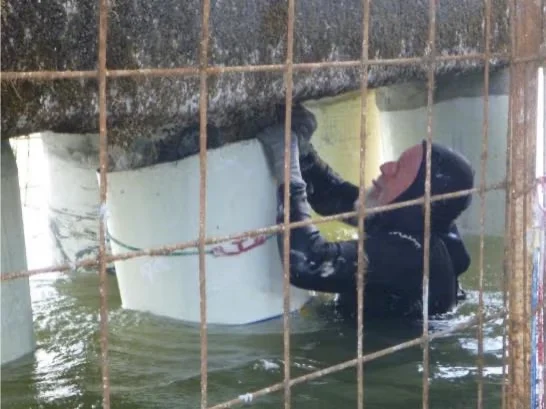
Have Beach House or Condo Piles That Need Repair?
Tell us about the piles and the site. Our team will recommend the right QuakeWrap® system and give your engineer the specifications.