
PILES · REPAIR GUIDE
Dock Piling Repair: Wraps, Sleeves and Jackets Compared
Most damaged dock pilings can be repaired in place, and the right fix depends on how much wood is gone. A plastic wrap keeps marine borers out but adds no strength. A grout-filled form replaces lost wood. An FRP jacket with bars inside restores the pile’s capacity. Match the fix to the damage.
Key takeaways
- Measure before you buy: the fix depends on how much of the pile’s section is left.
- Wraps protect, they do not repair: a PVC or polyethylene wrap stops borers but adds no strength.
- 10% to 50% section loss: encase the damaged length in a grout-filled form or jacket.
- Need the capacity back: an FRP jacket with GFRP bars and grout restores it in place, with the dock open.
- DIY has limits: owners can install Form-A-Tube® on basic repairs; structural piles need an engineer.
Can dock pilings be repaired without pulling them?
Yes, when the pile still has sound wood above and below the damage. The damaged length is cleaned, enclosed in a shell and filled, so the pile stays where it is and the deck stays on. Replacing a pile means removing or supporting the deck, cap and stringers above it and driving a new pile in a tight space. At one agricultural port dock, piles under the concrete cap could not be replaced with new driven piles at all, so every one was repaired in place.
Wrap, form or jacket: which fix fits the damage?
Start with how much of the pile is left. The U.S. military’s waterfront maintenance manual, UFC 4-150-07, lays out a simple ladder: wrap a pile that still has its full section, encase one that has lost 10% to 50% of it, and add fiber-reinforced strength when the pile has to carry more load than a wrap allows.
| What you find | Fix | What it does | Main tradeoff |
|---|---|---|---|
| Borer holes or early attack, pile still full size | Plastic barrier wrap (PVC or polyethylene) | Seals the pile so borers cannot get in or keep working | Adds no strength; a puncture over an untreated pile can let borers back in fast |
| About 10% to 50% of the section gone | Concrete encasement in a stay-in-place form, such as Form-A-Tube® | Concrete or grout replaces the lost wood and seals the pile | The form itself adds little strength; may cost more than replacing a few easy piles |
| Section loss on piles that carry real load, or piles you cannot reach to replace | PileMedic® FRP jacket with GFRP bars and grout | Restores axial and bending capacity in place | Costs more than a wrap; your engineer designs it |
| Pile detached or most of its section gone | PileMedic® jacket designed to carry all the load, or replacement | A new reinforced shell carries the load even where the old pile is gone | Replacement can be cheaper where the deck lifts off easily |
Based on techniques TR-3, TR-5 and TR-6 in UFC 4-150-07 and QuakeWrap project records. Your engineer of record makes the call for each pile.
What do plastic piling wraps actually do?
They keep marine borers out. UFC 4-150-07 calls PVC and polyethylene wrapping widely used for preventing or arresting borer attack, and more economical than concrete encasement, pile repair or replacement. It can go on new piles, on untreated piles, or on existing piles where borers have been found and the damage needs to stop.
The manual’s method: clean off anything sharp that could puncture the plastic, start the top wrap at least 1 ft above mean high water, overlap each lower piece on the one above it, and run the wrap below the mudline. Aluminum bands go around the top and bottom, and aluminum nails close the vertical seams. A thick 150 mil (3.8 mm) polyethylene wrap in the tidal zone also protects the pile from abrasion.
How do you know dock pilings are failing?
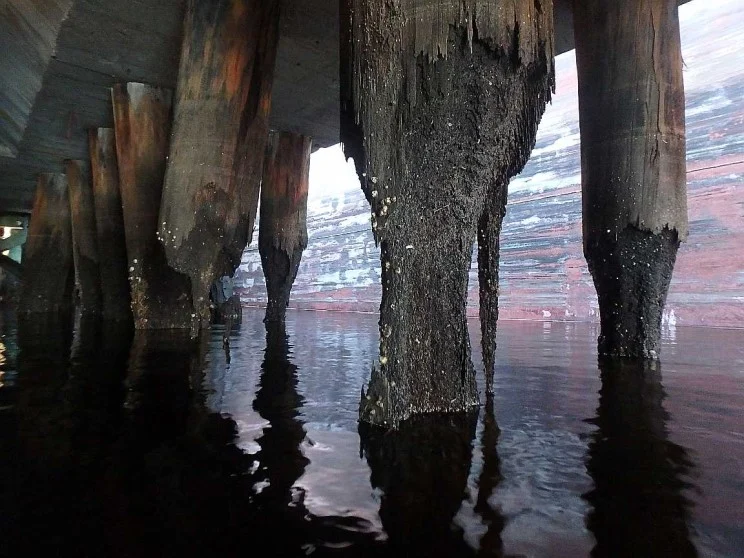
Look at the length between the mudline and the deck. Below the mudline, piles are generally in good condition; damage concentrates in the tidal and splash zone, where borers and rot do their work. Signs to look for:
- An hourglass shape at the waterline. Borers and rot thin the pile there first.
- Small round holes. Shipworms enter through holes only 0.5 to 3 mm wide, then tunnel inside while the outside looks sound.
- A rough, eaten surface in the tidal zone. Gribbles, crustaceans 3 to 6 mm long, burrow into the surface, and waves wash away the wood between burrows.
- Soft wood, or a hollow sound when struck. A pocket of decay or borer tunnels inside.
- A deck that sags or tilts, and loose or corroded connections at the pile tops.
Salty, slow water is the worst case: borer attack rises above roughly 15 parts per thousand salinity. A 2019 Pile Buck review lists the standard inspection tools for wood piles: a visual check, probing with an awl, a pick test, a moisture meter (decay starts above about 22% moisture) and sounding with a hammer. For more on how borers work, see advantages and disadvantages of timber piles.
Have an inspection report?
Send the pile count, sizes and findings. Our team will recommend the right QuakeWrap® system and give your engineer the specifications.
What is a piling sleeve or jacket?
A shell around the damaged length of the pile, filled with grout, concrete or resin. Sleeve and jacket mean the same thing on most docks. The difference that matters is how the shell is made. Conventional jackets are two half shells joined in the field: they are bulky, must be ordered to each pile size, add little strength, and their seams let moisture and oxygen back in.
A PileMedic® jacket is built on the pile from one flat roll of laminate, wrapped twice around plus an 8 in. overlap and bonded with epoxy, so there is no seam and no wait for shells made to size. QuakeWrap holds U.S. Patent 11,746,546 for this onsite-manufactured continuous structural sleeve. There are two ways to fill it, chosen by the damage:
- Snug shell with resin, for piles with cracks and borer tunnels that should stay close to their original size. The laminate goes on with a 1 to 2 mm gap, and low-viscosity resin flows into the gap, the cracks and the tunnels, bonding shell and pile together. The pile barely grows in size.
- Jacket with bars and grout, for real section loss. Spacers hold the jacket off the pile, non-metallic GFRP bars span the damaged length, and grout fills the space. The result is a new reinforced pile around the old one.
How a PileMedic® jacket goes on a dock pile
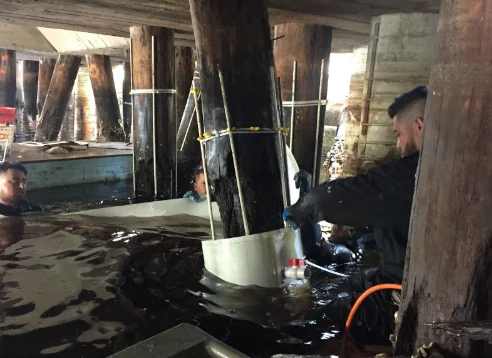
Jackets are wrapped near the waterline and slid down the pile, so a crew can often work from a skiff or barge with few or no divers, and no cofferdam. A typical sequence, which your engineer’s specification governs:
- Expose sound woodClear around the pile, into the seabed if needed, to expose at least 1 ft of sound pile below the damage.
- Clean the pileRemove marine growth, debris and loose wood so the fill bonds to sound material.
- Set spacers and barsBand spacers around the pile every 2 to 3 ft and snap in GFRP bars if the design calls for them.
- Wrap the jacketWrap the laminate twice around the spacers plus an 8 in. overlap, bonded with epoxy. Stacked jackets overlap by 4 in.
- Seal and fillEmbed the jacket 6 to 12 in. into the seabed or close it with a bottom seal, then pump grout from the bottom up, keeping the hose in the grout.
- Finish and inspectSlope the top to shed water, let the grout cure and inspect the repair. The pile reaches full capacity within 24 hours.
What QuakeWrap dock and marina repairs show
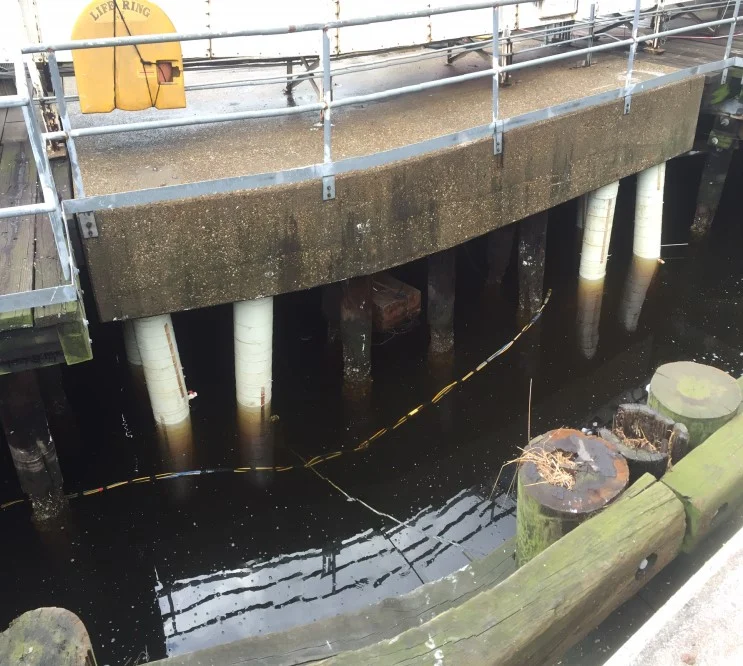
We compared QuakeWrap’s dock and marina pile repairs from our project sheets and case studies. Two patterns stand out: the docks stayed in use during the work, and repairs went ahead on piles that had lost half or more of their wood, the point where wrapping alone would not be enough.
| Project | Piles | Damage | Repair | Result |
|---|---|---|---|---|
| Perdue AgriBusiness dock, Chesapeake, Virginia | 500+ timber, 12 in. | Average 50% section loss; some detached | PileMedic® jackets, six #4 GFRP bars, underwater grout | Original axial and bending capacity; dock stayed open |
| Port O’Connor boat dock, Texas | 19 submerged timber | Some with more than 75% of their volume gone | PileMedic® PLG60.60 laminate jackets | Done in less than a week |
| Valvoline river dock, St. Louis, Missouri | 18 timber | Timber piles under a truss bridge at the dock | Glass laminate shells from 5 ft below grade to the cap, voids filled with resin | Installed from barges |
| Marina Casa de Campo, Dominican Republic | Piles and caps of six concrete fingers | Corroded concrete in seawater | Glass FRP wrapped underwater | Limited disruption to marina activities |
| Ancora Marina, Germany | 100+ steel pipe piles | Steel piles and the seawall | PileMedic® | Repaired at the largest marina on the Baltic Sea |
Compiled November 2026 from QuakeWrap project sheets and case studies.
The method has also been load tested. In full-scale tests for the Nebraska Department of Roads, five damaged timber piles repaired with FRP laminates carried 5.3 to 9.9 times their design load. See test results and approvals.
Can I repair my own dock pilings?
For basic repairs, yes. Form-A-Tube® is made for contractors and do-it-yourself dock and marina owners. PVC strips snap together into a tube around the pile with no epoxy, bolts or hardware, and the tube is filled with concrete or grout. Strips also bend into an oval tube around a group of piles.
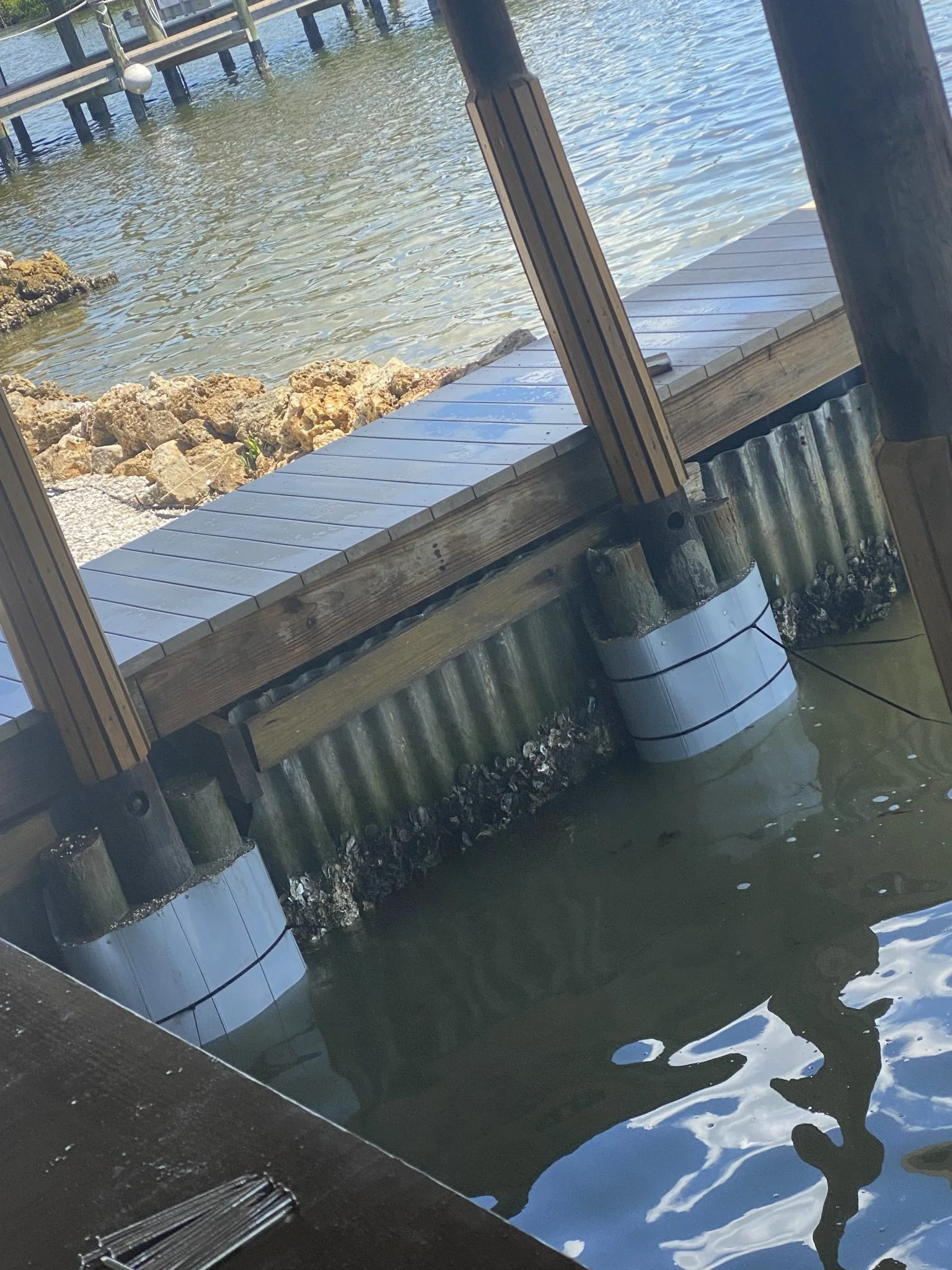
Know the limit. Form-A-Tube® encases and protects a pile but does not add structural FRP strength the way PileMedic® does. If the dock carries vehicles, equipment or a building, or the piles have lost much of their section, have an engineer specify the repair.
How much does it cost to repair a dock piling?
It depends on the fix, the pile size, the damaged length and how hard the piles are to reach. A wrap costs the least. The UFC manual notes that concrete encasement may cost more than replacing one or more piles, and that economics should decide. Access is the biggest swing: work from a skiff at low tide prices very differently from work that needs a dive team. For a PileMedic® jacket, estimate the materials for one pile below.
Dock Piling Repair Cost Estimator
Enter the jacket diameter and the length of pile to repair. The estimator returns an approximate cost for the PileMedic® jacket and epoxy, the spacers and banding, and the GFRP rebar, plus a total for one pile.
Materials only, and approximate. The jacket diameter is typically 4 to 6 in. (100 to 150 mm) larger than the pile. Assumes 6 spacers every 2 ft (600 mm) and 6 GFRP rebars. Grout, bottom seal and ShearWraps are not included, and neither are labor, diving, permits or freight. Your engineer’s design and a site visit set the final number.
Want a detailed breakdown for your piles?
GET AN FRP CONSULTATION- Number of piles and damaged length: material scales with both.
- Pile size and material: steel piles may need load transfer devices.
- Access and water depth: dry, tidal or submerged work changes the crew, equipment and need for divers.
- Permits: work in or near water usually needs them. See environmental permitting for marine repairs.
Dock piling repair FAQs
Can dock pilings be repaired instead of replaced?
Often, yes, when the pile has sound wood above and below the damage. The damaged length is enclosed in a jacket or form and filled with grout, concrete or resin, with the deck left in place.
Do plastic piling wraps make a pile stronger?
No. PVC and polyethylene wraps keep marine borers out and stop further damage, but they add no strength. A pile that has already lost wood needs encasement or a structural jacket.
What is the difference between a piling wrap and a piling jacket?
A wrap is a thin plastic barrier against borers. A jacket or sleeve is a shell around the damaged length, filled with grout, concrete or resin, that replaces lost wood. An FRP jacket with GFRP bars can also restore the pile’s capacity.
Can dock pilings be repaired underwater?
Yes. PileMedic® jackets are wrapped near the waterline and slid down the pile, and the grout is pumped in underwater. No cofferdam is needed, and often few or no divers.
How long does a dock piling repair take?
It depends on the number of piles and access. At a Texas boat dock, 19 submerged timber piles were repaired in less than a week, and a PileMedic® repair reaches full pile capacity within 24 hours.
Can I repair dock pilings myself?
For basic repairs, yes. Dock and marina owners can install Form-A-Tube® PVC forms and fill them with concrete. Piles that carry heavy loads or have lost much of their section need an engineer’s specification.
Who designs the repair?
Your engineer of record. Our team will recommend the right QuakeWrap® system and provide product data sheets, specifications and sample design details for your engineer.
Sources
- U.S. Army Corps of Engineers, Naval Facilities Engineering Command and Air Force Civil Engineer Support Agency, UFC 4-150-07, Maintenance and Operation: Maintenance of Waterfront Facilities, 19 June 2001, Change 1, 1 September 2012, repair techniques TR-3, TR-5 and TR-6.
- Tingley, Keller and La Spina, “Timber Pile Bridges,” Pile Buck Magazine, Vol. 35 No. 4, July/August 2019 (see Technical Papers).
- QuakeWrap, Inc., Perdue AgriBusiness timber pile repair project sheet.
- QuakeWrap, Inc., Repair of Deteriorated Submerged Timber Piles, Port O’Connor, Texas (project sheet).
- QuakeWrap, Inc., Repair of Timber Truss Bridge Substructure at Valvoline River Dock (project sheet).
- Ehsani, M., Repair, Replace or Encapsulate? A Practical Approach to Rehabilitating Concrete Marina Fingers, Marina Casa de Campo case study, 2026.
- QuakeWrap, Inc., Test Results & Approvals (Nebraska Department of Roads full-scale timber pile tests).
Have Dock or Marina Piles That Need Repair?
Tell us the pile count, sizes, damage and water depth. Our team will recommend the right QuakeWrap® system and give your engineer the specifications.