
TIMBER PILES · EXPLAINER
Advantages and Disadvantages of Timber Piles
Timber piles are low cost, renewable and easy to handle, drive and cut to length, and they are economical for pile loads of about 50 to 150 kips and lengths of 20 to 125 ft. Their drawbacks are lower axial capacity, difficult splicing, and decay and marine borer attack wherever the wood sits above the groundwater table or in salt water. See how long they last.
Key takeaways
- Pros: low cost, renewable, easy to handle, drive and cut to length, and economical for 50 to 150 kip loads.
- Cons: 35 to 150 kip typical design loads, hard to splice, and the tip can split or broom in dense soil.
- Exposure sets the life: indefinite below the groundwater table, about 25 to 50 years as treated marine piles.
- The tidal zone is the weak spot: fungi attack above water, shipworms and gribbles in the tidal and submerged zones.
- Damaged piles can be saved: repair in place usually costs less than replacement.
What are timber piles?
Timber piles are tree trunks, trimmed and usually pressure treated, driven into the ground to carry a structure’s load down to firmer soil by skin friction, end bearing or both. They have supported structures for more than 6,000 years. A building in Venice built in 900 A.D. was rebuilt around 1900 on the same piles.
In North America most timber piles are southern yellow pine or Douglas fir, made to ASTM D25. They still carry many rail, county and secondary highway bridges, piers, docks and beach houses.
Because they are trees, timber piles taper. Southern pine narrows about 0.1 in. per foot, so the tip is the smallest and weakest section. ASTM D25 sizes piles by circumference 3 ft from the butt. Class A piles are at least 44 in. around there, about 14 in. in diameter, and Class B piles 35 to 41 in. depending on length. Many projects simply specify an 8 in. minimum tip with natural taper.
How much load can a timber pile carry?
Timber piles typically carry axial design loads of 35 to 150 kips. In practice a timber foundation pile is normally designed for about 30 tons, sometimes 40 tons where soils allow, while beach house piles are often designed for only 10 tons. A treated southern pine pile has an allowable compressive stress of 1,200 psi parallel to the grain (Douglas fir 1,250 psi).
Steel and concrete piles carry more. Typical design loads are 100 to 400 kips for steel H-piles, 200 to 500 kips for steel pipe piles and 100 to 250 kips for precast concrete. That is the first trade-off with timber: lower cost per pile, but often more piles. For a full side-by-side, read timber vs. concrete piles.
What are the advantages of timber piles?
The main advantages of timber piles are low cost and ease of construction. The Timber Pile Design and Construction Manual, which follows FHWA pile selection guidance, lists these:
- Low cost. Economical for pile loads of about 50 to 150 kips and lengths of about 20 to 125 ft.
- Renewable. Grown, not manufactured.
- Easy to handle on site.
- Easy to drive in soils free of boulders and obstructions.
- Easy to cut to length. Butts are cut to elevation after driving, typically with a chain saw, and the cut end is treated per AWPA M-4.
- Length changes absorbed. Variations in required pile length are easily accounted for.
- Taper adds resistance. The tapered shape resists more load in granular soils than a uniform pile.
- Long life when submerged. Below the groundwater table, timber piles last indefinitely.
What are the disadvantages of timber piles?
The main disadvantages of timber piles are low axial capacity, difficult splicing, damage during hard driving, and decay and borer attack where the wood is not permanently wet. Each has a known design response.
| Disadvantage | Why it matters | Typical response |
|---|---|---|
| Low axial capacity | Typical design loads of 35 to 150 kips, against 100 to 500 kips for steel and concrete pile types | More piles, or a higher-capacity pile type for heavy loads |
| Difficult to splice | Length is limited by the tree: southern pine is generally available under 70 ft | Specify length up front; Douglas fir reaches about 125 ft |
| Hard driving | Driving through dense soils can split or broom the tip, and boulders stop the pile | Metal boots or points on the tip; another pile type for obstructed ground |
| Decay above the water table | Fungi need oxygen and wood above about 30% moisture; brown rot can cut strength by up to 70% while the wood looks sound | Pressure treatment to AWPA standards; inspect the zone above water |
| Marine borers | Shipworms tunnel inside the pile and gribbles thin it from outside, in salt and brackish water | Marine-grade or dual treatment; encasement once damage starts |
| Treatment limits | Environmental limits on creosote and other treatments, especially at water crossings, leave newer piles more exposed | Plan for inspection and protection of the tidal zone |
Sources: AWPI Timber Pile Design and Construction Manual (2002); Graham, National Timber Piling Council; Lopez-Anido et al., ASCE (2004); Ehsani et al., IABMAS (2024).
Already seeing decay or borer damage?
Timber piles can be restored in place, even with a missing section. Our team will recommend the right PileMedic® system and provide specifications for your engineer.
How long do timber piles last?
Timber piles last indefinitely when they stay below the groundwater table, 100 years or more when treated, embedded and capped with concrete, and about 25 to 50 years as treated marine piles, depending on climate. Durability depends almost entirely on exposure. These are FHWA conclusions as summarized in the AWPI manual, for piles treated to AWPA standards.
| Exposure | Expected life |
|---|---|
| Foundation piles submerged in groundwater | Indefinitely |
| Fully embedded treated piles, partly above groundwater, with a concrete cap | 100 years or longer |
| Treated trestle piles over land | About 75 years in the north, about 40 years in the southern U.S. |
| Treated piles in fresh water | About 5 to 10 years less than land trestle piles in the same area |
| Treated piles in brackish water | Set by local experience |
| Treated marine piles | About 50 years in northern climates, 25 years in southern climates |
Graham (National Timber Piling Council) gives beach house piles about 75 years in the north and 50 in the south, slightly different from the FHWA trestle figures.
The pattern is simple. Wood that never dries out and never sees oxygen does not decay, and wood out of reach of marine borers is not eaten. Below the mud line, piles are generally in good condition. The trouble is the length between the mud line and the deck, which is where submerged pile repairs focus.
What attacks timber piles, and where?
Decay fungi attack timber piles above the waterline, and marine borers attack them in the tidal and submerged zones. A marine timber pile passes through five exposure zones: atmospheric, splash, tidal, continuously submerged and soil.
- Decay fungi work in the upper zones, where there is oxygen and the wood stays moist, often in the untreated center of the pile. Most fungi cannot survive submerged.
- Shipworms such as Teredo enter through holes only 0.5 to 3 mm wide, then tunnel along the grain as they grow to between 6 in. and 6 ft long. They leave a honeycomb inside an outer surface that looks sound.
- Gribbles (Limnoria) are 3 to 6 mm crustaceans that burrow into the surface. Waves wash away the thin wood between burrows, so damage is typically worst in the tidal zone.
Site conditions shift the risk. Borer attack rises above roughly 15 parts per thousand salinity and falls in fast water: Teredo does not attack above about 1.4 knots, or Limnoria above about 1.8 knots. Because so much of this damage is inside the pile, it often goes unnoticed until the outer shell begins to fail.
Do timber piles need to be treated?
Yes, any timber pile that will sit above the groundwater table or in fresh, brackish or salt water needs pressure preservative treatment. The common treatments are creosote, chromated copper arsenate (CCA) for southern pine and ammoniacal copper zinc arsenate (ACZA) for Douglas fir. Marine piles need far higher retention than foundation piles.
| Use category | Creosote (pcf) | CCA (pcf) |
|---|---|---|
| Foundation | 12 | 0.8 |
| Land and fresh water | 12 | 0.8 |
| Marine, north of Delaware or San Francisco | 16 | 1.5 |
| Marine, south of New Jersey or San Francisco | 20 | 2.5 |
| Dual treatment | 20 | 1.0 |
Dual treatment gives the most protection where Limnoria tripunctata and pholads are expected. Follow current AWPA standards for design.
Treatment is also where the rules have changed. CCA manufacturers voluntarily stopped making CCA-treated wood for homeowner uses in December 2003, but the U.S. EPA still lists pilings and foundation support beams among its approved uses. Creosote has protected wood since the mid-1800s, and the EPA notes it may pose risks to fish and invertebrates when used in aquatic structures. Both are under EPA registration review. Limits on treated wood at water crossings are one reason newer piles decay faster.
When should timber piles not be used?
Timber piles are a poor fit where loads exceed their capacity, where they must be driven through boulders or hard strata, or where the required length is longer than available trees. They also need proper treatment, and a plan for inspection, anywhere above the water table or in salt or brackish water.
- Heavy or concentrated loads that would need too many piles. Steel or concrete is usually the better choice.
- Obstructed or very dense ground, where the tip can split or broom, even with a metal boot.
- Very long piles, since timber is difficult to splice.
- Salty, slow-moving water without marine-grade treatment, where borers do the most damage.
Can a deteriorated timber pile be saved?
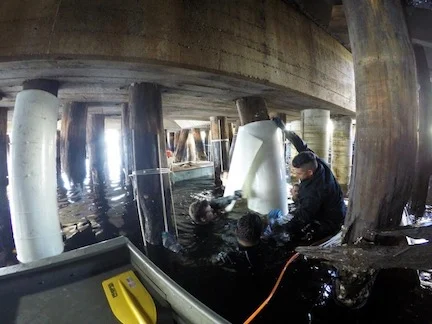
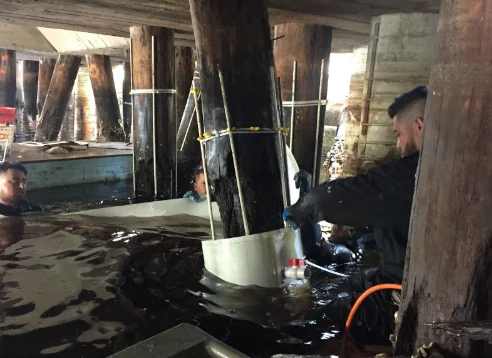
Usually, yes. Replacing a timber pile costs more than rehabilitating it, and under an existing deck or cap a new pile often cannot be driven at all. Most deteriorated timber piles are repaired in place by posting or splicing, by concrete jacketing, or by encasing the damaged length in an FRP shell filled with resin or grout, with GFRP bars when much of the section is gone.
For the methods and full-scale test results, read timber pile repair methods. For every pile material, see pile repair methods, or explore pile repair by structure.
Timber pile FAQs
Why use timber piles?
They are low cost, renewable, easy to handle and drive, and easy to cut to length. They are economical for pile loads of about 50 to 150 kips and lengths of about 20 to 125 ft, as friction piles, end bearing piles or both.
How much load can a timber pile carry?
Typical axial design loads are 35 to 150 kips. A timber foundation pile is normally designed for about 30 tons, sometimes 40 tons where soils allow, and beach house piles often for about 10 tons.
How long do timber piles last?
Piles fully below the groundwater table last indefinitely, and treated, fully embedded piles with a concrete cap last 100 years or more. Treated marine piles last about 50 years in northern climates and 25 years in southern climates.
What wood is used for timber piles?
In North America, mostly southern yellow pine and Douglas fir, made to ASTM D25. Southern pine is generally available in lengths under 70 ft, while Douglas fir reaches about 125 ft.
Are timber piles better than steel piles?
For lighter loads, timber usually costs less. Steel H-piles typically carry 100 to 400 kips and steel pipe piles 200 to 500 kips, and steel is easier to splice, but exposed steel is vulnerable to corrosion.
Is CCA-treated wood still allowed for piles?
Yes. CCA-treated wood was withdrawn from homeowner uses in December 2003, but the U.S. EPA still lists pilings and foundation support beams among its approved uses.
Where should timber piles not be used?
Where loads exceed their capacity, where they must be driven through boulders or hard strata, and in salt or brackish water or above the water table without proper preservative treatment.
Can a deteriorated timber pile be saved?
Usually. Decayed or borer-damaged piles can be repaired in place by posting, splicing or FRP encasement, even with part of the section missing, which typically costs less than replacement.
Sources
- Collin, J. G., Timber Pile Design and Construction Manual, Timber Piling Council, American Wood Preservers Institute, 2002 (includes FHWA service life conclusions).
- Graham, J. S., Design of Timber Foundation Piling for Highway Bridges and Other Structures, National Timber Piling Council.
- Lopez-Anido et al., “Assessment of Wood Pile Deterioration due to Marine Organisms,” Journal of Waterway, Port, Coastal and Ocean Engineering, ASCE, March/April 2004.
- U.S. Environmental Protection Agency, Chromated Arsenicals (CCA), last updated December 22, 2025.
- U.S. Environmental Protection Agency, Creosote, last updated December 22, 2025.
- Ehsani (QuakeWrap), Gallagher (Stantec) and Herbert (Western Infrastructure Renewal), “Repair of Timber Piles in Rail Bridges: A Canadian Perspective,” IABMAS Conference, Copenhagen, June 2024.
- Gull, Mohammadi, Taghinezhad and Azizinamini (Florida International University), “Experimental Evaluation of Repair Options for Timber Piles,” Transportation Research Record 2481, Transportation Research Board, 2015. Research for the Nebraska Department of Roads.
- QuakeWrap, Inc., Agricultural port timber pile project sheet (Perdue AgriBusiness, Chesapeake, Virginia).
Have Timber Piles Showing Their Age?
Tell us about the piles and their exposure. Our team will recommend the right PileMedic® system and provide specifications for your engineer.