
PILES · REPAIR GUIDE
Submerged Pile Repair: New Advances in Repairing Piles Underwater
Submerged piles can be repaired in place, with no cofferdam, by wrapping them in thin FRP laminate jackets bonded with an epoxy that cures underwater, then filling the space around the pile with grout. The jacket confines the pile and replaces hoop ties, so divers place single bars instead of handling cages. See how it works.
Key takeaways
- No cofferdam: FRP laminate jackets bond with epoxy that cures underwater, then the annulus is grouted.
- Diver time is the cost: labor and diving can be some 75% of a pile repair, so fewer diver tasks means a cheaper job.
- One roll fits every pile: the laminate is cut on site and wrapped twice plus 8 in., with no custom jackets.
- No cages: the seamless jacket confines the pile and replaces hoop ties, so divers place single bars.
- Steel needs a load path: bolt-on ShearWrap™ and ShearClamp™ replace underwater welding.
How are submerged piles repaired?
Most submerged piles are repaired by encasing the damaged length in a jacket and filling the gap between jacket and pile with grout, concrete or epoxy. Bars can go into that gap to restore strength. The FHWA describes jackets this way: they protect the pile, and with reinforcing inside they restore its capacity, so even severely damaged piles can be reconstructed in place.
The hard part is doing it underwater. This article, adapted from Prof. Ehsani’s 2020 paper for the Structural Engineering Institute, covers why the usual tools struggle below the water line and what a newer approach, the PileMedic® laminate jacket, changes for divers and engineers. For the full range of options by pile type, see Pile Repair Methods.
Why is underwater pile repair so hard and costly?
Underwater pile repair is costly because almost every hour is diver time, and depth, current, visibility and cold all cut what a diver can get done. Most structural engineers design buildings and bridges. Relatively few design marine work such as submerged piles, seawalls or sheet piles, where the repair has to happen in current and murky water.
The damage also sits in the worst place. Prof. Ehsani’s 2011 article on the first underwater PileMedic® repair noted that the most severe conditions are in the splash zone, between low and high tide, where chlorides reach the steel even in good concrete. FHWA agrees that the splash zone deteriorates fastest for steel and concrete. Timber is different: FHWA says its critical deterioration zone extends over the full length of the pile (see timber pile repair methods).
Depth cuts into what a diver can do each day. FHWA gives this guide to productive bottom time:
| Bottom depth | Productive time per day |
|---|---|
| 10 ft (3.0 m) | 6 hours |
| 40 ft (12.2 m) | 6 hours |
| 60 ft (18.2 m) | 4 hours |
| 80 ft (24.4 m) | 3 hours |
| 100 ft (30.5 m) | 2 hours |
Source: FHWA, Underwater Bridge Repair, Rehabilitation, and Countermeasures, Figure 5-2, April 2010. FHWA adds that current, visibility, temperature and the effort of the task all change productivity, and that more than 3 ft of visibility is desirable.
Working in the dry is not a free alternative. FHWA notes that cofferdams need more material and bracing the deeper they go. As the 2020 paper reported, labor and diving account for some 75% of the total cost of a pile repair, so a system that saves diver time saves real money.
What is wrong with traditional pile jackets underwater?
Traditional methods were built for dry work or for one pile size, and each loses time underwater. Here is how they compare:
| Method | How it works | Underwater drawback |
|---|---|---|
| Wet layup FRP fabric | Fabric is saturated with resin and bonded to the pile surface | Needs a smooth, dry surface, which underwater means a cofferdam |
| Seamed fiberglass jacket | Two half shells bolted or glued along a vertical seam, then grouted | Made for one pile size; the seam lets in moisture and oxygen and keeps the jacket from confining the pile |
| Fabric form with reinforced concrete | A fabric form is hung around a rebar cage and filled | Assembled cages take two divers to handle, and flexible forms need many spacers to keep an even grout thickness |
| PileMedic® laminate jacket | Laminate cut from a roll is wrapped twice around the pile, bonded with underwater-curing epoxy and grouted | Divers handle a thin sheet and single bars; the engineer sets the laminate grade and number of plies |
Have submerged piles that need repair?
Tell us the pile type, water depth and how far the damage goes. Our team will recommend the right PileMedic® system and provide specifications for your engineer.
How PileMedic® laminate jackets work underwater
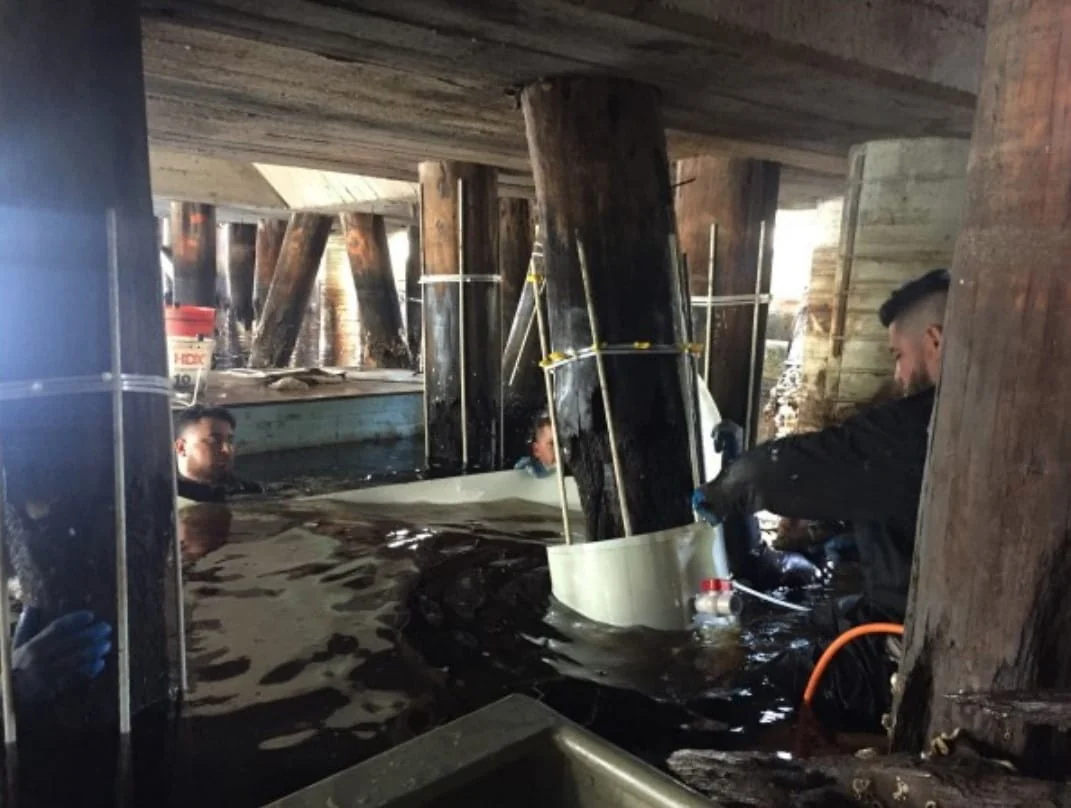
The patented PileMedic® jacket is assembled around the pile on site from a high-strength thin flat roll of laminate, so one roll fits every pile on the job. PileMedic® is based on FRP laminates Prof. Ehsani developed around 2009 and 2010: layers of carbon or glass fabric saturated with resin and pressed under heat and pressure into a very thin sheet, supplied in rolls 4 ft wide and hundreds of feet long. Three properties matter underwater.
Size and shape
At typically less than 0.05 in. thick, the laminate wraps around piles of any shape and size. The standard detail wraps it twice (720 degrees) plus an 8 in. extension. On site, the crew cuts the length from the roll, coats the second half with epoxy paste, and wraps it to form a two-ply shell. No jacket is custom ordered, shipped or stored.
Confinement
The seamless shell squeezes the pile evenly all the way around, which raises the strength of the pile and the new grout. Because the jacket does the job of hoop reinforcement, divers install vertical bars one at a time, only when needed. Dropping the assembled cage, which takes two divers to handle, saves significant time. The fibers can be oriented to set strength in the hoop and vertical directions for each project; current grades are on the product data sheets.
Corrosion protection
Oxygen dissolved in water is the fuel for corrosion. The seamless shell keeps moisture and oxygen away from the pile and drastically slows the corrosion rate. FHWA rightly cautions that a jacket also hides the pile from future inspection, so record the pile’s condition before it is wrapped.
Which repair does a damaged pile need?
The repair depends on the pile material and how much section is gone. FHWA offers these rules of thumb, which it says must be used with engineering judgment and analysis:
| Pile and damage | Possible repair |
|---|---|
| Steel, under 15% section loss | Pile jacket |
| Steel, 15% to 30% section loss | Pile jacket with reinforcement |
| Steel, over 30% section loss | Partial replacement |
| Concrete, corrosion with under 15% reinforcing loss | Pile jacket |
| Concrete, over 15% reinforcing loss plus spalling | Pile jacket with reinforcement |
| Concrete, ASR or DEF deterioration | Jacket with full capacity reinforcement, or replacement |
| Timber, under 15% section loss | Pile wrap |
| Timber, 15% to 50% section loss | Pile jacket with reinforcing |
| Timber, over 50% section loss | Partial or full replacement |
Source: FHWA, Figure 8-1, April 2010. Wraps and coatings are also listed for steel and concrete with little or no damage.
A structural jacket can go further than the table suggests when it is designed to carry the full pile load. At an agricultural port, timber piles with an average of 50% section loss, some completely detached, were restored to original axial and bending capacity this way. For the trade-offs between pile materials, see timber vs. concrete piles and the pros and cons of timber piles.
Parts designed for divers
Developing the system for the U.S. military and other clients produced accessories that make underwater work faster and the design more precise.
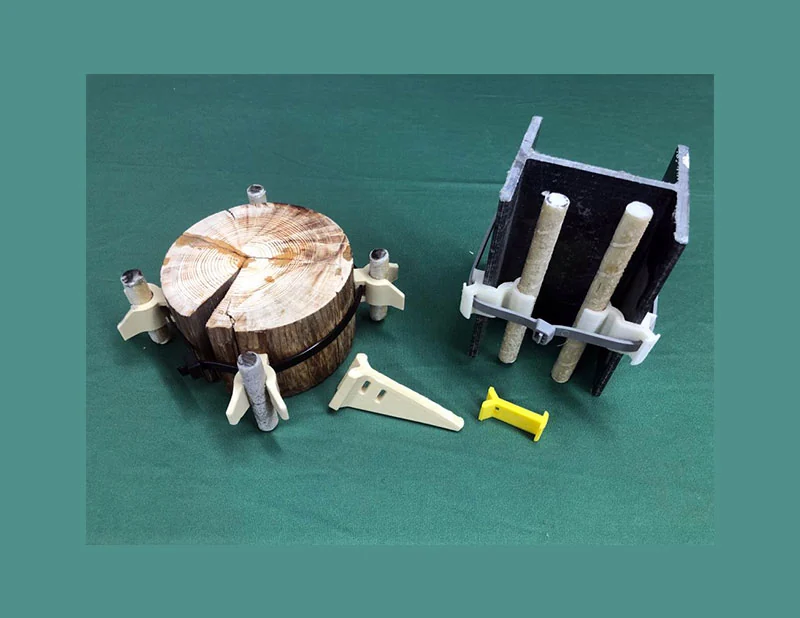
- Spacers. Divers pass a zip tie through several plastic spacers, fasten them around the pile and snap the vertical bars, usually GFRP, into place. The engineer knows exactly where each bar sits, and the spacer length sets the annular space. A version clips to H-pile flanges.
- Bottom seal. If the repair reaches the mud line, the soil seals the bottom of the jacket. If it stops in the splash zone, a skirt pin or other bottom seal closes the jacket at the right height.
- Load transfer on steel piles. New grout does not bond reliably to steel. ShearWrap™ bands (about 3 to 4 in. wide and 0.2 in. thick) are placed loosely around round piles, usually above water, slid into position and torqued. ShearClamp™ units do the same on H-pile flanges. On one recent project, flammable materials on site ruled out any welding.
For a full walkthrough of the steel case, read Steel Pipe Pile Repair.
How a submerged pile is repaired, step by step
A typical underwater sequence has five steps. Your engineer’s design and the project specifications govern.
- Prepare the pileClean off marine growth, commonly with high-pressure water. Set spacers and bars, and add ShearWraps™ on steel piles. Jet away soil where the jacket will be embedded.
- Cut and coat topsideOn the barge or deck, cut the laminate to two wraps plus 8 in. and trowel 30 to 40 mil of epoxy paste on the second half.
- Wrap and slide downWrap the shell at the waterline, strap it while the epoxy cures, and slide it down the pile. Stack 4 ft jackets with 4 in. overlaps.
- Seal the bottomEmbed the bottom jacket 6 to 12 in. in the soil or close it with a bottom seal, then set a grout plug.
- Grout by tremieFill the annulus with underwater grout. Its pressure presses the plies together, and the straps come off the next day.
What tests and field projects show
Several government agencies have tested the system. Results apply to the specimens tested; reports are on Test Results & Approvals.
| Program | What was tested | Finding |
|---|---|---|
| Texas DOT, University of Houston (2015) | 14 corroded steel H-piles with FRP jackets | Capacity restored to the uncorroded value in 13; the exception was built without its designed anchors |
| Nebraska DOR, Florida International University (2014) | 5 damaged timber piles with PileMedic® glass laminates | Failure loads 5.3 to 9.9 times design capacity |
| Caltrans and USDOT (2015) | Earthquake-damaged 24 x 36 in. bridge column with fractured bars | Lateral strength and deformation capacity restored |
| U.S. Army Corps of Engineers PIER (2017) | Commercial pile jackets for rapid port repair | One jacket packaged in modular kits that fit on C-17 aircraft |
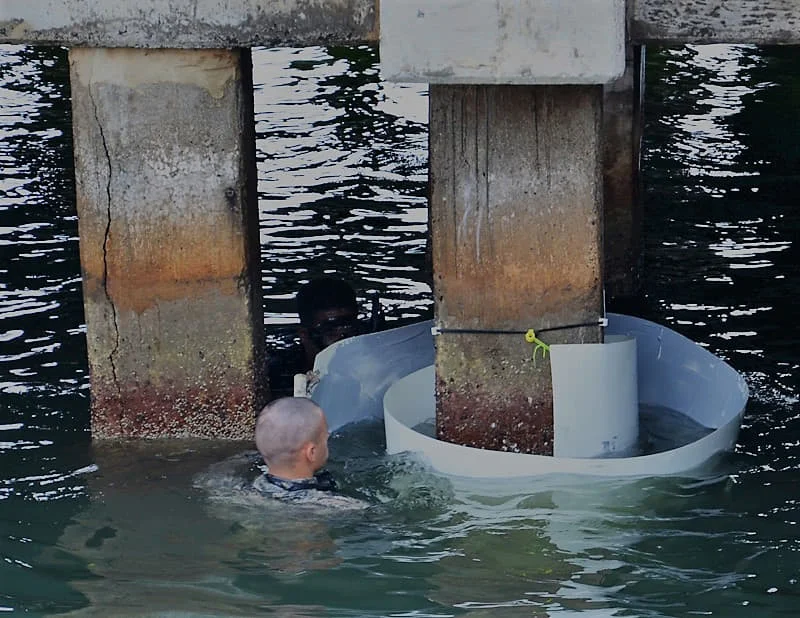
In the field, the system has repaired more than 500 timber piles at the largest agricultural port in the U.S., 90 concrete piles at the Port of Seattle, 95 steel piles in Houston, 265 steel piles for Indiana DOT, a jetty for the Nigerian National Petroleum Corporation and bridges in Australia, including 40 piles in a crocodile-infested river. At the end of a 3-year U.S. Army Corps of Engineers study, U.S. Navy divers repaired piles with PileMedic® at Pearl Harbor, Hawaii. Members of the diving team estimated the system cut repair time to as little as one third of the pile jackets they had used before.
Plays from YouTube
The advantage was that the broken pile could be repaired and reinstated up to the required bearing capacity and strength value, and no additional piles needed to be installed. This reduced cost and timing in repair method.
Submerged pile repair FAQs
Can submerged piles be repaired without a cofferdam?
Yes. PileMedic® laminates are bonded with an epoxy that cures underwater, and the jacket is filled with underwater grout, concrete or epoxy, so no cofferdam or dewatering is needed.
Do divers have to assemble rebar cages underwater?
No. The jacket confines the pile and acts as the hoop reinforcement, so divers snap individual vertical bars into spacers when the design calls for them.
How is the bottom of the jacket sealed?
If the repair reaches the mud line, the jacket is embedded in the soil, which seals it. If it stops in the splash zone, a skirt pin or other bottom seal closes the jacket at the right height before grouting.
How is load transferred on steel piles underwater?
With ShearWrap™ bands on round piles and ShearClamp™ units on H-piles. Both bolt on and are torqued in place, so no underwater welding is needed.
What drives the cost of underwater pile repair?
Mostly diver time. Labor and diving can be some 75% of the total, and FHWA notes that depth, current, visibility and temperature all cut diver productivity.
How soon can a repaired pile carry load?
PileMedic® restores full pile capacity within 24 hours of installation.
Which piles can be repaired this way?
Timber, concrete and steel piles, round, square, octagonal or H-shaped, in fresh or salt water. One roll of laminate is cut to fit each pile on site.
Sources
- M. Ehsani, New Advances in Repair of Submerged Piles, Structural Engineering Institute Technical Corner, July 14, 2020. More on Technical Papers.
- M. Ehsani and A. Tipnis, Miami Building First to Benefit from Innovative PileMedic™ Jacket, Concrete Repair Bulletin, July/August 2011.
- Federal Highway Administration, Underwater Bridge Repair, Rehabilitation, and Countermeasures, Publication FHWA-NHI-10-029, Collins Engineers for FHWA, April 2010.
- M. Ehsani, S. Day and T. White, Repair of ASR-Damaged Piles, Concrete International, April 2017.
- Agency test summaries: Texas DOT Report 0-6731-1 (2015), Nebraska Department of Roads (2014), Caltrans and USDOT (2015), U.S. Army Corps of Engineers PIER fact sheet (2017), on Test Results & Approvals.
- J. Verstreepen, Port Engineer Interview, Pile Buck, Vol. 36 No. 3, 2020.
Have Submerged Piles That Need Repair?
Tell us the pile type, water depth and site conditions. Our team will recommend the right PileMedic® system and provide specifications for your engineer.