
BRIDGE PILES · CASE STORY
Bridge Pile Repair Case Study: 40 Piles in a Crocodile-Infested River
Forty ASR-cracked bridge piles in Queensland’s Barron River were encased underwater in seamless PileMedic® jackets in about five working weeks in 2015, for A$0.95 million, about 61% less than the escalated A$2.46 million bid for concrete encasement. Divers worked inside steel cages to keep the crocodiles and bull sharks out. Jump to the cost comparison.
Key takeaways
- The job: 40 ASR-cracked prestressed piles under a Queensland highway bridge, encased underwater in 2015.
- The constraints: piles 12 in. apart, 1 ft visibility, strong tides, and crocodiles and bull sharks.
- The fix: seamless PileMedic® laminate jackets filled with underwater grout, with divers working inside steel cages.
- The design check: two plies on a 25 in. jacket gave 648 psi of confinement, more than double the 300 psi required.
- The result: about 35 working days and A$0.95 million, about 61% less than the A$2.46 million concrete encasement bid.
What happened at the Barron River bridge?
The Queensland Department of Transport and Main Roads (DTMR) needed to protect 40 cracking concrete piles under a highway bridge, underwater, in a river known for crocodiles. It took 15 years to find a method that met the engineering criteria, fit between the piles and fit the budget. When it came, the repair itself took about 35 working days. This is the story as told in the paper Prof. Mo Ehsani, Stephen Day and Tony White presented at the International Bridge Conference in 2016.
| Item | Detail |
|---|---|
| Structure | Captain Cook Highway southbound bridge over the tidal Barron River estuary, 4.5 miles (7 km) north of Cairns, Queensland, Australia |
| Bridge | Built 1977; 579 ft (176.5 m) long, 34 ft (10.4 m) wide, seven 77 ft (23.5 m) spans |
| Piles | 20.7 in. (525 mm) octagonal prestressed concrete, all raked, 10 under each pile cap |
| Damage | Alkali-silica reaction (ASR) cracking, with corrosion risk |
| Owner | Queensland Department of Transport and Main Roads (DTMR) |
| General contractor | Roadtek, DTMR’s in-house delivery arm |
| Underwater contractor | JD Marine |
| QuakeWrap® role | QuakeWrap (Australia) provided training and technical advice |
| System | PileMedic® glass FRP laminate jackets filled with cementitious underwater grout |
| Completed | 2015 |
The problem: ASR was cracking the piles from the inside
The piles were being damaged by alkali-silica reaction, a slow chemical attack inside the concrete. The FHWA‘s underwater repair manual explains it: alkalis in the cement react with silica in certain aggregates, and the gel that forms expands when it gets wet, cracking the concrete. Wet and dry cycles in the splash zone speed it up, and salt water can make it worse. In prestressed piles some of the cracking can be hidden, because the prestress squeezes horizontal cracks shut.
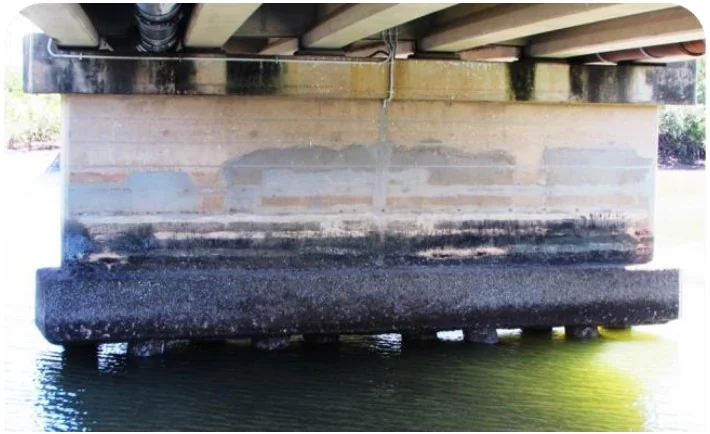
In 2000, inspectors found severe ASR cracking in 13 of the 40 piles in the four river piers. The count kept growing: 14 cracked piles in 2004 and 22 by 2014. Cracks let in the chlorides, moisture and oxygen that corrode the prestressing steel, so DTMR decided that encasing the piles was the right long-term treatment.
DTMR set two criteria for any encasement:
- Confine the pile with at least 300 psi (2.1 MPa). Research by Carse (1992) and others showed ASR slows as internal pressure rises, so the jacket had to push back on the swelling concrete, not just cover it.
- Block chlorides, moisture and oxygen. ASR needs water, and corrosion needs oxygen and an electrolyte.
The constraints: tight piles, murky water and crocodiles
A reinforced concrete jacket could meet the design criteria. The site was the problem.
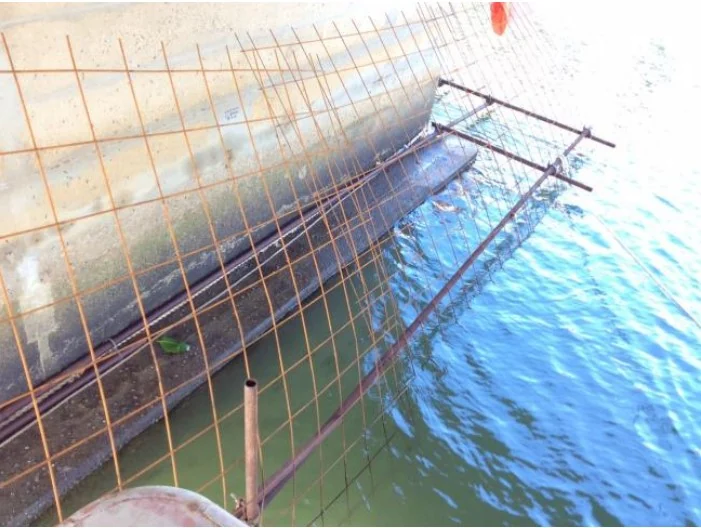
- Tight spacing. The raked piles stand as close as 12 in. (300 mm) apart, too close for individual concrete jackets.
- Always underwater. The tidal range is about 15 ft (4.5 m), but in normal tides rarely more than 20 in. (0.5 m) of pile is exposed.
- Almost no visibility. In the murky estuary, visibility was often just 1 ft (0.3 m). For comparison, FHWA says more than 3 ft is desirable for underwater repairs.
- Strong tidal flow. Tidal movement of 6 to 10 ft (2 to 3 m) had to be managed during the work.
- Crocodiles, bull sharks and jellyfish. The river is a known crocodile habitat. The Queensland Government‘s attack records list a non-fatal crocodile attack on the Barron River at Cairns in December 2004, and in 2012 the state sent boats out to survey crocodile numbers on the river after community concerns.
- Flash floods. Work had to be scheduled in the dry season, with the crew ready to evacuate quickly.
- Limited funding. Every option had to fit a fixed budget.
Why did it take 15 years to find a repair?
Every option DTMR tried failed either the engineering test or the budget. Seamed fiberglass jackets were ruled out early: their vertical seam lets in moisture and oxygen, the seam and bolts limit the confining pressure, and each jacket is made for one pile size.
| Year | What happened |
|---|---|
| 2000 | Severe ASR cracking found in 13 of the 40 river piles. |
| 2003 | DTMR, the University of Southern Queensland and the NSW Roads and Traffic Authority develop a finger-jointed FRP prototype jacket. In trials it cannot withstand the pressure of fresh grout, and the project ends. |
| 2006 | A call for expressions of interest draws four submissions, all reinforced concrete encasement. Final estimates exceed the funding, and the project is postponed while DTMR watches the market for new FRP options. |
| 2008 | The concrete encasement option is bid at A$2.0 million. |
| 2014 | Divers clean and inspect every pile for A$150,000. Cracked piles have reached 22. PileMedic® is identified at around 40% of the earlier tendered prices and approved as a trial installation. |
| 2015 | All 40 piles are encased underwater in about five working weeks. |
In hindsight the delay paid off. The laminate technology that solved the problem did not exist when the search began.
Have bridge piles that need repair?
Tell us about the bridge, the piles and the site. Our team will recommend the right PileMedic® system and provide specifications for your engineer.
The solution: seamless laminate jackets that confine the pile
The adopted solution wrapped each pile in a PileMedic® jacket: a thin FRP laminate wrapped twice around the pile with an 8 in. (200 mm) lap, bonded to itself with an epoxy paste that cures underwater, and filled with grout. With no seam and continuous fibers all the way around, the shell can build high confining pressure and keeps water and oxygen out.
PileMedic® laminates are made by saturating carbon or glass fabric, up to 60 in. (1.5 m) wide, with resin and pressing it under uniform heat and pressure. The result is thin enough to bend into a circle, with strength in the hoop direction, the vertical direction or both. Rolls are 4 ft (1.2 m) wide and 250 ft (76 m) long and are cut to length on site, so one roll fits every pile on the bridge.
It was not untested. The first PileMedic® repair of submerged piles had been done in Miami in 2011, and Caltrans, Texas DOT and the Nebraska Department of Roads had studied the system on concrete columns, steel H-piles and timber piles. See test results and approvals and how submerged piles are repaired.
Worked example: checking the 300 psi confinement requirement
The jacket’s confining pressure comes from a simple hoop stress check, p = 4T / d, for a two-ply jacket. Here is the paper’s example with the project’s dimensions.
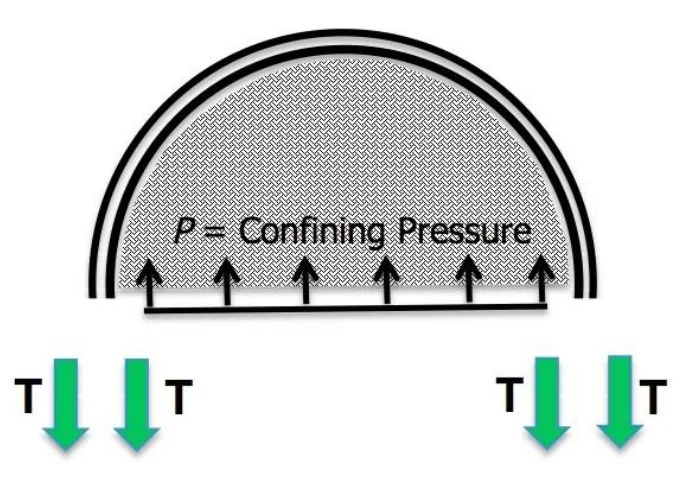
- Set the jacket sizeA 2 in. (50 mm) grout annulus around each pile gives a jacket diameter of d = 25 in. (635 mm), small enough to leave working room between neighboring piles.
- Take the laminate strengthThe paper uses a laminate with a breaking strength of T = 4,050 lb per inch of width (18 kN).
- Count the forcesCut the jacket in half: two plies on each side give four tension forces, so 4T = p x d.
- Solvep = 4 x 4,050 / 25 = 648 psi (4.5 MPa).
- Compare648 / 300 = 2.16, so the jacket gives more than double DTMR’s 300 psi criterion.
The same numbers set the cut length. A 25 in. circle has a circumference of 3.14 x 25 = 78.5 in., so each piece was cut to 2 x 78.5 + 8 = 165 in. (4.2 m). Only the second ply and the lap need epoxy: 78.5 + 8 = 86.5 in. of each sheet was coated.
How the 40 piles were encased underwater
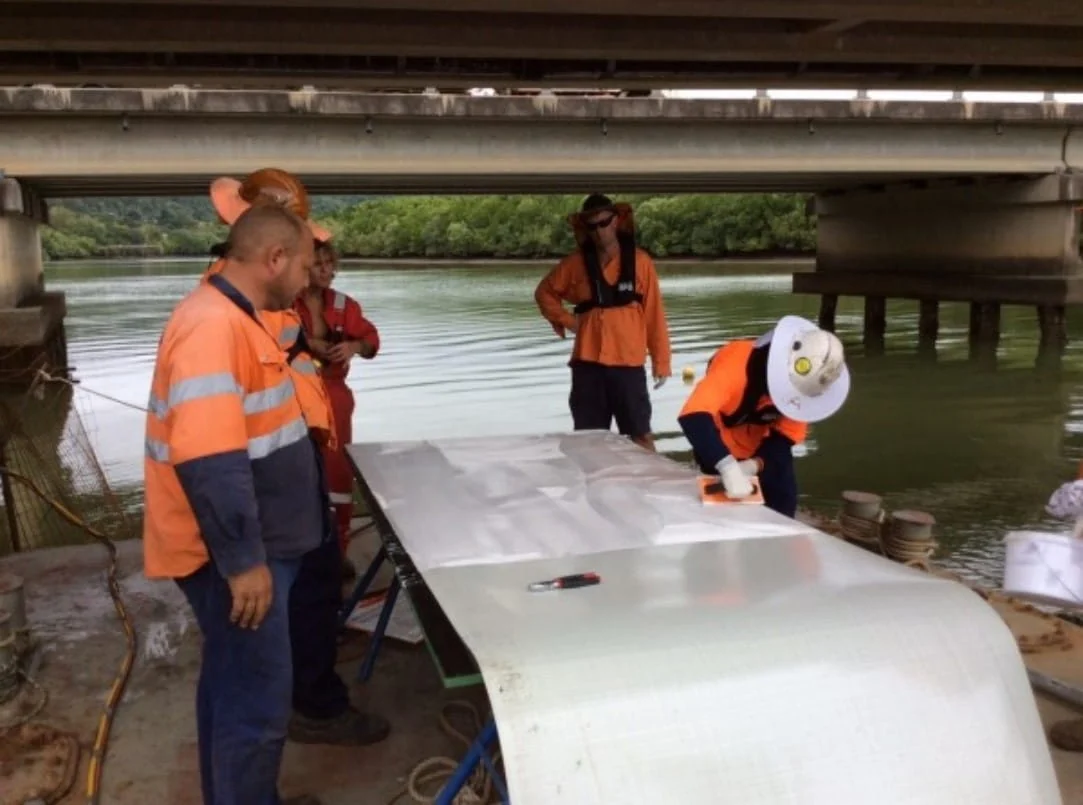
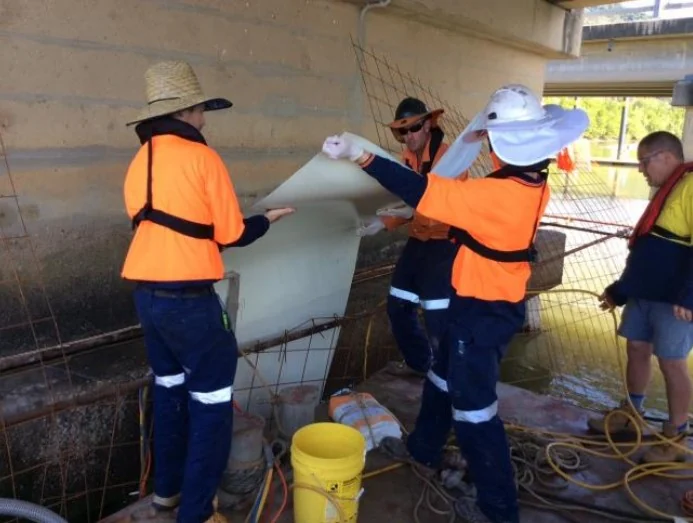
The crew worked from a barge with a small crane, which served as the work platform and staging area for resin and grout. The diving crew was four people: two divers installing, one backup diver and one supervisor. On the barge, two more workers cut the laminate and mixed and spread the epoxy.
- Cage the pierA steel cage went around each pier to protect the divers.
- Cut and coatThe 4 ft wide laminate was cut to 165 in., laid flat on a table and coated with 30 to 40 mil of toothpaste-like epoxy over 86.5 in. using a notched trowel.
- Pass it over the cageThe coated sheet was passed over the cage to the divers. Large as it is, it is easy to handle once submerged.
- Wrap over spacersDivers wrapped it over spacers, such as short pieces of 2 in. PVC pipe, to set the annulus. The wet epoxy acts as a lubricant for fine adjustment, and ratchet straps hold the shape while it cures.
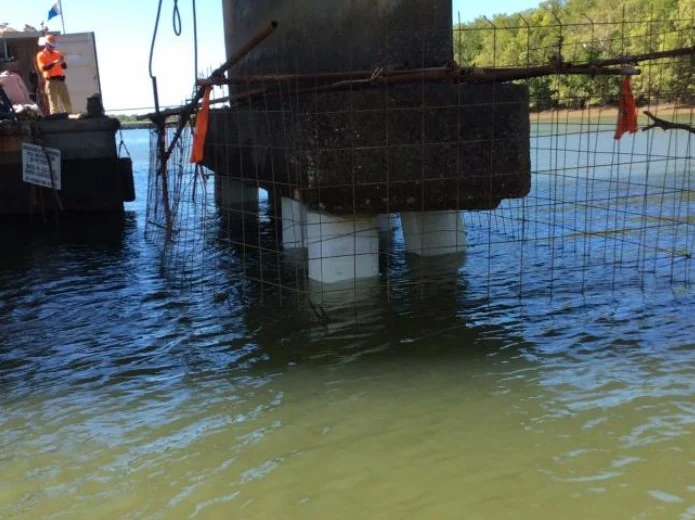
- Stack the jacketsThe first 4 ft jacket went in with its bottom about 18 in. (450 mm) below the mud line. Each next jacket overlapped the one below by 4 in. (100 mm), sealed with epoxy.
- Grout by tremieA shear mixer and pump placed cementitious underwater grout in the annulus. Its pressure pushes the plies together, and its heat helps the epoxy cure. The straps came off the next day.
How long did the repair take?
The repair took about five working weeks, or 35 days, for all 40 piles. Each pier of 10 piles followed the same weekly rhythm:
| Task | Time |
|---|---|
| Install the steel protective cage | 1 day |
| Wrap 10 piles and place the grout | 4 days |
| Demobilize and move to the next pier | 1 day |
| All four piers, 40 piles | About 35 working days |
The paper credits the crew for adapting to constant challenges in a trying tropical environment.
Results: what the repair cost compared with concrete encasement
The PileMedic® repair cost A$0.95 million, about 39% of the A$2.46 million (2015 dollars) the concrete encasement would have cost, or about 61% less. These are DTMR’s figures as reported in the paper, in Australian dollars from 2008 to 2015, not current prices.
| Item | Cost (A$) |
|---|---|
| Reinforced concrete encasement bid, 2008 | 2.0 million |
| Same bid in 2015 dollars | 2.46 million |
| PileMedic® option, estimate | 1.1 million |
| PileMedic® option, final cost | 0.95 million |
| Difference, final cost vs. escalated concrete bid | 1.51 million (about 61% less) |
Source: Ehsani, Day and White, IBC 2016, from DTMR data. The percentage and difference are our arithmetic on those figures: 0.95 / 2.46 = 38.6%.
The final cost came in A$150,000 under the PileMedic® estimate, mainly because the system was easy to install and the diving crew got faster as the project went on. Diving itself was a real line item: the 2014 cleaning and inspection alone cost A$150,000, of which 30%, about A$45,000, went to crocodile protection.
Plays from YouTube
Lessons for other bridge pile repairs
Few bridges have crocodiles, but many have tight piles, poor visibility and a fixed budget. What carries over:
- Write performance criteria, not a method. DTMR’s two criteria, 300 psi of confinement and a moisture barrier, let a new product compete with concrete.
- For ASR, confinement matters as much as cover. FHWA notes that piles with ASR may need replacement unless a jacket strong enough to carry the full pile load rebuilds them in place.
- Size the jacket to the site. A 2 in. annulus kept jackets small enough to work between piles 12 in. apart.
- Price the diving, not just the materials. Diver safety, visibility and current set the schedule, and the schedule sets the cost.
- Seamless beats seamed. A vertical seam is where water gets in and where confinement stops.
For bridge piles of every material, see bridge piling repair and pile repair methods. If your piles are wood, start with timber pile repair methods.
Barron River bridge pile FAQs
What is ASR in bridge piles?
Alkali-silica reaction is a reaction between alkalis in cement and silica in some aggregates. The gel it forms swells when wet and cracks the concrete, and wet and dry cycles in the splash zone speed it up.
Why does confinement help piles with ASR?
Research such as Carse (1992) showed ASR slows as internal pressure rises. A jacket that confines the pile builds that pressure, and a seamless shell also keeps out the water ASR needs.
Why not use a reinforced concrete jacket?
The piles were as close as 12 in. apart, too tight for individual concrete jackets, and encasing whole pile groups underwater in poor visibility pushed the cost beyond the funding.
Why were standard fiberglass pile jackets rejected?
They come as half shells joined along a vertical seam. The seam lets moisture and oxygen in and limits confining pressure, and each jacket has to be made for one pile size.
How were the divers protected from crocodiles?
A steel cage was installed around each pier before work began, and the laminate was passed over the cage to the divers inside.
How long did the repair take, and what did it cost?
About five working weeks for all 40 piles. The final cost was A$0.95 million, about 61% less than the A$2.46 million escalated bid for concrete encasement.
Can this approach work on other bridge piles?
Yes. PileMedic® jackets are used on concrete, steel and timber bridge piles, in water or on land. Our team will recommend the right system and provide specifications for your engineer.
Sources
- M. Ehsani, S. Day and T. White, Repair of Deteriorated Bridge Piles in a Crocodile-Infested River, International Bridge Conference, Washington, DC, June 2016, paper IBC-16-19.
- M. Ehsani, S. Day and T. White, Repair of ASR-Damaged Piles, Concrete International, April 2017, pp. 61 to 65. More on Technical Papers.
- Federal Highway Administration, Underwater Bridge Repair, Rehabilitation, and Countermeasures, Publication FHWA-NHI-10-029, Collins Engineers for FHWA, April 2010.
- Queensland Government, Crocodile attacks, last updated December 12, 2025.
- Queensland Government, Minister takes action on Barron River crocodiles, ministerial media statement, August 29, 2012.
- M. Ehsani and A. Tipnis, Miami Building First to Benefit from Innovative PileMedic™ Jacket, Concrete Repair Bulletin, July/August 2011.
Have Bridge Piles That Need Repair?
Tell us about the bridge, the piles and the site. Our team will recommend the right PileMedic® system and provide specifications for your engineer.