
PILES · REPAIR GUIDE
Steel Pipe Pile Repair: How to Restore Corroded Piles Without Welding
Corroded steel pipe piles are usually repaired by encasing the damaged length in a new grout or concrete shell that carries the load past the corrosion. New concrete does not bond reliably to steel, so the shell needs a mechanical load path. Bolt-on ShearWrap™ bands inside a PileMedic® jacket provide it, with no welding on the pile. Compare the repair options.
Key takeaways
- Damage is local: pipe piles corrode fastest in the splash zone, so most repairs cover a few feet, not the whole pile.
- Measure before you choose: ultrasonic wall readings set the repair. FHWA suggests a jacket under 15% section loss and a reinforced jacket from 15 to 30%.
- Bond is the catch: new concrete does not grip steel reliably, so an encasement needs a mechanical load path.
- No welding needed: bolt-on ShearWrap™ bands carry load into a PileMedic® jacket and back, above or below water.
- Plan for corrosion: a sealed jacket slows it, and cathodic protection is the way to stop it.
Why do steel pipe piles corrode?
Steel pipe piles corrode fastest in the splash zone, the band a few feet above and below the water line where the steel is wet, then dry, and always has oxygen. The FHWA‘s underwater repair manual puts it plainly: the most rapid deterioration of elements in water happens in the splash zone, because moisture and oxygen are both readily available. Fully submerged steel corrodes more slowly because there is less oxygen.
Below the mud line the picture is usually better still. A long-running National Bureau of Standards study of steel piles pulled after up to 40 years of service found no appreciable corrosion in undisturbed soil below the water table. That is why most pipe pile repairs are local: the damage sits in a band of a few feet, and the rest of the pile is sound.
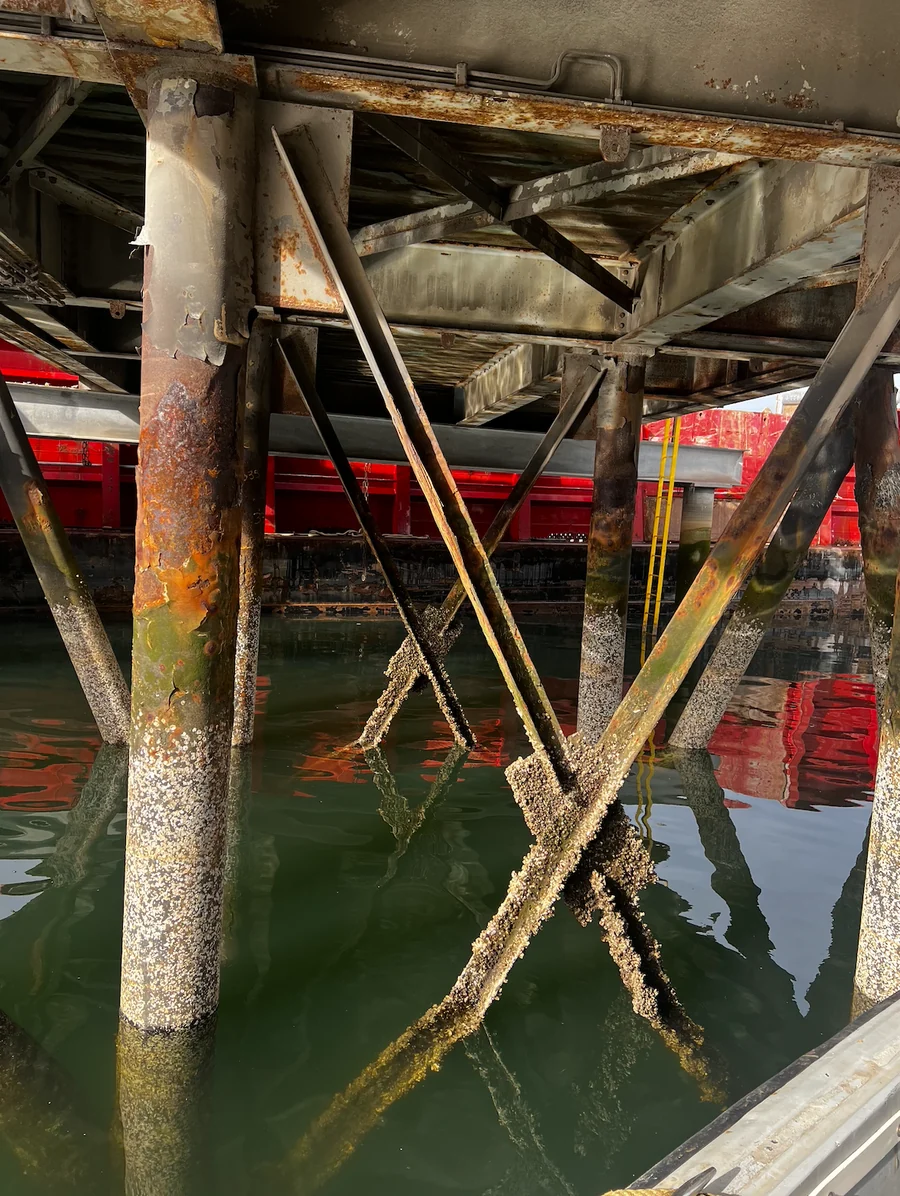
Pipe piles, hollow or filled with concrete, carry bridges, piers and docks, offshore platforms, industrial plants and buildings. They are typically 30 to 120 ft long and carry 200 to 500 kips. What attacks them:
- Wet and dry cycles in salt water. Tides and spray keep the splash zone wet with oxygen-rich water.
- Galvanic action. Where dissimilar metals meet in an electrolyte such as seawater, corrosion speeds up.
- Bacteria and fouling. Marine growth and microbial activity add to the attack.
- Fatigue. Repeated loading from waves, berthing and traffic can start cracks in thinned walls.
- Polluted or acidic water. FHWA notes that corrosion is mainly a concern in salt, brackish or acidic water, and normally minimal in fresh water.
How do you know if a steel pipe pile needs repair?
You know a pipe pile needs repair when an inspection shows the wall has thinned enough to cut into its load capacity. The visible warning signs come first:
- Rust, scaling or pitting, especially between low and high tide.
- Holes or obvious thinning in the pipe wall.
- Unexpected movement, or cracked and spalled concrete where the pile meets the cap.
- Corroded or broken cross bracing.
- Scour or erosion around the pile at the mud line.
Seeing rust only tells you where to look. FHWA explains that visual and tactile inspections find local corrosion, but measuring how much steel is left takes a Level III inspection, most commonly with ultrasonic thickness testing. Divers map where the corrosion starts and stops on each pile and take wall readings through the worst of it. Those numbers set the repair length, whether bars go into the new shell and how much load the shell must carry.
The FRP repairs were completed in just two weeks, improving all 4 bridges to a Satisfactory Condition Rating (NBI rating of 6). All of this was affordable enough to be funded with the region's operations budget and happened on one of the busiest highways in Missouri without causing any delays or distractions to the traveling public.
What are the options for repairing steel pipe piles?
There are five common ways to restore a corroded pipe pile: splice in new steel, weld on a steel jacket, encase it in concrete over welded studs, encase it in a jacket with a bolted load path, or replace it. The right one depends on how much steel is left, the water depth and whether welding is allowed on site. Your engineer of record chooses and designs the repair.
| Method | How it works | Limits |
|---|---|---|
| Coating or pile wrap | A barrier coat or wrap over cleaned steel | Protection only. Adds no strength back to a thinned wall |
| Cut out and splice | The corroded length is cut out and new pipe welded in | Underwater welding is costly, and many sites forbid hot work |
| Welded steel jacket | A new steel shell is welded around the pile | Also needs underwater welding, and the new steel will corrode too |
| Concrete encasement with welded studs | Shear studs are welded to the pile and a reinforced shell is cast around it | Welding to corroded steel may not be feasible or permitted |
| PileMedic® jacket with ShearWrap™ | Bolted bands, vertical bars and a seamless FRP laminate jacket filled with grout | Bands are made to each pile size, and the engineer sets their number and spacing |
| Partial or full replacement | A new pile is driven, often beside the old one, and the load moved to it | Costly and disruptive, and often impossible under an existing deck |
How much section is gone is the first filter. FHWA gives these rules of thumb for steel piles, which it says must be used with engineering judgment and analysis:
| Section loss | Typical repair |
|---|---|
| No significant loss | Coatings or a pile wrap |
| Under 15% | Pile jacket |
| 15% to 30% | Pile jacket with reinforcement |
| Over 30% | Partial replacement |
Source: FHWA, Underwater Bridge Repair, Rehabilitation, and Countermeasures, Figure 8-1, April 2010.
The last row is where a structural jacket earns its keep. FHWA also notes that for severely damaged piles, jackets essentially let a pile be reconstructed in place, provided the jacket reaches far enough above and below the damage to move load from the pile, into the repair and back. That load path is the hard part on steel.
Not sure which repair fits your piles?
Send the pile diameter, wall thickness readings and the length of the corroded zone. Our team will recommend the right PileMedic® system and provide specifications for your engineer.
Why can't you just encase a steel pile in concrete?
You can encase it, but you cannot count on the concrete sticking to the steel. On a timber or concrete pile, the rough surface bonds well to the new shell and the two work together. A smooth, corroded steel pipe does not give that bond, so the new shell can slide along the pile instead of sharing its load.
Building codes treat steel the same way. In steel building design, ANSI/AISC 360-16 (Section I6.3) lists three ways to move force between steel and concrete: direct bearing, shear connectors and direct bond. It states that direct bond “shall not be used for encased composite members.” Force has to go through something mechanical.
The usual mechanical answer is to weld shear studs to the pile. Underwater, that is a problem. FHWA calls for at least 1 to 2 ft of visibility for wet welding and a written weld procedure for every job, and many industrial sites with flammable materials forbid hot work altogether. On one recent QuakeWrap project, flammable materials on site ruled out any welding.
How ShearWrap™ transfers load without welding
ShearWrap™ replaces welded studs with bolts. Each one is a steel band in two half circles, about 3 to 4 in. wide and 0.2 in. thick. It goes around the pile loosely, often above water, slides down to its elevation and is torqued to a set value. That tension presses the band against the pile and builds friction that resists a designed shear force. Wings can be welded to the band itself, never to the pile, to raise its capacity.
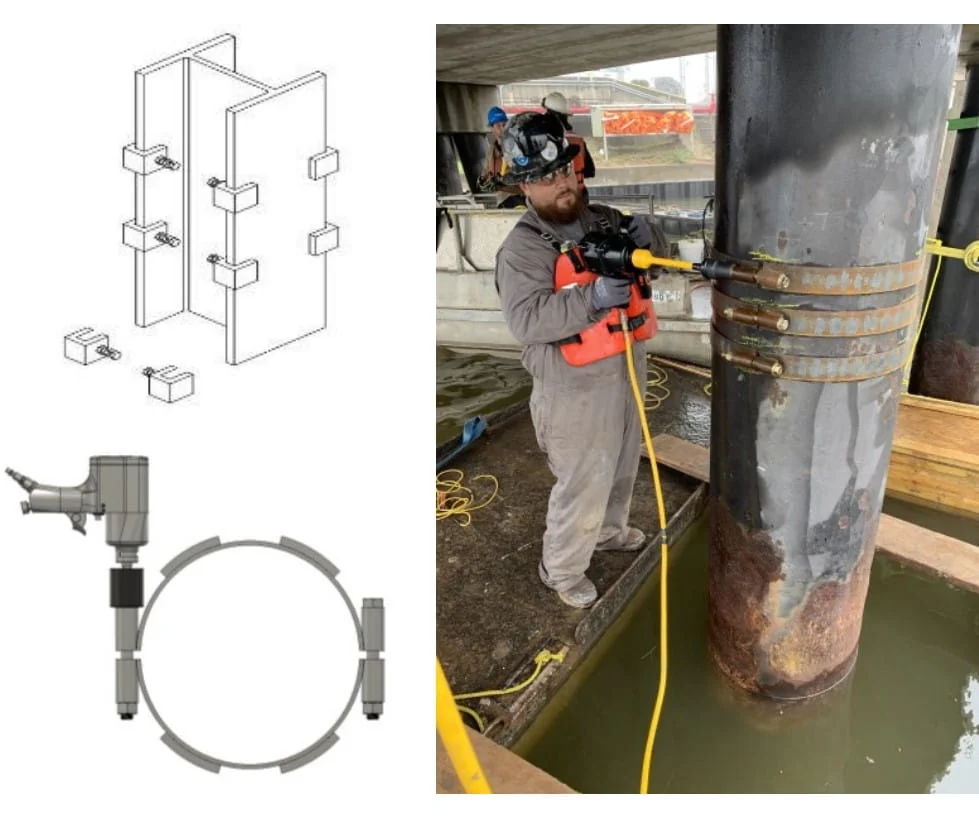
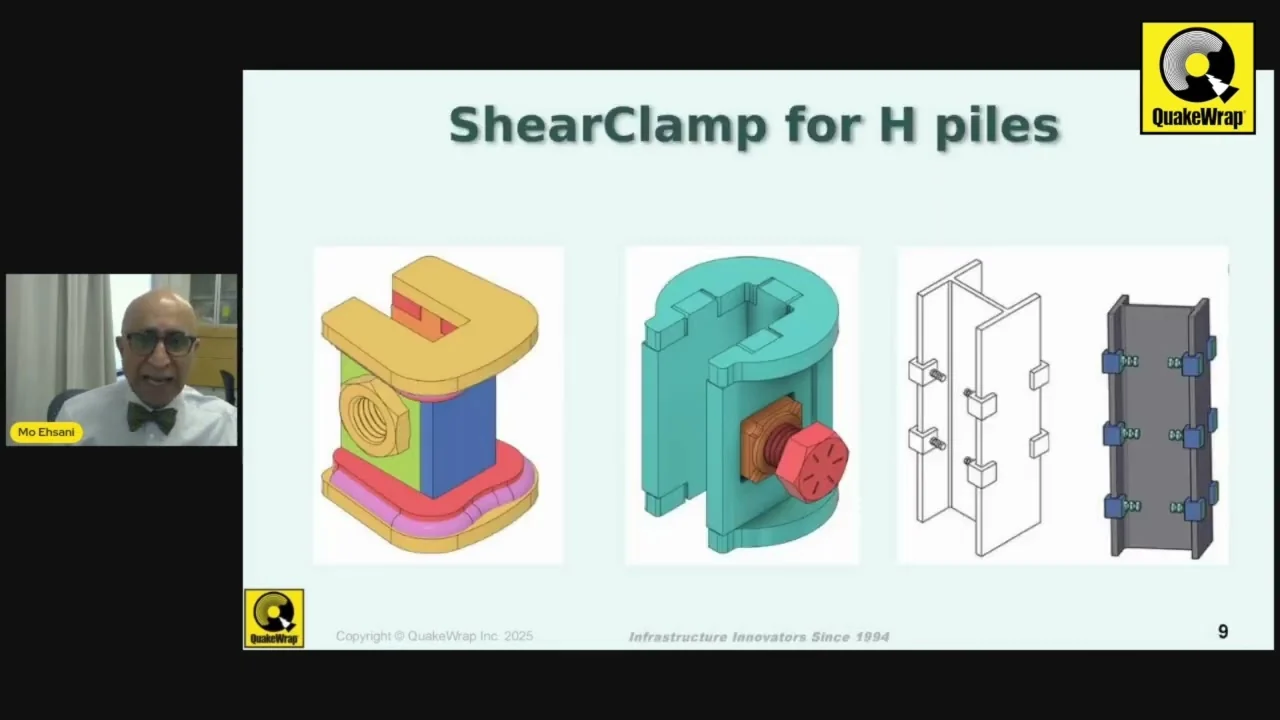
Groups of bands go above and below the damage. Load coming down the pile passes into the new shell at the upper group, travels through the shell past the corroded length, and returns to sound steel at the lower group. Once grouted, the bands are fully embedded and out of the water. ShearClamp™ does the same job on H-piles, bolting to the flanges and adding bearing to friction.
- Steel pile aboveCarries the load down to the repair.
- Upper ShearWraps™Transfer load into the shell by friction.
- Grout or concrete shellCarries the load past the corroded zone, confined by the PileMedic® jacket.
- Lower ShearWraps™Transfer load back into sound pile.
- Steel pile belowCarries the load on to the foundation.
How a steel pipe pile is repaired with PileMedic®
A typical repair takes five steps. Your engineer’s design and the project specifications govern, and the installation videos show each one.
- Clean and measureClean off marine growth and loose rust, and confirm wall thickness and the limits of the corroded zone.
- Set ShearWraps™Slide the bands to their elevations above and below the damage and torque the bolts.
- Add barsFix spacers around the pile and snap in GFRP or steel bars if the design calls for them.
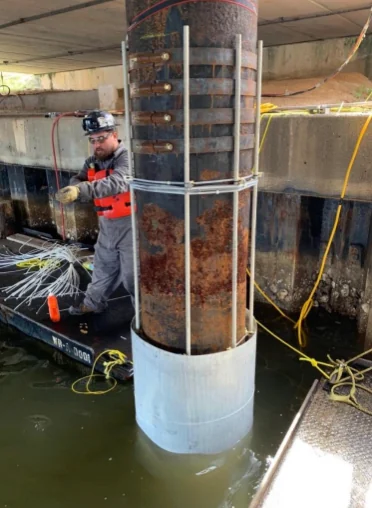
- Wrap the jacketWrap the PileMedic® laminate twice around the spacers plus 8 in., bonded to itself with epoxy that cures underwater. Stack 4 ft jackets with 4 in. overlaps.
- Seal and groutClose the bottom with the soil or a bottom seal and fill the annulus with grout, fully encasing the bands.
Case example: steel pipe piles under a Seattle pier
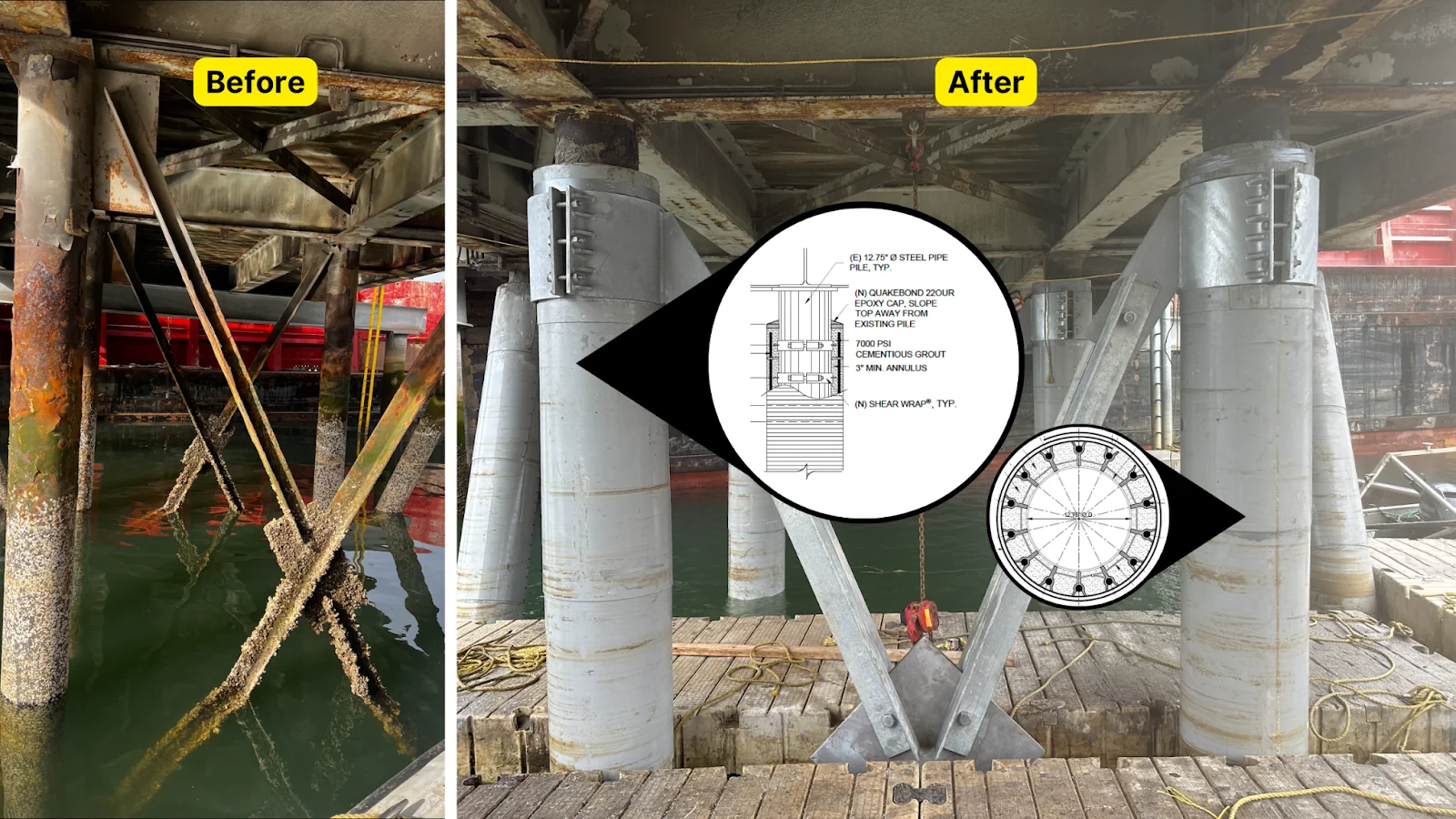
At a pier in Seattle, inspection found severe corrosion and section loss in the steel pipe piles, with holes through the pile walls and corroded cross braces. The repair combined PileMedic® laminate jackets, ShearWrap™ bands to carry load past the corroded length, vertical reinforcing bars and redesigned braces. Holes in the pile walls were patched, nothing was welded to the piles, and the pier stayed in service.
Plays from YouTube
Will a pile jacket stop corrosion?
A jacket slows corrosion a great deal, but it is not a guarantee, and you should plan for that. The seamless laminate shell keeps moisture and oxygen away from the steel, and the grout around the pile is alkaline. Both slow the attack.
FHWA is careful here: it says no pile jacket technique other than cathodic protection should be considered to prevent corrosion, and that a jacket hides the pile from later inspection. Its manual also covers pile jacket and anode systems that combine the two. If the structure must last decades more, ask your engineer whether to add cathodic protection, and record wall readings before the jacket goes on so future inspectors have a baseline.
Where has this been used, and what do tests show?
PileMedic® has been used on steel pile repairs at jetties, piers and terminals around the world. Systems and details vary by project.
| Project | Piles repaired | Year |
|---|---|---|
| Chevron Jetty | 69 steel pipe piles | 2025 |
| Canada Place, Vancouver, BC | 38 and 43 in. diameter steel caisson piles | 2023 |
| Innophos Pier, Veracruz, Mexico | 65 steel piles | 2023 |
| Okrika Jetty, Nigeria | 90 steel piles, 1 m diameter by 12 m tall | 2016 |
| BHP Nelsons Point, Port Hedland, Australia | 11 hollow tubular steel piles, 800 mm, PileMedic® PLG14.13 | Not listed |
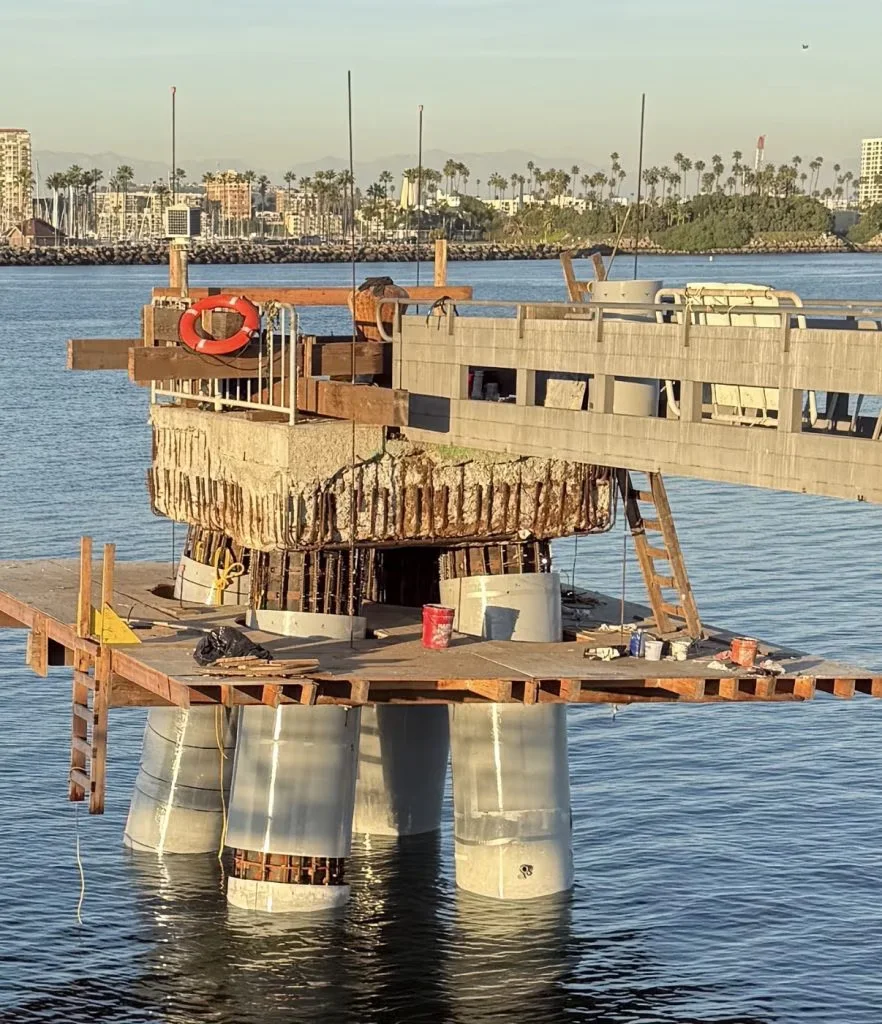
| Port of Long Beach, California | Steel pipe piles on two cruise terminal dolphins | Not listed |
Source: PileMedic® project map, pilemedic.com.
The closest agency test is on H-piles, not pipe piles. For Texas DOT, the University of Houston repaired 14 corroded HP12x53 steel H-piles with two FRP jacket systems patented by Prof. Ehsani. Axial capacity came back to the uncorroded value in 13 of the 14. The one exception had been built without the anchors its design called for. See test results and approvals for the report, and ask us for the data closest to your pile size.
Steel pipe pile repair FAQs
How do I know if my steel pipe piles need repair?
Look for rust, pitting or holes in the pipe wall, especially in the splash zone, plus cracked concrete at the cap and corroded bracing. Then measure the remaining wall thickness, usually with ultrasonic testing, to see how much capacity is left.
Can steel pipe piles be repaired without welding?
Yes. ShearWrap™ bands are bolted and torqued to the pile above and below the corroded zone and move load into a new grout shell by friction, so nothing is welded or drilled on the existing pile.
How much section loss can be repaired?
FHWA suggests a jacket below about 15% section loss, a reinforced jacket from 15 to 30%, and partial replacement above that. A reinforced jacket with a designed load path can rebuild a severely damaged pile in place, which is what your engineer would check.
Can the repair be done underwater?
Yes. The bands are easy for divers to place, and the PileMedic® laminate is bonded with an epoxy that cures underwater, so no cofferdam or dewatering is needed.
Will a jacket stop the pile from corroding?
It slows corrosion a great deal by sealing out water and oxygen, but FHWA advises that only cathodic protection should be relied on to prevent corrosion. For a long remaining life, ask your engineer about adding it.
How long does a pipe pile repair take?
It depends on access and the length of the repair. On Missouri DOT’s steel piles, each 2 ft shell took about two hours and 49 piles were done in two weeks.
Who designs the repair?
Your engineer of record. Our team will recommend the right PileMedic® system, including the ShearWrap™ type and quantity, and provide specifications for your engineer.
Sources
- Federal Highway Administration, Underwater Bridge Repair, Rehabilitation, and Countermeasures, Publication FHWA-NHI-10-029, Collins Engineers for FHWA, April 2010.
- National Bureau of Standards, Corrosion of Steel Pilings in Soils, M. Romanoff, NBS Monograph 58, April 1962.
- American Institute of Steel Construction, ANSI/AISC 360-16 Specification for Structural Steel Buildings, Section I6.3, July 7, 2016.
- M. Ehsani and M. Croarkin, A Novel Solution for Restoration of Deteriorated Piles, Government Engineering, March-April 2011.
- M. Ehsani, New Advances in Repair of Submerged Piles, Structural Engineering Institute Technical Corner, July 14, 2020.
- Texas DOT and FHWA, Report 0-6731-1, University of Houston, 2015. Summary on Test Results & Approvals.
- QuakeWrap, Inc., Marine Infrastructure Live, S3E2, Steel Pipe Pile Repair and Lessons from Seattle, March 30, 2025.
Have Corroded Steel Pipe Piles?
Tell us the pile diameter, wall loss and how far the corrosion goes. Our team will recommend the right PileMedic® system and provide specifications for your engineer.