
SEAWALLS · PERMITTING GUIDE
Environmental Permitting for Marine Repairs: A Guide for Seawall Owners
Repairs to seawalls, bulkheads and other structures in U.S. waters usually involve the U.S. Army Corps of Engineers, which evaluates permit applications for essentially all construction in the nation’s waters. Many routine activities fall under nationwide permits, but your Corps district decides. Here is how the federal process works and the environmental facts you and your engineer can document for a low-impact repair. This guide is not legal advice. See what to prepare.
Key takeaways
- Expect the Corps: USACE evaluates permit applications for essentially all construction in the nation’s waters, under Section 10 and Section 404.
- Nationwide permits: 57 general permits for minimal-impact activities took effect March 15, 2026; your district decides if one fits.
- Small footprint: SPiRe®+ repairs typically add only about 75 mm (3 in.) in front of the existing wall.
- Less in-water work: the old wall stays as formwork, with no cofferdam and, in many cases, no demolition or dredging.
- Nothing to leach: the cured GFRP panels are inert, do not corrode and need no coatings or preservatives.
Do you need a permit to repair a seawall?
In most cases you should expect to. The U.S. Army Corps of Engineers Regulatory Program says the Corps evaluates permit applications for essentially all construction activities that occur in the nation’s waters, including wetlands. A seawall or bulkhead sits right at the edge of those waters, so repair work on it usually involves the Corps in some way, even when the work qualifies for a streamlined general permit.
The Regulatory Program is one of the oldest in the federal government. It started with a simple purpose, protecting the navigable capacity of the nation’s waters, and today aims to protect aquatic resources and navigation while allowing reasonable development. States and local governments often have their own reviews as well, so the Corps is usually one stop, not the only one.
Which federal laws apply to work in the water?
The Corps’ main permitting authorities are Section 10 of the Rivers and Harbors Act of 1899 and Section 404 of the Clean Water Act, according to its federal regulation page. Section 103 of the Marine Protection, Research and Sanctuaries Act covers ocean dumping of dredged material. The Corps’ regulations split the work up like this:
| Authority | Regulation | What the regulation covers (by its title) |
|---|---|---|
| Rivers and Harbors Act of 1899, Section 10 | 33 CFR Part 322 | Permits for structures in or affecting navigable waters of the U.S. |
| Clean Water Act, Section 404 | 33 CFR Part 323 | Permits for discharges of dredged or fill material into waters of the U.S. |
| Marine Protection, Research and Sanctuaries Act, Section 103 | 33 CFR Part 324 | Permits for ocean dumping of dredged material |
| Nationwide permits | 33 CFR Part 330 | The nationwide permit program |
Source: U.S. Army Corps of Engineers, Regulations and Guidance, accessed October 2026.
The same page lists related laws a Corps review may involve, including the Coastal Zone Management Act, the Endangered Species Act, the National Historic Preservation Act, the Fish and Wildlife Coordination Act and the Essential Fish Habitat regulations. Which of them apply depends on your site. The definition of “waters of the United States” is also under rulemaking: the Corps and EPA proposed an updated definition in November 2025 and a supplemental proposal in September 2026.
What is a nationwide permit?
A nationwide permit (NWP) is a general permit that authorizes certain activities with minimal individual and cumulative adverse effects on the aquatic environment, without a full individual permit review. The Corps’ nationwide permits page says NWPs cover activities that need Department of the Army permits under Section 404 and/or Section 10, including bank stabilization activities.
The current set took effect on March 15, 2026. According to the Corps’ January 2026 fact sheet, the Corps reissued 56 existing NWPs and issued one new one, general permits can last no more than five years, and NWPs authorize about 25,000 reported activities a year plus about 30,000 that do not need to be reported. Division engineers can add regional conditions to protect local resources, for example to minimize adverse effects on fish or shellfish spawning or wildlife nesting.
Three NWPs are often discussed for seawall and shoreline work. The 2026 summary chart describes them this way:
| Nationwide permit | Authority | What the 2026 summary chart says it covers |
|---|---|---|
| NWP 3, Maintenance | Sections 10 and 404 | Repair, rehabilitation or replacement of previously authorized, currently serviceable structures or fills, with only minor deviations |
| NWP 13, Bank Stabilization | Sections 10 and 404 | Bank stabilization, generally limited to 500 ft along the bank unless the district engineer waives it; waivers for bulkheads are limited to 1,000 ft along the shore |
| NWP 54, Living Shorelines | Sections 10 and 404 | Construction and maintenance of living shorelines |
Each NWP also has notification thresholds, general conditions and regional conditions. Whether your project qualifies is decided by your Corps district. Read the current permit text before you plan around one.
You can apply online through the Corps’ Regulatory Request System (RRS), and the Regulatory Program page links to a tool to find your regulatory office. The full 2026 rule is in the Federal Register, January 8, 2026.
Need product data for a permit application?
Tell us about the structure and site. Our team will recommend the right QuakeWrap® system and provide product data and specifications for your engineer.
Why does repairing in place reduce environmental impact?
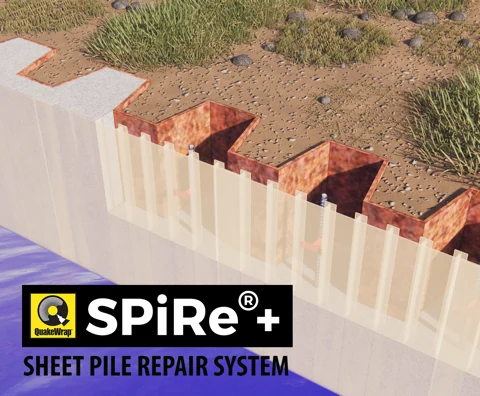
Repairing a seawall in place keeps most of the construction out of the water. With the SPiRe®+ system, pultruded glass fiber reinforced polymer (GFRP) panels are set in front of the existing wall and filled with grout. The old wall stays and becomes the formwork for the repair, which in many cases removes the need for demolition, excavation, dredging or hauling away old material.
| SPiRe®+ repair in place | Conventional replacement or reconstruction | |
|---|---|---|
| Existing wall | Stays in place and serves as the formwork | Can require demolition and removal |
| Excavation and dredging | Not needed in many cases | Can require excavation and dredging |
| Equipment | Relatively small equipment; lightweight panels | Typically larger equipment |
| Noise, vibration and turbidity | Significantly reduced | Higher |
| Waste | Little demolition waste | Demolition debris and removed materials |
| Underwater disturbance | Minimal; panels install without a cofferdam | Greater |
| Materials | Conserved by extending the life of the existing wall | A new wall from new materials |
Source: QuakeWrap®, Environmental Considerations of the SPiRe®+ Seawall Repair System (2026). Your engineer confirms these points for your project.
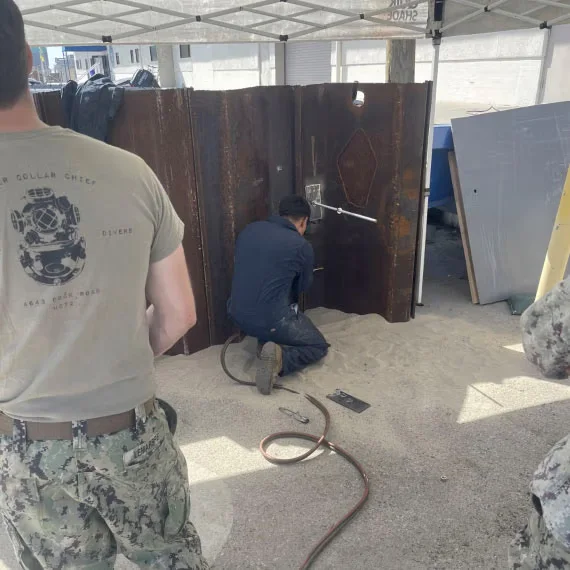
Plays from YouTube
How far does a SPiRe®+ repair extend into the waterway?
Typical SPiRe®+ installations project only about 75 mm (3 in.) from the face of the existing seawall. That low profile limits encroachment into the waterway, preserves the existing hydraulic conditions and has minimal effect on tidal flows or navigation. The exact projection depends on the space your engineer specifies between the panels and the wall.
Do SPiRe®+ panels affect water quality?
The panels are designed not to add anything to the water. They are made of glass fibers in a thermoset polymer matrix that is chemically stable and inert once cured, and similar GFRP has been used for decades in marine structures, vessels and docks.
- No corrosion products. Unlike steel, GFRP does not corrode, so it releases no corrosion products into the water.
- No coatings or treatments. The panels need no periodic protective coatings, chemical treatments or preservatives.
- A barrier for the old wall. The cured, impermeable panels help keep concrete fragments, corroded steel and other deterioration by-products out of the water.
- Weather resistant. They resist corrosion, ultraviolet exposure, freeze-thaw cycling and marine conditions.
The June 2026 product data sheet also notes that the panels are non-reactive and do not require a Safety Data Sheet, which can help when an agency asks what is going into the water. Request it from the product data sheets library.
Can marine repair work be scheduled around spawning seasons?
Yes. With SPiRe®+, installation methods can be selected to avoid sensitive breeding, migration or spawning periods, and the work can generally be done with minimal underwater disturbance. That flexibility matters because the Corps’ fact sheet notes that division engineers may add regional conditions to nationwide permits, for example to minimize adverse effects on fish or shellfish spawning or wildlife nesting. Ask your district about any work windows for your site.
What should you send your engineer and permitting agency?
A clear description of the repair speeds up every review. Your engineer of record prepares the design and the permit drawings. A checklist of the facts and documents that describe a SPiRe®+ repair:
- The wall: type, length, height, condition, photos and the water depth along it.
- The repair: panel type, the projection from the existing face and the fill material, from your engineer’s design.
- Product data: the SPiRe®+ data sheet, specifications and sample design details.
- The method: how the panels go in, the equipment, whether any cofferdam, excavation or dredging is needed, and how turbidity is controlled.
- The schedule: planned dates and any work windows for spawning or nesting seasons.
- The history: whether the existing wall was previously authorized, and any permits on file.
The anticipated service life of a SPiRe®+ repair is measured in decades, and fewer future repairs mean less future disturbance. That is part of why QuakeWrap® considers SPiRe®+ a low-impact repair for coastal and estuarine environments. Whether an agency agrees is its call, and the facts above are what it will look at.
Who handles the permit?
The owner applies, usually through the engineer of record or a permitting consultant. QuakeWrap® is a product company, not the engineer of record. Our team will recommend the right QuakeWrap® system and provide product data, specifications and sample design details for your engineer to use. For background on the structures themselves, see What Is a Seawall? and repairing seawalls without cofferdams.
Permitting is also a cost and schedule item. If you are budgeting a project, our seawall repair cost guide covers how permits and engineering fit into the price, and Rising Sea Levels and Seawalls covers projects that raise a wall at the same time.
Environmental permitting FAQs
Who issues permits for seawall work in U.S. waters?
The U.S. Army Corps of Engineers evaluates permit applications for essentially all construction activities in the nation’s waters, under Section 10 of the Rivers and Harbors Act and Section 404 of the Clean Water Act. State and local agencies may also have requirements.
What is a nationwide permit?
A general permit from the Corps that authorizes certain activities with minimal individual and cumulative adverse effects on the aquatic environment. The current 57 nationwide permits took effect on March 15, 2026.
Which nationwide permit covers seawall repair?
NWP 3 (Maintenance) and NWP 13 (Bank Stabilization) are often discussed for shoreline work, but whether any NWP covers your project is decided by your Corps district.
Do SPiRe®+ panels leach anything into the water?
Once cured, the glass fiber and thermoset polymer panels are chemically stable and inert. They do not corrode, so they release no corrosion products, and they need no chemical treatments, preservatives or coatings.
How far does the repair extend into the waterway?
Typical installations project only about 75 mm (3 in.) from the face of the existing seawall. The exact projection depends on the repair your engineer designs.
Does the old seawall have to be removed?
In many cases, no. The existing wall stays in place and serves as the formwork for the repair.
Can you provide product data for the environmental review?
Yes. Our team will recommend the right QuakeWrap® system and provide product data sheets, specifications and sample design details for your engineer.
Sources
- U.S. Army Corps of Engineers, Regulatory Program and Permits, accessed October 2026.
- U.S. Army Corps of Engineers, Regulations and Guidance, accessed October 2026.
- U.S. Army Corps of Engineers, Nationwide Permits, accessed October 2026.
- U.S. Army Corps of Engineers, Nationwide Permit Reissuance fact sheet, January 8, 2026.
- U.S. Army Corps of Engineers, 2026 Nationwide Permits Final Action Summary Chart, 2026.
- Federal Register, Reissuance and Modification of Nationwide Permits, January 8, 2026.
- QuakeWrap, Inc., Environmental Considerations of the SPiRe®+ Seawall Repair System, June 2026.
- QuakeWrap, Inc., SPiRe®+ Panel product data sheet, June 2026.
Planning a Marine Repair?
Tell us about the structure and site conditions. Our team will recommend the right QuakeWrap® system and provide specifications for your engineer.