
SEAWALLS · GUIDE
What Is a Seawall? Types, How They Work and Why They Fail
A seawall is a wall built along the shoreline, parallel to the water, that stops waves and tides from eroding the land behind it and protects homes, roads and ports from flooding and storm surge. Seawalls are built from concrete, steel, vinyl, timber, rock and FRP. Here is how they work, how they differ from bulkheads, why they fail and how a damaged wall can be repaired. Jump to repair options.
Key takeaways
- Definition: a seawall is a wall along the shore that stops waves and tides from eroding the land behind it.
- Seawall vs. bulkhead: a seawall mainly holds back waves, a bulkhead mainly holds back soil, and the terms are often used interchangeably.
- Shape matters: vertical walls reflect the most wave energy and can scour the beach in front; curved and stepped faces absorb more.
- Most failures start with soil loss: toe scour, holes, failed tiebacks and overtopping let fill wash out from behind the wall.
- Repair is often possible: if the buried part is sound, FRP panels and grout can rebuild the face without a cofferdam.
What is a seawall?
A seawall is a coastal defense structure that fixes the boundary between land and water. It runs along the shore and is built to stop further erosion of the shoreline and to protect what sits behind it, from homes and parks to roads, ports and utilities, against tides, waves and storm surge.
Engineers group shoreline structures by what they do. The U.S. Army Corps of Engineers design manual classes vertical structures as either seawalls or bulkheads, according to their function, and calls protective materials laid on a slope revetments. Seawalls, it says, are the more massive structures, and their main job is to intercept waves.
Seawalls also need less space than dikes and other coastal defenses, which is why they line so many waterfront cities, marinas and canal communities. The trade-off is that a seawall protects mainly the land directly behind it, and it changes how waves behave in front of it.
What is the difference between a seawall and a bulkhead?
A bulkhead mainly holds back soil, while a seawall mainly holds back waves. The Corps manual notes that the two terms are often used interchangeably, but a bulkhead is primarily intended to retain the land or keep it from sliding, with wave protection secondary. Seawalls are heavier walls built to take wave action head on.
| Structure | Main job | Typical construction | Where it is used |
|---|---|---|---|
| Seawall | Intercept waves and protect the land behind | Massive concrete or rock, with vertical, curved (concave) or stepped faces | Open coasts with intense wave action |
| Bulkhead | Retain soil and stop the land from sliding | Cantilevered or anchored sheet piles (steel, vinyl, aluminum, concrete, timber) or gravity structures such as rock-filled timber cribs | Canals, marinas and docks where boats need deep water right at the shore |
| Revetment | Armor a sloped bank against erosion | Stone or concrete armor over filter layers, with toe protection | Banks and bluffs with room for a slope |
| Living shoreline | Stabilize the shore with natural materials | Plants, sand, rock or oyster shells | Sheltered bays, estuaries and tributaries |
Sources: U.S. Army Corps of Engineers, EM 1110-2-1614 (1995), for seawalls, bulkheads and revetments; NOAA Fisheries for living shorelines.
In everyday use, most people call any wall at the water’s edge a seawall, including the steel sheet pile walls that line Florida canals and the timber walls behind lake homes. They fail in the same ways and are repaired with the same methods, so this guide covers both. See seawall and bulkhead repair for repair options by wall type.
How do seawalls work?
Seawalls work by reflecting or redirecting incoming wave energy back toward the sea, so less of that energy is left to erode the shore. The shape of the face decides how much energy bounces back and how much is absorbed.
Vertical seawalls
A vertical wall reflects wave energy almost straight back into the water. It is useful on steep beaches where heavy waves hit directly. The Corps manual warns that vertical walls are nearly perfect wave reflectors, and the reflected waves can scour the base of the wall and erode the beach in front of it.
Curved and stepped seawalls
A curved (concave) face redirects most of the incoming energy, so reflected waves and turbulence are lower, less water overtops the wall and the toe gets extra protection. Stepped and rough faces absorb or dissipate more energy than a flat vertical face. Design is more complex, and deflected waves can still scour the base. The Corps manual uses the curved-face seawall at Galveston, Texas, as one of its examples.
Mound seawalls
A mound seawall is a sloping pile of rock or concrete units that breaks up wave energy and retains sediment behind it. It is designed for an acceptable rate of overtopping, and its slope can double as space for walkways and recreation.
What are the different types of seawalls?
Seawalls are usually described by material: timber, steel sheet pile, vinyl, concrete, rock (cobblestone or riprap) and fiber reinforced polymer (FRP). The right choice depends on the wave climate, the soil, the level of protection needed and the budget.
| Type | How it is built | Strengths | Limitations |
|---|---|---|---|
| Timber | Vertical log piles covered with wood planks and sheets | Low initial cost; natural appearance | Height limits in high surf; needs preservative treatment against rot and marine borers; hard to install in very hard ground; more maintenance |
| Steel sheet pile | Interlocking steel sheets driven into the ground, often anchored with tiebacks | Strong; drives into almost any soil; suits tall walls | Expensive to buy and heavy to transport; corrodes, so protective coatings must be renewed |
| Vinyl (PVC) sheet pile | Pre-colored vinyl sheet piling | Lower cost; easy to install; color can be chosen | Height limits; can’t be driven into hard ground; single corrugated sheets may not withstand harsh winters and ice push |
| Concrete | Reinforced concrete cast from the foundation to the crest, or precast sheet piles | One of the most common types; strong against waves, tides and erosion | Water that enters through cracks corrodes the reinforcing steel |
| Cobblestone or rock | Large rocks and boulders arranged as a solid barrier | Suits light to moderate wave action; blends with the coastline | Can still erode over time; may need maintenance and periodic beach replenishment |
| Riprap | Large and small boulders and chunks of concrete | Dissipates wave force before it reaches the soil behind the rocks | Rock size and layout are site specific; ask your engineer |
| FRP sheet pile or panels | Composite sheet piles, or FRP panels used to rebuild an existing wall | Non-corroding; lightweight | Design is specific to the product; your engineer checks capacity |
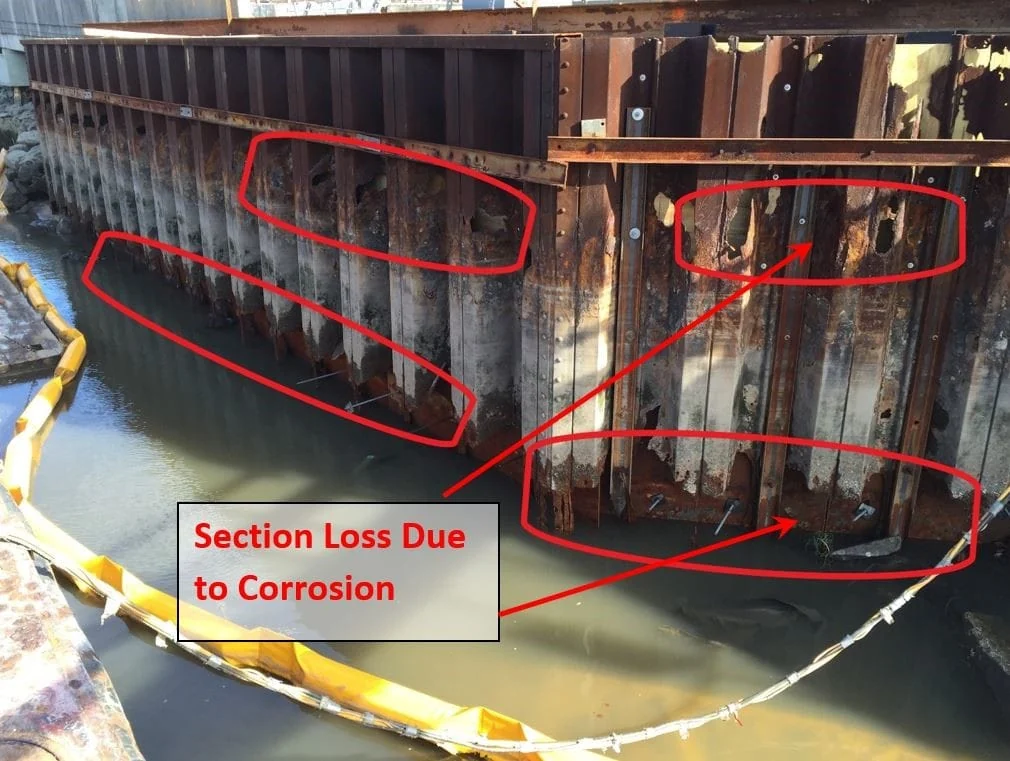
Sheet pile walls of any material are long structural sections with interlocking edges that form a continuous wall. On steel and concrete walls, damage usually starts in the splash zone between low and high tide, where constant wetting and drying drives corrosion. The part buried in soil usually stays sound, because there is too little oxygen there to keep corrosion going.
What are the advantages and disadvantages of seawalls?
The main advantage of a seawall is that it stops erosion at a fixed line and protects valuable land behind it in a small footprint. The main disadvantage is that it can increase erosion next to and in front of the wall, and it needs regular inspection and repair.
| Topic | Advantage | Disadvantage |
|---|---|---|
| Erosion | Fixes the boundary between land and sea and stops erosion of the shore behind the wall | Can disrupt natural sediment transport and increase erosion on adjacent shorelines and the beach in front |
| Durability | More durable than soft defenses such as beach nourishment, especially in reinforced concrete | Steel corrodes, concrete cracks and timber decays, so walls need regular inspection and maintenance |
| Footprint | Needs less space than dikes and other coastal defenses | Can interfere with natural processes such as habitat migration |
| Water levels | Designed to resist wave forces and extreme water levels | A wall built for today’s water levels may need to be raised as seas rise |
| Cost | A deteriorated wall can often be repaired in place instead of replaced | High construction cost for materials and labor |
Rising water is the disadvantage most owners will face next. If waves already wash over the top of your wall in storms, read how rising sea levels affect seawalls and how an existing wall can be raised.
Have a seawall that is losing soil or rusting through?
Send us the wall type, its condition and a few photos. Our team will recommend the right QuakeWrap® system and provide specifications for your engineer.
Why do seawalls fail?
Most seawalls fail because soil washes out from behind or beneath them, not because the wall snaps. New York Sea Grant‘s maintenance guide for shoreline structures traces failures to a handful of causes:
- Toe scour. Waves undermine the base of the wall. Telltale signs are tilting or tipping toward the water and uneven settling.
- Loss of fill. Soil leaks through holes, cracks, open joints or failed filter fabric, leaving voids, hollows and sinkholes behind the wall.
- Failed anchors. If the top of the wall looks wavy or bowed when you sight along it, a tieback rod or deadman may be defective.
- Overtopping. Ground that stays wet or collects debris after heavy waves means the wall is too low for the conditions. Spray is acceptable, but “green water” over the top is a bad sign.
- Flanking. Erosion working around the ends of the wall puts the whole structure at risk.
Corrosion speeds all of this up. Salt water attacks steel sheet piles and the rebar inside concrete, and timber rots above the waterline and is attacked by marine borers below it. For the full list of warning signs and what each repair costs, see our seawall repair cost guide.
How long does a seawall last?
Many seawalls last 30 to 50 years with proper installation and maintenance, but the real number depends on the material, the water and how quickly damage is fixed. New York Sea Grant puts properly designed, built and maintained wooden bulkheads at 10 to 20 years of effective protection.
Two things shorten a wall’s life more than anything else: skipped inspections and slow repairs. A failed tieback or a small hole in the splash zone is a modest fix. Left alone for a few storm seasons, the same defect can empty the soil behind the wall and turn a repair into a replacement.
Can a seawall be repaired instead of replaced?
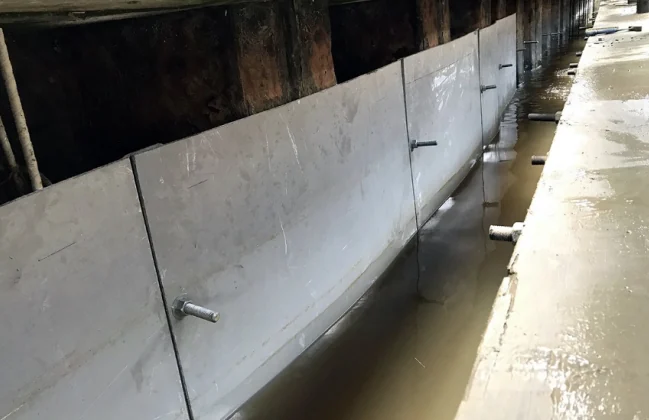
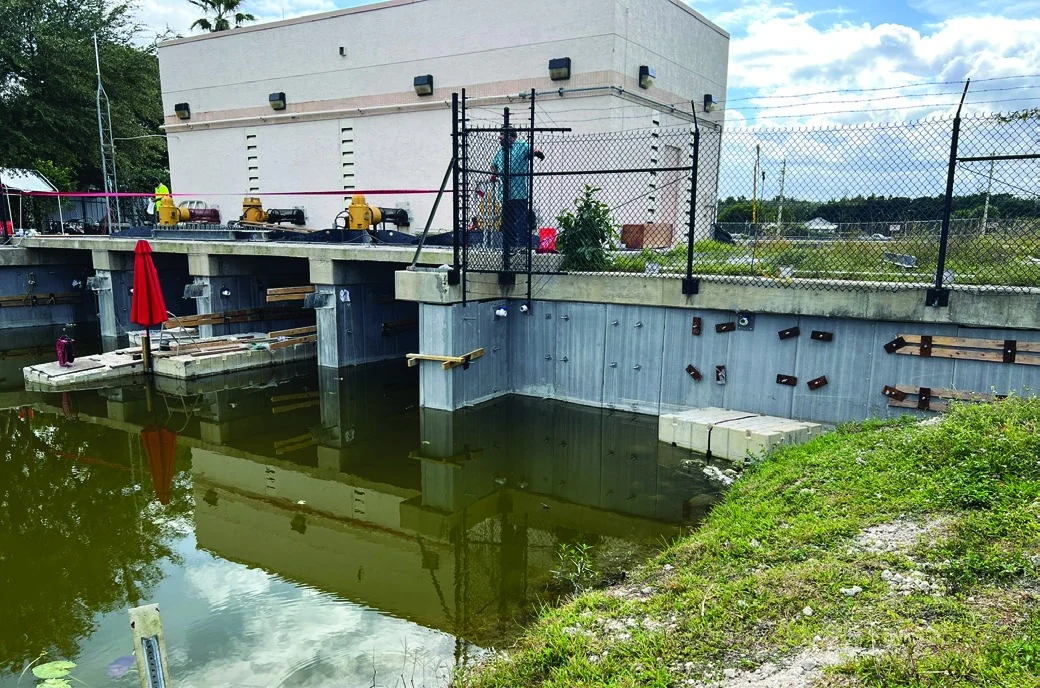
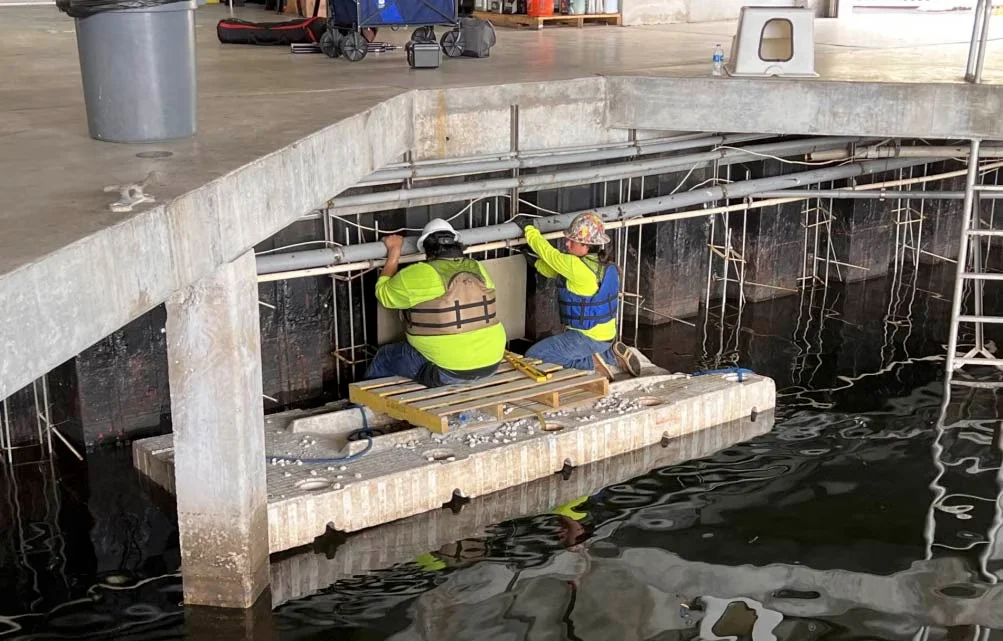
Often, yes. When the part of the wall buried in soil is still sound, a corroded wall can be rebuilt in place by setting new panels in front of it and filling the gap with grout. The old wall stays where it is and becomes the backing for a new, watertight face.
QuakeWrap® SPiRe®+ panels are made for this. Each pultruded FRP panel is 3 ft (914 mm) wide, comes in 6 to 20 ft lengths in 2 ft increments and weighs 3.57 lb/sq ft, so crews can place it by hand. The smooth outer face stays visible, and the grit-coated T profiles on the inner face lock into the grout. Because the panels install underwater, there is no cofferdam to build or water to pump out.
- Inspect and designYour engineer of record checks the wall and the soil and designs the repair. We supply product data and sample details.
- Anchor the panelsPanels are bolted to the existing wall at the stand-off your engineer specifies, with overlapping edges sealed.
- Seal and groutThe bottom and sides are sealed and the space behind the panels is filled with grout, forming a new composite wall.
Plays from YouTube
Repair is not always the answer. If the wall is failing along most of its length, or the steel is too far gone to anchor to, replacement or a new wall in front may make more sense. The economical solution for seawall and bulkhead repair compares welding, coatings and FRP panels, and the cost guide covers the 50% rule for repair versus replace.
What are the alternatives to seawalls?
The main alternatives are living shorelines, beach nourishment, dune restoration and offshore breakwaters. NOAA Fisheries describes a living shoreline as a nature-based way to stabilize a shoreline with natural materials such as plants, sand, rock or oyster shells, and notes that hardened shorelines like concrete seawalls and bulkheads generally offer minimal to no ecological benefits and can be costly to maintain.
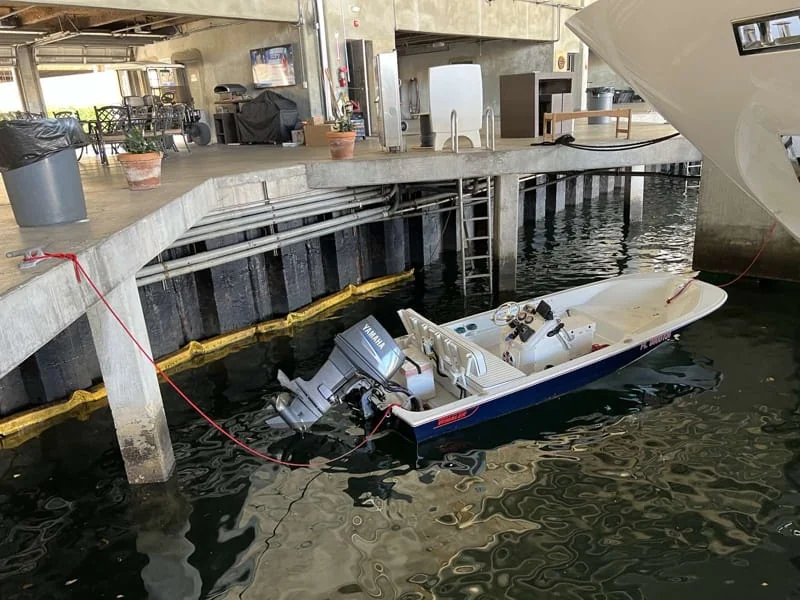
Soft approaches suit sheltered water and sites with room to spread out. Where a home, road or port sits right at the water’s edge, or boats need deep water at the wall, a seawall or bulkhead is often the only practical option. In that case, keeping the existing wall in good repair is usually the lowest-impact choice. Read more about environmental permitting for marine repairs.
Seawall FAQs
What is the purpose of a seawall?
A seawall stops waves and tides from eroding the shore and protects the land, buildings and infrastructure behind it from flooding and storm surge. It fixes the line between land and water.
What is the difference between a seawall and a bulkhead?
A bulkhead mainly retains soil and keeps the land from sliding, while a seawall is a heavier structure built mainly to intercept waves, according to the U.S. Army Corps of Engineers. In everyday use the terms are often interchangeable.
How do seawalls affect coastal ecosystems?
Seawalls can change how water and sediment move along the shore, which can increase erosion nearby and shift where plants and animals live. Vertical walls reflect the most wave energy and can scour the beach in front of them.
How long does a seawall last?
Many seawalls last 30 to 50 years with proper installation and maintenance. New York Sea Grant puts well-built, well-maintained wooden bulkheads at 10 to 20 years.
What determines the cost of a seawall?
Design height, wave loads, wall type, materials, distance to materials, local labor, access and ongoing maintenance. Our seawall repair cost guide gives per-foot prices for common repairs.
What are the alternatives to seawalls?
Living shorelines, beach nourishment, dune restoration and offshore breakwaters. They keep more natural processes working but need more space and suit calmer water.
Can a corroded seawall be repaired instead of replaced?
Often, yes. When the buried part of the wall is still sound, SPiRe®+ FRP panels can be bolted in front of it and filled with grout to form a new watertight face, without cofferdams. Your engineer of record decides whether repair is feasible.
Sources
- U.S. Army Corps of Engineers, EM 1110-2-1614, Design of Coastal Revetments, Seawalls, and Bulkheads, June 30, 1995.
- New York Sea Grant, Maintaining Shoreline Erosion Control Structures, C. O’Neill, 2002.
- NOAA Fisheries, Understanding Living Shorelines, accessed October 20, 2026.
- M. Ehsani, Evolution of FRP Products for Concrete Repair, Concrete International, April 2025.
- QuakeWrap, Inc., SPiRe®+ Panel product data sheet, June 2026.
- QuakeWrap, Inc., What Is a Seawall (January 2024) and Seawall Repair Cost (December 2023) guides.
Have a Seawall That Needs Attention?
Tell us about the wall and site conditions. Our team will recommend the right QuakeWrap® system and provide specifications for your engineer.