
SEAWALLS · COST GUIDE
Seawall Repair Cost: Prices per Foot and How to Estimate Yours
Most seawall repairs cost $100 to $250 per linear foot, or about $15,000 to $60,000 for a typical waterfront home. Sealing cracks and joints sits at the low end. Fixing a leaning wall, a failed toe or cracked panels can run $200 to $600 per foot. Here is what drives the number, when repair beats replacement, and how to estimate your own wall. Jump to the estimator.
Key takeaways
- Typical repair: $100 to $250 per linear foot, with most homeowners spending $15,000 to $60,000.
- Damage type sets the price: grouting joints is about $100 per foot, restoring cracked panels up to $600.
- Repair or replace: new walls run $100 to $800 per foot. If repair would cost half of that or more, consider replacing.
- Access is the hidden cost: divers, cofferdams and permits can outweigh materials.
- Catch it early: a wavy top line, tilting or sinkholes behind the wall mean it is time to call an engineer.
Estimate your seawall repair cost
Measure three things: the length of wall that needs repair, the height of the damaged zone, and the average wall thickness. Length times height gives the surface area, which drives material quantities and crew time. Use the estimator below for a materials range.
Seawall Cost Estimator
Enter the length and height of the wall you want to repair and its average thickness. The estimator works out the surface area and an estimated range for SPiRe®+ panels, miscellaneous materials and grout.
Materials only, and approximate. Labor is not included: it depends on the method (divers or waders) and the job location, including union affiliation and local cost of living. A standard 4-person crew covers about 15 to 20 sq ft per hour. Your engineer’s design and a site visit set the final number.
Want a detailed breakdown of your estimated cost?
GET A SEAWALL REPAIR CONSULTATIONHow much does seawall repair cost?
Contractors generally charge $100 to $250 per linear foot to repair a seawall, according to Angi‘s 2025 cost guide. Most homeowners spend $15,000 to $60,000, and the average is about $37,500. Longer walls and heavier damage push toward the top of the range.
Large commercial walls are a different scale. In our 2023 guide we noted that small residential repairs start around $15,000, while big commercial seawalls can pass $1,000,000. Price per foot is a starting point. What actually sets the cost is how much of the wall is damaged, how deep the damage goes, and how hard it is to reach.
| Wall length | Typical repair cost |
|---|---|
| 10 ft | $1,000 to $2,500 |
| 30 ft | $3,000 to $7,500 |
| 50 ft | $5,000 to $12,500 |
| 80 ft | $6,000 to $20,000 |
| 100 ft | $10,000 to $25,000 |
| 150 ft | $15,000 to $37,500 |
| 200 ft | $20,000 to $50,000 |
| 250 ft | $25,000 to $62,500 |
Source: Angi, updated November 2025. Ranges assume typical repairs at $100 to $250 per linear foot.
Seawall repair cost by type of repair
The kind of damage matters more than the length of the wall. Sealing a crack is a patch. Fixing a wall that is leaning or losing its toe means restoring how the wall holds back soil, and the price reflects that.
| Repair | Cost per linear foot | What it addresses |
|---|---|---|
| Grouting joints | $100 to $125 | Open joints between panels that let soil wash out |
| Fixing small cracks | $100 to $180 | Surface cracks before water and salt reach the reinforcement |
| New concrete caps and tiebacks | $125 to $230 | A damaged cap or anchors that hold the wall upright |
| Soil stabilization | $120 to $270 | Voids and soft soil behind the wall |
| Fixing leaning walls | $200 to $600 | A wall rotating toward the water |
| Installing secondary anchors | $225 to $300 | Added anchoring where tiebacks have failed |
| Fixing joint separation | $250 to $500 | Panels pulling apart along the wall |
| Addressing toe berm failure | $300 to $600 | Scour at the base that undermines the wall |
| Restoring cracked panels | $450 to $600 | Panels that have lost section or strength |
Cost ranges: Angi, November 2025. Descriptions are ours.
What drives seawall repair cost
Every quote is built from the same handful of factors. Knowing them helps you read a bid and spot what is missing.
Size of the repair
Length and height set the surface area that needs work. A longer, taller wall needs more material and more crew time. Many repairs only need the band where corrosion is worst, often the splash zone, rather than the full height.
How bad the damage is
Minor cracks or small areas of missing concrete keep costs low. Widespread or structural damage, such as a leaning wall, failed tiebacks or lost toe support, moves the job from patching to restoring capacity.
Wall material and shoreline
Steel, vinyl, aluminum, timber and concrete walls fail in different ways and take different fixes. Salt water is harder on materials than fresh water, and the shoreline, rocky or sandy, changes how the toe behaves.
Access and water depth
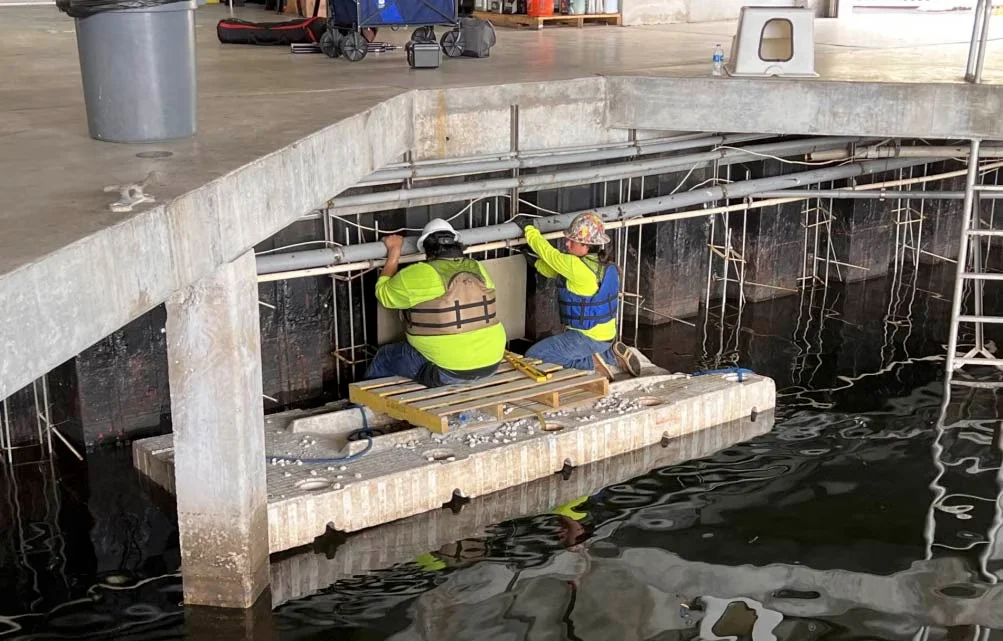
How crews reach the wall is one of the biggest swing factors. Work from land or a barge, with waders or with divers, all price differently. Remote or tight sites need extra logistics. Methods that need a cofferdam or dewatering add cost and time before any repair begins.
Labor and location
Labor is 25% to 40% of a typical repair and runs about $50 to $100 per hour (Angi). Rates vary with union affiliation and local cost of living. As a rule of thumb from our own estimating, a standard 4-person crew covers about 15 to 20 sq ft of wall per hour.
Permits and engineering
Repairs in the water usually need permits, and structural repairs need an engineer to define the scope and sign off on the design. Budget time for both. If you also plan dock work, doing both at once can make permitting simpler. See environmental permitting for marine repairs.
Repair or replace your seawall?
A new seawall typically costs $10,000 to $100,000, or about $100 to $800 per linear foot, and complex projects can reach $1,000 per foot (Angi). Our 2023 guide put new residential walls at $150 to $600 per foot and commercial or high-erosion sites at $700 to $2,000 per foot.
The deciding question is whether the wall as a whole is still sound. Damage to individual parts, like a broken tieback or a scoured toe, is far easier to fix than a wall whose material has aged out everywhere. A qualified marine engineer should make that call after an inspection.
- Usually a repair: sound sheet piles or panels with localized corrosion, open joints, a damaged cap, or early toe scour.
- Look at replacement: widespread section loss, a wall failing along most of its length, or repairs that keep coming back.
- Repair in between: if the steel is too corroded to anchor to, new H-piles can be driven just in front of the wall and panels spanned between them.
Not sure if your wall can be repaired?
Send photos, the wall type and its length. Our team will recommend the right QuakeWrap® system and give your engineer the specifications.
Signs your seawall needs repair now
Small problems get expensive fast once water starts moving soil out from behind the wall. Walk your wall a few times a year and after big storms, and take photos so you can compare over time. New York Sea Grant’s guide for shoreline structures points to these warning signs:
- A wavy or bowed top line. Sight along the top of the wall. If it is not straight, a tieback rod or deadman anchoring the wall may have failed.
- Tilting toward the water or uneven settling. Telltale signs that the toe is being undermined.
- Sinkholes or low spots behind the wall. Fill is washing out through holes, cracks or open joints.
- Bottom of the wall pushed seaward. Boards or panels angled out at the base point to toe scour.
- Rust staining, cracks and spalling. Corrosion in the splash zone that will keep growing.
Common causes are soil erosion from tides, skipped maintenance, hurricanes that scour soil from behind the wall, earthquakes that crack concrete, and the steady corrosion of a salt water environment. For more on how walls fail, read What Is a Seawall?
How to repair a seawall without replacing it
One way to restore a corroded wall in place is a stay-in-place panel system such as SPiRe®+. Fiber reinforced polymer (FRP) panels are anchored a few inches in front of the existing wall and the gap is filled with grout. The result is a new watertight, structural face that stops soil loss and keeps oxygen and moisture off the old steel or concrete.
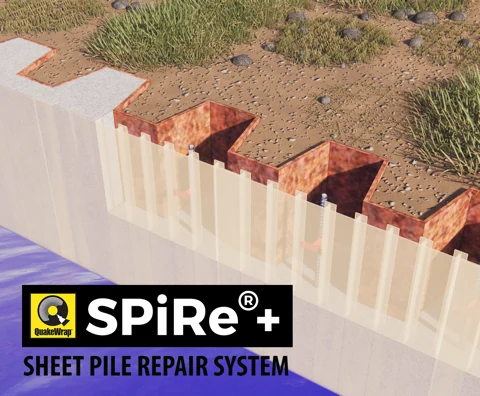
- AnchorL-bolts are anchored to the seawall on an approximate 3 ft x 3 ft grid, and the panels are set at the required stand-off from the wall.
- Seal the jointsOverlapping panel edges are sealed with a rubber butyl sealant until the full repair length and height is covered.
- Close the spaceThe bottom and sides of the space are sealed, for example with FRP or plywood plates cut to the wall profile.
- GroutEpoxy grout seals the bottom, cementitious grout fills the bulk of the space, and epoxy grout seals the top.
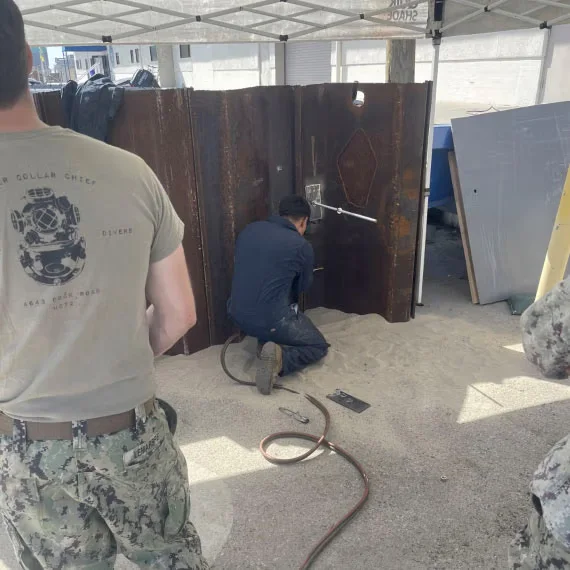
Because the panels go on underwater, there is no cofferdam to build and no water to pump out, which is where much of the cost and schedule of a conventional repair goes. Each 3 ft wide panel is 0.20 in. thick, comes in 6 to 20 ft lengths and weighs about 3.57 lb/sq ft, so crews can handle it by hand.
Plays from YouTube
How to keep seawall repair costs down
- Inspect on a schedule. Catching a failed tieback or early toe scour turns a rebuild into a repair.
- Fix drainage and the toe early. Most expensive failures start with soil washing out behind or under the wall.
- Repair only what is damaged. Targeting the corroded band instead of the full wall height cuts material and time.
- Avoid cofferdams where you can. Systems installed underwater skip a large share of the cost and schedule.
- Bundle the work. Doing dock and seawall work together can simplify permits and mobilization.
- Bring in an engineer first. A clear scope gets you comparable bids and fewer change orders.
Seawall repair cost FAQs
How much does it cost to repair a seawall per foot?
Most seawall repairs cost $100 to $250 per linear foot. Simple joint grouting or crack repair can be $100 to $180 per foot, while fixing a leaning wall, toe failure or cracked panels runs $200 to $600 per foot.
How much does it cost to repair a 100 ft seawall?
At typical rates, about $10,000 to $25,000. A 100 ft wall that needs structural work such as panel restoration can cost $45,000 to $60,000 or more.
Is it cheaper to repair or replace a seawall?
Repair is usually cheaper. A new seawall typically runs $100 to $800 per linear foot. A common rule of thumb is to consider replacement when repairs would cost 50% or more of a new wall.
How long does a seawall last?
With proper installation and maintenance, many seawalls last 30 to 50 years. Material, water conditions and how quickly damage is repaired all change that number.
How long does a seawall repair take?
It depends on the area and access. As a guide, a 4-person crew covers about 15 to 20 sq ft of wall per hour, so a 600 sq ft repair is roughly 30 to 40 crew-hours on the wall, plus mobilization and permitting.
Can a seawall be repaired without draining the water?
Yes. Stay-in-place FRP panel systems such as SPiRe®+ are installed underwater without cofferdams, which avoids much of the cost and time of dewatering.
What is the most common cause of seawall damage?
Soil washing out from behind or under the wall, usually through open joints or toe scour, combined with corrosion in salt water. Storms speed up both.
Sources
- Angi, How Much Does It Cost to Repair a Seawall? Updated November 21, 2025.
- New York Sea Grant, Maintaining Shoreline Erosion Control Structures, C. O’Neill, 2002.
- QuakeWrap, Inc., Seawall Repair Cost guide, December 2023 (labor rate, residential and commercial ranges, lifespan).
- QuakeWrap, Inc., SPiRe®+ Panel product data sheet, June 2026.
- QuakeWrap, Inc., Port of West St. Mary project sheet.
Want a Number for Your Seawall?
Send the wall type, length and a few photos. Our team will recommend the right QuakeWrap® system and give your engineer the specifications to price it.