
SEAWALLS · REPAIR GUIDE
Seawall and Bulkhead Repair: An Economical Solution With FRP Panels
The most economical way to repair a corroded seawall or bulkhead is often to rebuild it in place: bolt fiber reinforced polymer (FRP) panels in front of the old wall and fill the gap with grout. The new shell keeps oxygen and water off the corroding wall and stops soil loss, without cofferdams, dewatering or underwater welding. Here is why walls fail, how the methods compare and how a 926 ft wall was repaired. Jump to the case study.
Key takeaways
- Damage starts in the splash zone: the band between low and high tide corrodes first, while the buried part of the wall usually stays sound.
- Welding and coatings fall short: welded plates corrode again, and coatings need a cofferdam and crack over time.
- FRP panels and grout rebuild the face in place: no cofferdam, no dewatering and no steel to corrode.
- Proven at scale: the first SPiRe® repair covered a 926 ft wall, 4 to 14 ft tall, in Chesapeake, Virginia.
- Strength can be designed in: SPiRe®+ panels equal No. 6 Grade 60 bars at 3.5 in., checked by your engineer of record.
How do you repair a corroded seawall or bulkhead?
There is no universally accepted method for repairing corroded seawalls. The three common approaches are welding new steel plates over the damage, cleaning the wall and coating it, or building a new protective face in front of it. The first two leave the wall exposed to the same corrosion that damaged it. The third replaces the exposed face with materials that cannot corrode.
This article is based on Prof. Ehsani’s paper An Economical Solution for Repair of Seawalls and Bulkheads (2023), updated with the current SPiRe®+ panel data. For prices per foot, see the seawall repair cost guide.
Why do seawalls and bulkheads fail at the splash zone?
Seawalls and bulkheads usually fail in the splash zone, the band between low and high tide, because constant wetting and drying drives corrosion there. Sheet piles and bulkheads retain soil at the water’s edge, and this is the part of the wall that takes the beating as it ages.
In reinforced concrete walls, water gets in through cracks and corrodes the reinforcing steel. Steel and timber walls also weaken with age. In extreme cases the section loss is large enough for soil to wash out through cracks and holes, and the ground the bulkhead supports starts to settle.
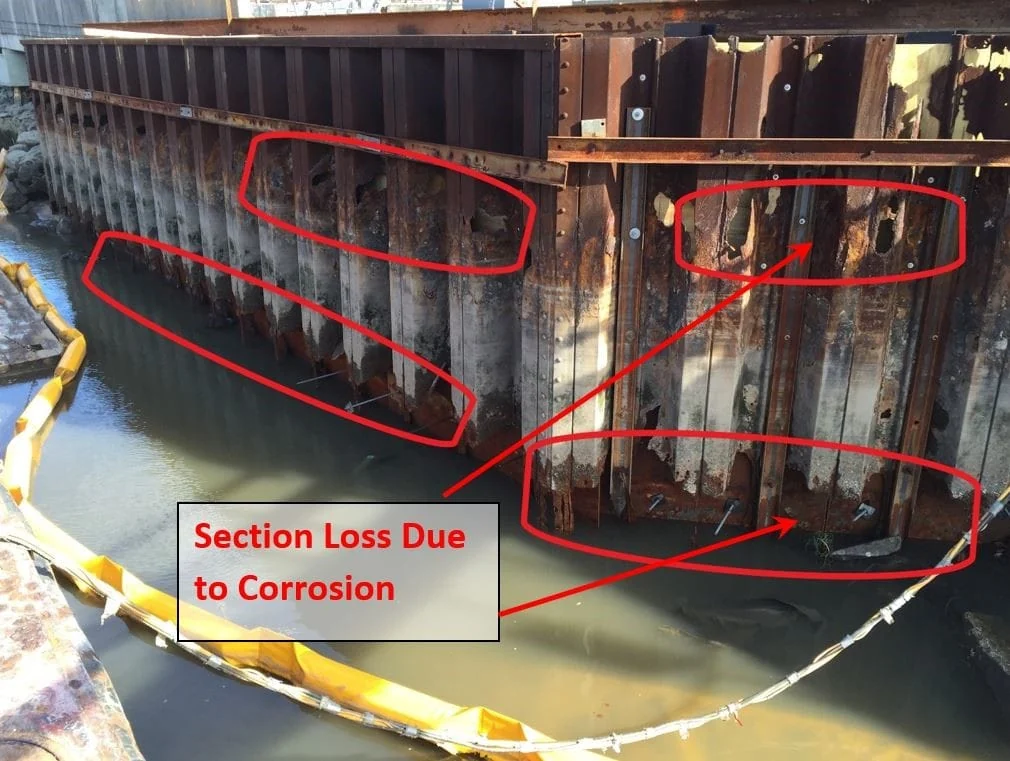
The part of the wall embedded in soil usually stays relatively undamaged, because there is too little oxygen at those depths to keep corrosion going. That sound lower section is what makes an in-place repair possible: the new face only has to cover and seal the damaged zone above it.
If you are not sure how far the damage goes, start with a walk-through. New York Sea Grant points to tilting toward the water, uneven settling, voids or sinkholes behind the wall and a wavy top line (a sign of a failed tieback) as signs that soil is being lost and the wall needs attention.
Welding, coatings or FRP panels: which repair works best?
FRP panels with grout avoid the two problems that limit the other methods: the need to work in the dry, and the risk of the repair corroding again. Here is how the three compare.
| Welded steel plates | Corrosion-inhibiting coating | FRP panels and grout | |
|---|---|---|---|
| How it works | New steel plates are welded to the wall where section loss is significant | Rust is cleaned off and a corrosion-inhibiting paint is applied | Panels form a stay-in-place shell in front of the wall, and the gap is filled with grout |
| Access | Welding underwater, and permits for it are difficult to obtain | A cofferdam and dewatering so the crew can reach the wall | Installed in the water, no cofferdam |
| Cost | Underwater welding is costly | Cofferdams are costly, especially in deep water | Lightweight panels are lifted by hand, so installation is faster in hard-to-reach areas |
| Long term | The new, unprotected steel corrodes just as the original did | Once the coating cracks, water and oxygen fuel corrosion again | No steel components; expected 50+ year service life |
Source: M. Ehsani, An Economical Solution for Repair of Seawalls and Bulkheads, 2023.
Replacement is the fourth option. It makes sense when a wall is failing along most of its length or the steel is too far gone to anchor to. A common rule of thumb is to look seriously at replacement when repair would cost half or more of a new wall. The repair or replace section of our cost guide walks through it.
Is your bulkhead losing soil?
Send us the wall type, its condition and the water depth. Our team will recommend the right QuakeWrap® system and provide specifications for your engineer.
What is the SPiRe® system?
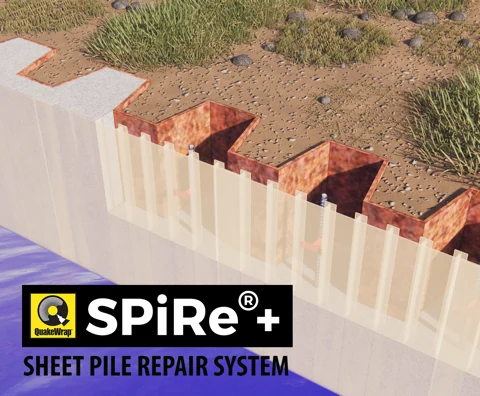
SPiRe® (Sheet Pile Repair) is a system of rigid FRP panels that form a permanent, watertight shell in front of a deteriorated wall. Following decades of research and development, Prof. Ehsani received U.S. Patent 10,968,631 for it in 2021.
The original SPiRe® panels use the sandwich construction common in the aerospace and shipbuilding industries. A proprietary lightweight core about 0.2 to 0.3 in. thick sits between one or more layers of unidirectional or biaxial glass or carbon fabric. The core and fabric are selected for each project, and the finished panel is typically less than 0.5 in. thick. Panels are made by resin infusion, can be shaped to match an existing wall, and are most often flat sheets 4 ft wide, made in any length and cut to length in the field.
SPiRe®+ is the newer, pultruded version. Its built-in T profiles lock into the grout and act as reinforcement, so the panel adds strength as well as protection.
| Original SPiRe® | SPiRe®+ | |
|---|---|---|
| Construction | Infused sandwich panel: lightweight core between glass or carbon fabric | Pultruded glass FRP in vinyl ester, with T profiles on one face |
| Width | Most often 4 ft | 3 ft (914 mm) |
| Thickness | Typically under 0.5 in. | 0.20 in. wall, 1.5 in. deep with T profiles |
| Lengths | Any length, cut in the field | 6 to 20 ft in 2 ft increments; longer on special order |
| Weight | Not stated in the paper | 3.57 lb/sq ft |
| Main role | Stay-in-place form and corrosion barrier | Form, corrosion barrier and reinforcement, equivalent to No. 6 Grade 60 bars at 3.5 in. |
Sources: Ehsani (2023) for SPiRe®; SPiRe®+ Panel product data sheet, June 2026.
How the 926 ft wall was repaired
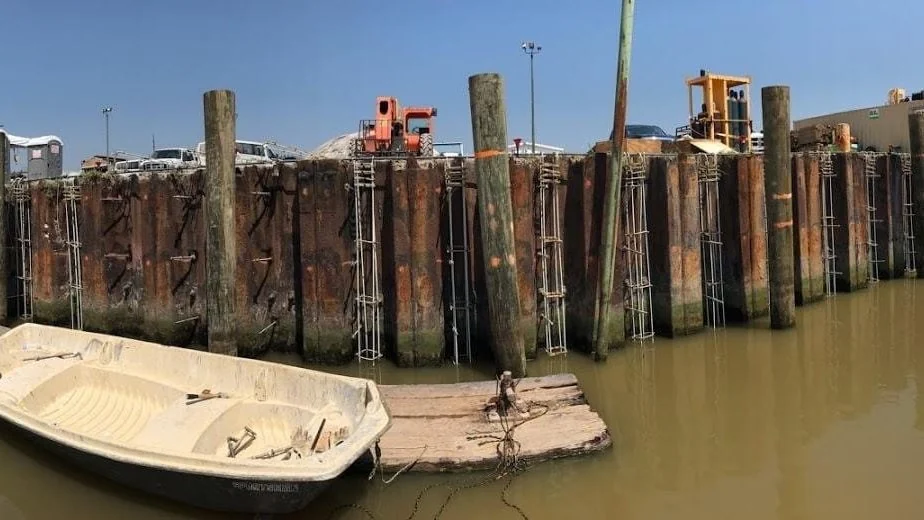
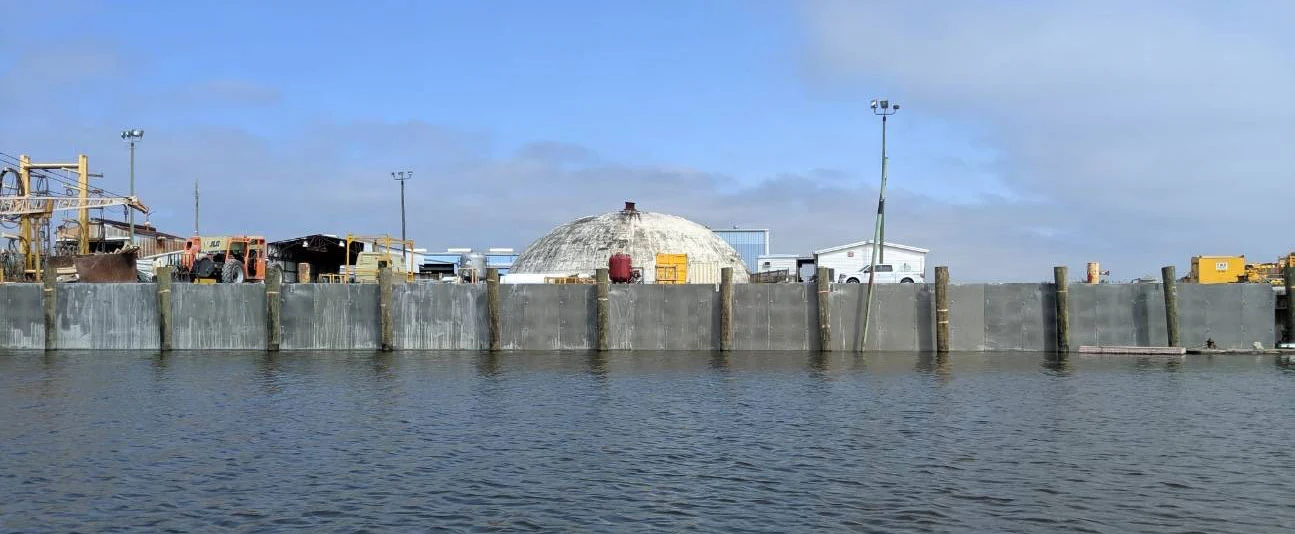
The first SPiRe® project repaired a 926 ft long corrugated steel sheet pile wall, 4 to 14 ft tall, at a pulp and paper plant in Chesapeake, Virginia. The wall was severely corroded, and the owners were concerned that chemicals on the plant grounds could leach through it into the river.
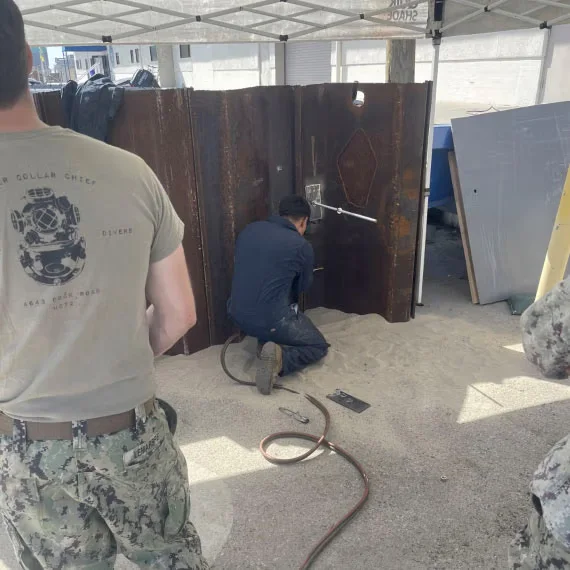
- AnchorHoles are cut in the sheet pile and stainless steel J-bolts are secured with a washer and nut as tie-downs. Where required, reinforcing bars go in the wall cavity, preferably glass FRP bars that cannot corrode.
- Connect the panelsEach panel has a 4 in. wide depressed lip along one long edge. Underwater epoxy paste seals the overlap, and J-bolts secure the overlapping edges to the wall, forming an impervious stay-in-place form.
- BraceIf needed, whalers are placed horizontally as temporary bracing so the panels don’t deflect too much while grout is placed.
- Seal the baseThe panel bottoms penetrate about 16 to 20 in. into the soft riverbed silt. About 6 to 12 in. of grout is placed by tremie along the base and left to harden into a seal.
- Grout and finishThe rest of the height can be grouted in a single lift. The whalers come off, and the J-bolt ends are trimmed and, if desired, capped.
The finished panels and grout form an impervious layer. Because oxygen is the fuel of corrosion, cutting off oxygen and moisture brings the corrosion of the old wall to a near halt. At Chesapeake, the same barrier also keeps toxic materials on the plant grounds from leaching into the river. FRP Construction LLC of Tucson was the general contractor and Crofton Industries of Portsmouth, Virginia, was the diving subcontractor.
Plays from YouTube
Why is this repair economical?
The savings come mostly from what the crew does not have to do. There is no cofferdam to build, no water to pump out, no underwater welding and no heavy lifting.
- No cofferdams. Panels go on in the water, which removes one of the biggest costs of a coating repair, especially in deep water.
- Light panels. Workers lift them by hand, which makes installation easier and faster in hard-to-reach areas such as under decks.
- Nothing to corrode. The repair system has no steel components, so it does not start the cycle over.
- Corrosion comes to a near halt. The shell keeps moisture and oxygen off the old wall.
- Long service life. The paper expects 50+ years of virtually maintenance-free protection.
Can the repair add strength to the wall?
Yes, it can be designed to. The projects in the 2023 paper were for corrosion protection only, but the system can also contribute to a wall’s load-carrying capacity. That has to be evaluated and designed case by case by the engineer of record.
SPiRe®+ makes the structural case easier. Its T profiles lock into the grout and work like built-in rebar: the June 2026 data sheet rates the panel as equivalent to No. 6 Grade 60 steel bars at 3.5 in. on center, which is more tension reinforcement than many walls need. The same data sheet requires design calculations certified by a licensed professional engineer. Our team supplies the product data, specifications and sample design details your engineer needs.
Where has SPiRe® been used?
When the paper was written in 2023, several ports and private piers had been repaired with the technique and the U.S. military had used it on several projects around the world. It listed a 1 km long seawall at the Port of Melbourne, Australia, as scheduled for repair in 2023.
Plays from YouTube
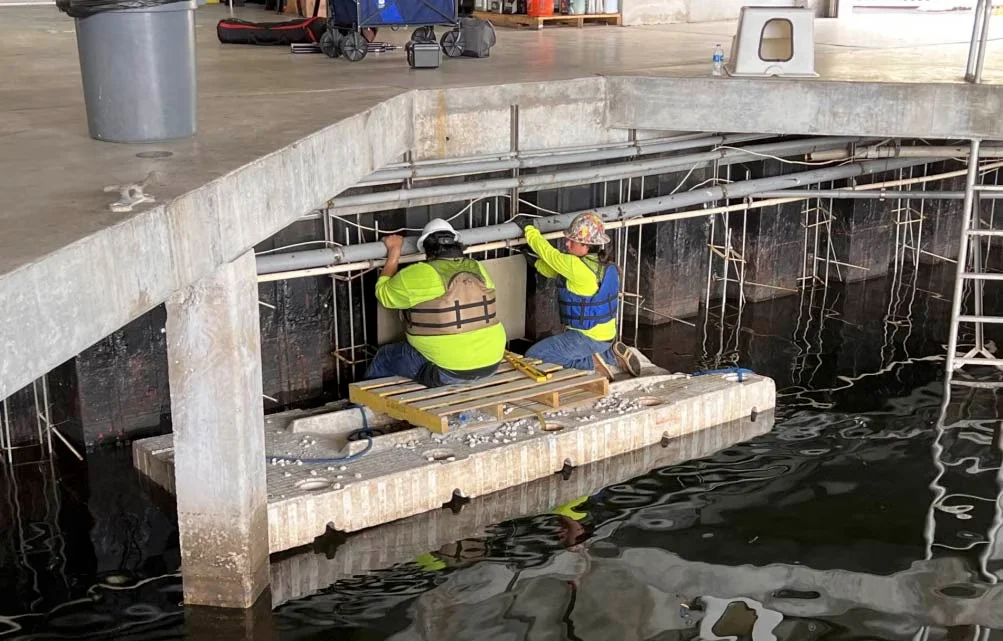
The newer SPiRe®+ panels have since been used on a severely corroded steel seawall in Weston, Florida, in June 2024, where holes as large as 1 sq ft were letting soil wash out. There, the walls were sandwiched between two sets of panels, one on each side. The same panels can also raise a wall that is now too low, as explained in Rising Sea Levels and Seawalls.
Who designs a seawall repair?
Your engineer of record designs the repair and signs off on it. QuakeWrap® is a product company: our team will recommend the right QuakeWrap® system and provide specifications, product data and sample design details for your engineer, and technical support for your contractor. Repairs in the water also need permits, so plan for them early. See environmental permitting for marine repairs.
Seawall and bulkhead repair FAQs
Why does a seawall corrode mostly near the waterline?
The splash zone between low and high tide goes through constant wet and dry cycles. Below the mudline there is too little oxygen to support ongoing corrosion, so the embedded part of the wall usually stays relatively undamaged.
Do I need a cofferdam to repair a corroded bulkhead?
Not with FRP panel repair. The panels are installed in the water, which removes the cofferdam and dewatering that coating repairs require.
Is welding steel plates a good way to repair a seawall?
It restores section, but permits for underwater welding are difficult to obtain, the work is costly, and the new unprotected steel corrodes just as the original did.
Can the repair add strength to the wall?
It can be designed to. SPiRe®+ panels are rated as equivalent to No. 6 Grade 60 bars at 3.5 in., and your engineer of record evaluates any structural contribution case by case.
What is the difference between SPiRe® and SPiRe®+?
The original SPiRe® panel is an infused sandwich panel, most often 4 ft wide, used mainly as a stay-in-place form. SPiRe®+ is a pultruded 3 ft wide panel with T profiles that also act as reinforcement.
How long does an FRP seawall repair last?
The 2023 paper expects a 50+ year service life of virtually maintenance-free protection, because the system has no steel components to corrode.
Who designs the repair?
Your engineer of record. Our team will recommend the right QuakeWrap® system and provide specifications, product data and sample design details.
Sources
- M. Ehsani, An Economical Solution for Repair of Seawalls and Bulkheads, QuakeWrap, Inc., February 2023.
- M. Ehsani, Evolution of FRP Products for Concrete Repair, Concrete International, April 2025.
- QuakeWrap, Inc., SPiRe®+ Panel product data sheet, June 2026.
- New York Sea Grant, Maintaining Shoreline Erosion Control Structures, C. O’Neill, 2002.
- U.S. Patent 10,968,631, issued April 6, 2021 (see Patents).
- QuakeWrap, Inc., Port of West St. Mary project sheet.
Have a Corroded Seawall or Bulkhead?
Tell us about the wall and site conditions. Our team will recommend the right QuakeWrap® system and provide specifications for your engineer.