
FRP · EXPLAINER
What Is FRP? Fiber Reinforced Polymer Explained
FRP (fiber reinforced polymer) is a composite of high-strength fibers, usually carbon or glass, held in a polymer resin such as epoxy. The fibers carry the load and the resin binds them and bonds them to the structure. Bonded to beams, columns, walls, piles and pipes, a layer often thinner than 0.1 in. restores or adds strength without adding real size or weight. See how FRP strengthens a structure.
Key takeaways
- FRP is fiber plus resin: carbon or glass fibers carry the load, and a resin such as epoxy binds them and bonds them to the structure.
- Stronger than steel in tension: about two to three times the tensile strength of steel, at a fraction of the weight.
- Thin and light: a shear wall upgrade can take under 0.1 in. of FRP instead of 6 in. or more of new concrete.
- Carbon or glass: carbon for strength and stiffness, glass for lower cost and non-conductive work.
- Designed to a guide: ACI PRC-440.2-23 (2023) covers externally bonded FRP, and the engineer of record certifies the design.
What is FRP?
FRP stands for fiber reinforced polymer, also called fiber reinforced plastic. It is a composite: strong, stiff fibers locked in a polymer resin. Neither part does the job alone. Loose fibers can’t carry compression or share load, and resin on its own is weak. Together they make a thin, light layer that is stronger than steel in tension and does not rust.
| Part | What it is | What it does |
|---|---|---|
| Fibers | Carbon, glass, aramid (Kevlar) or basalt | Carry the load. They are the main source of strength and stiffness. |
| + Polymer resin | Usually epoxy, vinyl ester or polyester | Spreads load between fibers, protects them from abrasion and moisture, and bonds the FRP to the structure. |
| = FRP composite | A fabric, laminate, panel or pipe | A thin, lightweight, corrosion-resistant layer that is strongest in the direction its fibers run. |
For design, the American Concrete Institute defines an FRP system as the fibers and resins in the laminate, the resins that bond it to the concrete, and any protective coatings (ACI PRC-440.2-23, 2023).
In construction, FRP is mostly used to repair and strengthen what is already built. It comes as dry fabric that is saturated with resin on site, as factory-made laminates and panels, and as structural pipe. You will see it called CFRP when the fiber is carbon and GFRP when it is glass.
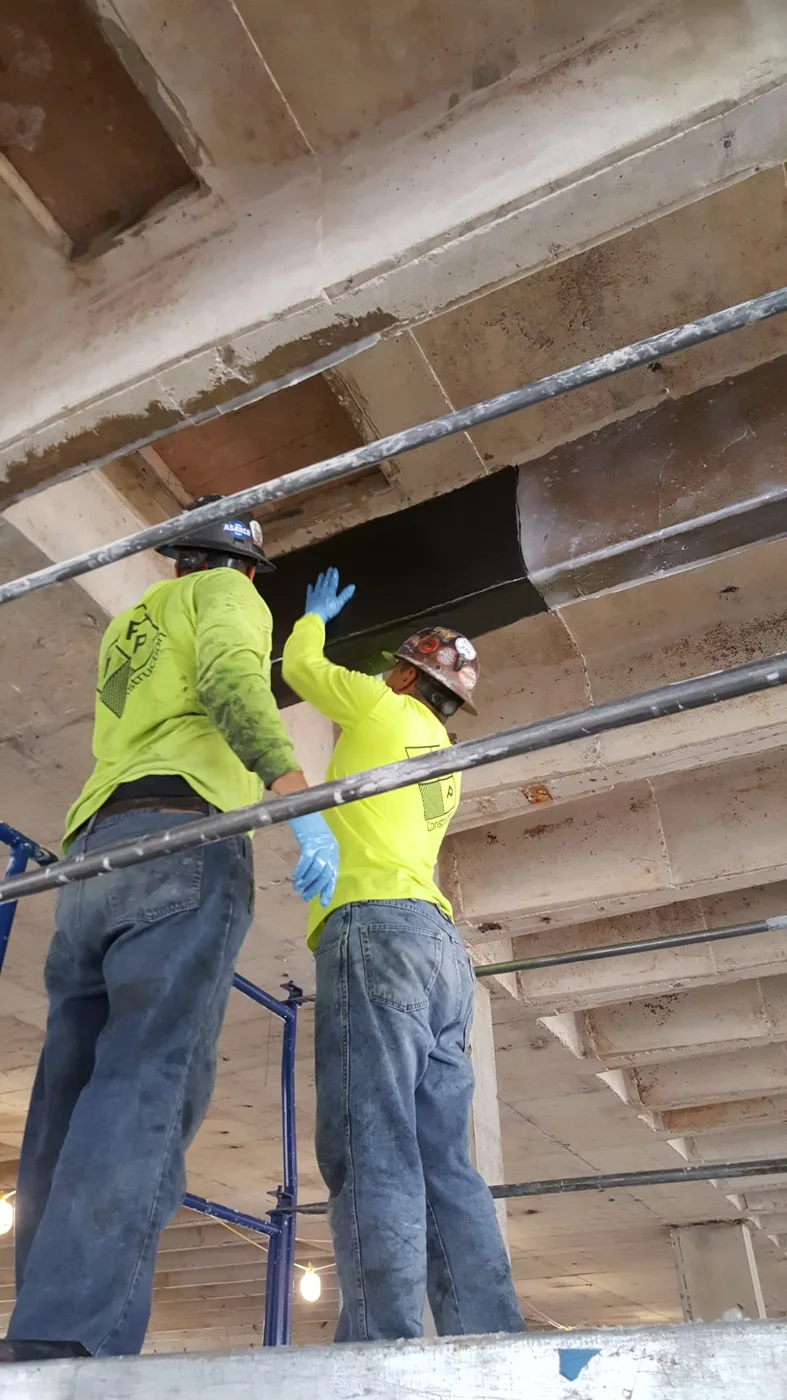
What is FRP made of?
Every FRP system combines one or more fibers with one resin. The choice of each sets the strength, stiffness, cost and where the product can go.
The fibers
- Carbon: the highest strength and stiffness. Common for bending and shear strengthening of beams, slabs and girders.
- Glass: lower cost and non-conductive. Fiberglass is the everyday name for glass FRP.
- Aramid (Kevlar) and basalt: less common in repair. The 2023 edition of the ACI design guide added basalt FRP to the commercially available systems it covers.
The resin
The resin, usually epoxy for structural repair, has two jobs inside the composite. It distributes the load among all the fibers, and it protects them from abrasion, moisture and other environmental attack. In a repair it is also the glue between the FRP and the beam, column or pipe.
Why fiber direction and fiber content matter
FRP is anisotropic: its properties change with direction. A unidirectional fabric is very strong along its fibers and much weaker across them. That is a feature, not a flaw. The engineer runs the fibers where the load runs, around a column for confinement or along the bottom of a beam for bending, and puts strength exactly where it is needed.
Is FRP stronger than steel?
In tension, yes. Once the epoxy cures, FRP reaches about two to three times the tensile strength of steel at a fraction of the weight, as Prof. Mo Ehsani noted in Concrete International in 2025. QuakeWrap® carbon fabrics saturated with QuakeBond™ 300SR cure to laminates of 129 to 179 ksi, and glass fabrics to 24.3 to 70.9 ksi, per the product data sheets.
FRP behaves differently from steel too. It stays elastic until it ruptures, with no yield plateau, and it is much weaker across its fibers than along them. That is why it is used as tension reinforcement, as shear wraps and as confinement, and why its design follows its own guide.
Carbon FRP vs. glass FRP: which is better?
Neither is better everywhere. Carbon is stronger and stiffer, glass costs less and does not conduct electricity, and many QuakeWrap® designs use both, choosing the fiber that suits each member.
| Carbon FRP (CFRP) | Glass FRP (GFRP) | |
|---|---|---|
| Laminate tensile strength | 129 to 179 ksi | 24.3 to 70.9 ksi |
| Stiffness | Highest | High, with lower stiffness |
| Material cost | Higher | Lower |
| Electrical conductivity | Conductive | Non-conductive (dielectric) |
| Common uses | Flexural and shear strengthening of beams, slabs and girders | Column confinement, masonry walls, blast and seismic retrofit, work near energized equipment |
Strength ranges are for QuakeWrap® fabrics saturated with QuakeBond™ 300SR, from the product data sheets. Check the current product data sheet before design.
Conductivity matters more than people expect. On a utility job near live equipment, glass was chosen for its dielectric properties. Read how in repairing corroded substation structures without an outage.
Is FRP right for your structure?
Tell us what you are repairing. Our team will recommend the right QuakeWrap® system and provide specifications for your engineer.
How does FRP compare with steel and concrete repairs?
FRP adds strength with almost no added size or weight, where steel plates and concrete jackets add bulk, weight and downtime. The conventional ways to strengthen concrete, as the ACI guide lists them, are bonded steel plates, steel jackets, enlarging the section with new concrete, and external post-tensioning (ACI PRC-440.2-23).
| FRP | Steel plates and jackets | Concrete jacketing | |
|---|---|---|---|
| Added size | Typically less than ½ in. | Moderate | Several inches |
| Added weight | Very little | Significant | Significant |
| Corrosion | Does not rust; seals the member | Needs ongoing protection | New rebar can corrode |
| Installation | Hand-applied, light equipment, cut to size on site | Lifting, welding or bolting | Formwork and curing time |
| Appearance | Can be painted, nearly invisible | Visible | Changes the member profile |
How does FRP strengthen a structure?
FRP strengthens a member in one of four ways, depending on where it is bonded and which way its fibers run.
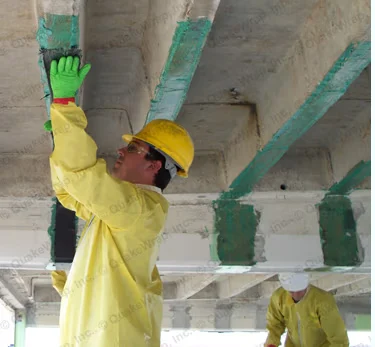
- Flexure (bending)FRP bonded to the tension face of a beam or slab acts as added tension reinforcement and raises bending capacity. See beam strengthening.
- ShearWraps and U-wraps on the sides of a member resist diagonal cracking.
- ConfinementFully wrapping a column or pile confines the concrete, which raises axial capacity and ductility. See column strengthening.
- Corrosion barrierEncasing a member shuts off the moisture and oxygen that feed corrosion, which sharply slows the corrosion of the steel and concrete inside.
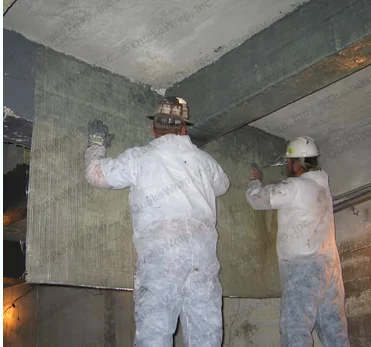
The corrosion barrier is easy to overlook. Paint protects steel until it cracks and peels a few years later. FRP is like a paint reinforced with fibers: it seals the member and keeps sealing it. That matters because corrosion is expensive. The 2016 NACE IMPACT study put its global cost at about US$2.5 trillion a year, 3.4% of world GDP, and estimated that existing corrosion control practices could save 15% to 35% of it.
What types of FRP repair systems are there?
FRP comes in several forms, from fabric saturated on site to factory-made laminates, panels and pipe. Each one solves a different access or surface problem.
| System | What it is | Best for |
|---|---|---|
| Wet layup | Fabric saturated with resin and applied like wallpaper. The original method. | Beams, slabs, walls, tanks and pipes with a prepared, dry surface |
| Dry layup | Dry fabric placed on a resin-coated surface and saturated in place | Large and vertical structures, including chimneys over 500 ft tall |
| PileMedic® laminates | Thin, pre-cured laminates wrapped into jackets and filled with grout | Piles, columns and poles, including underwater |
| SPiRe®+ panels | Pultruded glass panels that form a new reinforced shell filled with grout | Seawalls, piles, beams and slabs with rough or damaged surfaces |
| StifPipe® and PipeMedic® | Structural FRP pipe and liners | Culverts and pipelines rehabilitated from the inside, without digging |
| Hidden repairs | Paintable carbon FRP, or near surface mounted (NSM) carbon rods and strips set into grooves | Historic buildings where the repair must stay out of sight |
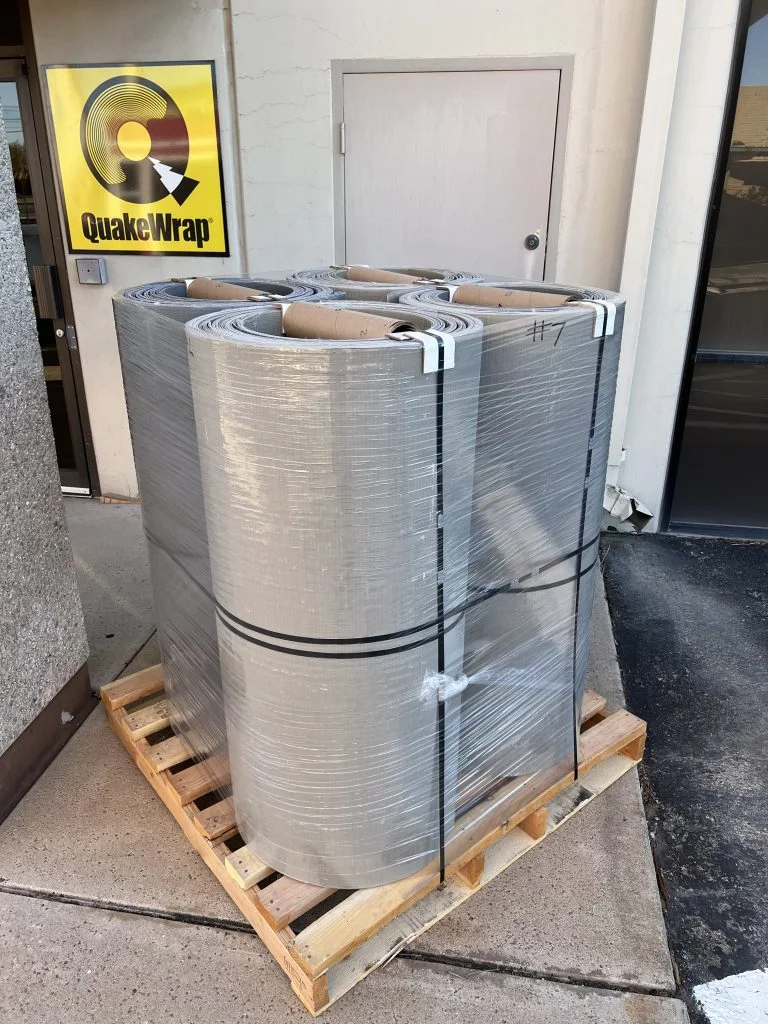
Where did FRP repair come from?
FRP structural repair began in the late 1980s, when Prof. Mo Ehsani and his associates at the University of Arizona pioneered the wet layup method. Each later product generation solved a limit of the one before it.
- Wet layup fabrics (1990). Carbon or glass fabric saturated with epoxy in the field. By the next day it reaches two to three times the tensile strength of steel. The method appeared in Concrete International in March 1990 and has since been used on thousands of projects.
- Factory-made laminates (2010). Wet layup has three limits: the fabric cannot follow the sharp corners of a steel H-pile, the surface must be patched smooth first, and it cannot go on underwater without a cofferdam. Laminates pressed under heat and pressure to about 0.04 in. thick remove most of that. Thousands of piles have been repaired with them since 2012.
- SPiRe® and SPiRe®+ panels (2018). SPiRe® launched in 2018 as a stay-in-place FRP form. SPiRe®+ panels, 3 ft wide with a 0.2 in. wall, replace three products at once: formwork, reinforcing steel and waterproofing.
Plays from YouTube
Where is FRP used in construction?
FRP is used wherever a structure needs more strength, or has lost strength, and adding steel or concrete would be too heavy, too slow or too disruptive. QuakeWrap® FRP has been used on more than 1,000 projects in 28 countries.
- Beams and girders: bending and shear strengthening of concrete and steel beams.
- Columns: confinement and repair of corroded concrete and steel columns.
- Piles: concrete, steel and timber piles, above and below water.
- Seawalls and bulkheads: corroded sheet pile and concrete walls.
- Pipelines and culverts: pressure pipes, sewers, penstocks and culverts, often without digging.
- Seismic retrofit: columns, walls and tilt-up buildings strengthened for earthquakes.
- Tanks, chimneys and blast hardening.
Owners turn to FRP to restore members weakened by corrosion, age or impact, to add capacity for heavier loads or a new use, to correct construction or design errors such as low-strength concrete, and to meet current seismic codes. Because it bonds to the outside, a wall, beam or slab can be strengthened without enlarging it.
What are the limitations of FRP?
FRP is not right for every job. Externally bonded FRP has limited fire resistance, its resin needs a coating to resist UV, bonded systems depend on proper surface preparation, and FRP and concrete expand differently with temperature.
| Limit | How it is handled |
|---|---|
| Fire resistance | Design checks for the member without the FRP, plus protective coatings where required |
| UV exposure | A protective top coat over the resin |
| Surface preparation | Laminates and SPiRe®+ panels need little or none |
| Sharp corners, such as H-piles | A laminate jacket formed around the whole section and filled with grout |
| Underwater work | PileMedic® laminates or SPiRe®+ panels, installed without a cofferdam |
| Severe section loss | Concrete-filled FRP jackets with new bars and load transfer devices |
Results also depend on design by a licensed engineer and installation by trained crews. QuakeWrap® supports the engineer of record with specifications and sample details.
Does FRP cost more than steel or concrete?
FRP materials cost more per pound, but the finished repair often costs less. It is light, installs quickly with small crews and light equipment, often avoids taking the structure out of service, and needs little maintenance. The ACI guide puts it this way: FRP often extends the life of existing infrastructure at a fraction of the monetary and environmental cost of replacing it (ACI PRC-440.2-23).
For worked numbers on real repairs, see steel column repair cost, an economical way to strengthen concrete columns and the PileMedic® cost estimator.
Is there a design standard for FRP?
Yes. The main US reference is the American Concrete Institute’s guide for externally bonded FRP systems, now ACI PRC-440.2-23, published in November 2023. It supersedes ACI 440.2R-17, which many earlier designs, including some on this site, cite. ACI also publishes a specification for unidirectional carbon and glass wet layup systems (ACI 440.8).
The guide is not a code on its own: the engineer of record makes and certifies the design calculations. QuakeWrap® FRP systems have also been evaluated by IAPMO UES (ER-828), and fabrics with QuakeBond™ 300SR have been listed to NSF/ANSI/CAN 61 for drinking water pipes and tanks. Current reports are on our test results and approvals page.
FRP frequently asked questions
What does FRP stand for?
Fiber reinforced polymer, sometimes called fiber reinforced plastic. It is a composite of strong fibers, such as carbon or glass, held in a polymer resin such as epoxy.
Is FRP stronger than steel?
In tension, yes. Cured FRP reaches about two to three times the tensile strength of steel at a fraction of the weight. QuakeWrap® U27C carbon fabric, for example, cures to a 179 ksi laminate only 0.047 in. thick.
Is FRP the same as fiberglass?
Fiberglass is the everyday name for glass fiber reinforced polymer (GFRP), which is one type of FRP. FRP also includes composites made with carbon, aramid (Kevlar) or basalt fibers.
What is the difference between CFRP and GFRP?
CFRP uses carbon fibers and has the highest strength and stiffness, so it is common for bending and shear strengthening of beams and slabs. GFRP uses glass fibers, costs less and is non-conductive, so it is common for column confinement, masonry walls and work near energized equipment.
Can FRP be installed underwater?
Wet layup fabric generally cannot be applied underwater without a cofferdam. Pre-cured laminates can: PileMedic® jackets are wrapped around submerged piles by divers, bonded with an epoxy that cures underwater and filled with grout.
How long does an FRP repair last?
FRP does not rust or rot, and a fully wrapped member is sealed from the moisture and oxygen that drive corrosion. Service life depends on exposure, the coating that protects the resin from UV, and the quality of design and installation.
What are the disadvantages of FRP?
Limited fire resistance, the need for UV protection, careful surface preparation for bonded systems, and a different thermal expansion from concrete. Wet layup also cannot follow sharp corners or go on underwater, which laminates and SPiRe®+ panels were developed to solve.
Which design guide covers FRP strengthening?
ACI PRC-440.2-23, the American Concrete Institute’s guide for externally bonded FRP systems for strengthening concrete structures, published November 2023. It supersedes ACI 440.2R-17. The engineer of record designs and certifies the repair.
Sources
- ACI Committee 440, Design and Construction of Externally Bonded FRP Systems for Strengthening Concrete Structures: Guide (ACI PRC-440.2-23), American Concrete Institute, November 2023.
- NACE International (now AMPP), IMPACT: International Measures of Prevention, Application, and Economics of Corrosion Technologies, 2016.
- Mo Ehsani, Evolution of FRP Products for Concrete Repair, Concrete International, April 2025.
- H. Saadatmanesh and M. R. Ehsani, Fiber Composite Plates Can Strengthen Beams, Concrete International, March 1990.
- QuakeWrap, Inc., product data sheets for U27C and U27G fabrics with QuakeBond™ 300SR.
- QuakeWrap, Inc., What Is FRP? (introduction), 2013 to 2023 editions.

Ready to See What FRP Can Do for Your Structure?
Talk to the team that pioneered FRP repair. We will recommend the right QuakeWrap® system and provide specifications for your engineer.