
UTILITIES · CASE STUDY
Substation Structure Repair: Fixing Corroded Steel Columns Without an Outage
Corroded steel substation structures can be repaired in service by filling the base with grout and wrapping it in a grout-filled glass FRP laminate jacket with a drain. At two Tucson Electric Power substations, nearly sixty damaged structures were repaired this way while the substations stayed energized, and the repaired structures now exceed their design strength. See how it was done.
Key takeaways
- Hidden damage: galvanized tube columns corroded from the inside at the base, where stress is highest.
- Collars failed: bolted steel collars were heavy, custom-made and hid ongoing corrosion.
- The fix: grout inside, a two-ply glass laminate shell outside, four U-bars and a drain over the lower 3 ft.
- No outage: nearly sixty structures were repaired with both substations fully operational.
- The result: repaired structures exceed their design strength, and corrosion stopped.
How do you repair a corroded substation structure without an outage?
You repair it with light, non-conductive materials that go on by hand around the energized equipment. In this project, published by Prof. Mo Ehsani and Gannon McGhee, PE, of Tucson Electric Power (TEP) at the 2015 ASCE Electrical Transmission and Substation Structures Conference, crews strengthened the lower 3 ft of each corroded column with grout and a two-ply glass laminate shell. With safety personnel overseeing the work, no outage was needed.
| Details | |
|---|---|
| Owner | Tucson Electric Power (TEP), two substations |
| Structures | Nearly sixty galvanized square hollow steel tube (HSS) equipment supports |
| Damage | Wall loss worst near the base, mostly on the inside |
| Earlier repair | Bolted steel collars |
| Repair | Glass SuperLaminate™ jacket, grout fill, four No. 5 U-bars and a drain |
| Repair zone | Lower 3 ft of each structure |
| Outage | None. The substations stayed fully operational |
| Published | 2015 ASCE Electrical Transmission and Substation Structures Conference |
Why do galvanized substation columns corrode from the inside?
In this case, the inside of the tubes near the base was likely never properly galvanized, and rainwater trapped inside did the rest. An inspection found extensive corrosion on many support columns, and it looked as though it had started on the inside of the wall, so the damage was probably worse than it appeared.
Ultrasonic thickness readings along the height of the columns confirmed it. Wall loss was most severe near the base, and in many columns most of the damage was inside, with little or none visible from outside. That is also where bending stresses in the column are highest.
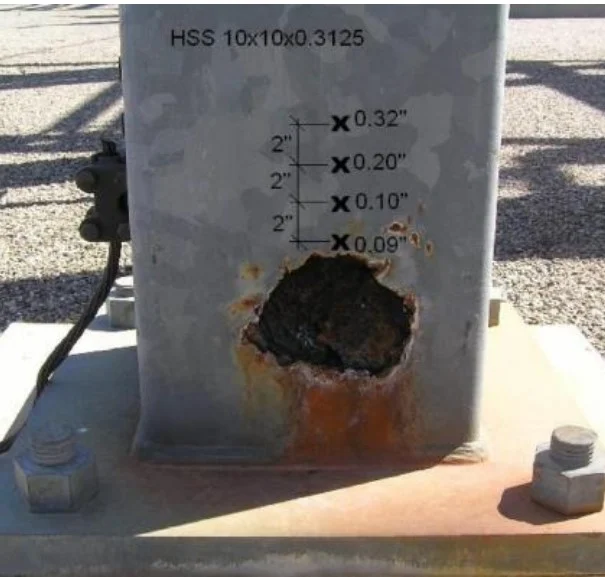
The likely causes
- Galvanizing that did not reach the inside. The acid bath was probably not fully drained from the tubes during prep, so the inside near the base was not properly galvanized.
- Grout that trapped water. Grout placed between the base plate and the foundation during installation trapped rainwater inside the columns and sped up corrosion.
This matches industry guidance for hollow sections. The American Galvanizers Association notes that square and rectangular HSS must be thoroughly cleaned for the zinc to bond to the steel, that no cleaning solution should be left trapped inside, and that end plates must be designed with vent and drain holes (2017). A base detail that skips this can leave the inside of a tube unprotected.
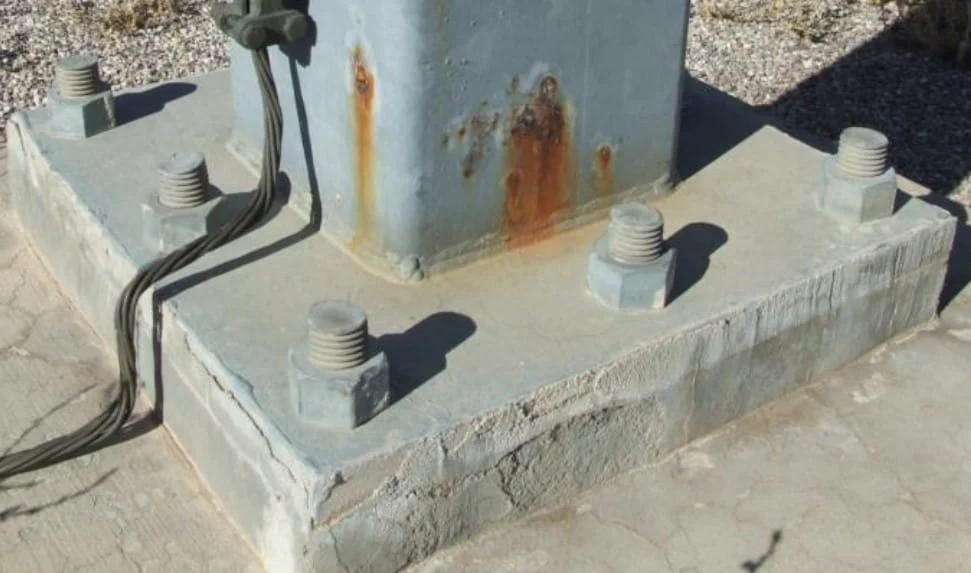
Why didn't bolted steel collars work?
The collars added steel but did not stop the corrosion, and they hid it. Each one had to be made to fit a different column size and designed around the base configuration and any equipment at that column. They were very heavy and hard to install.
An examination of the repaired columns showed corrosion still going on inside, with the collars covering the damage. In essence, a false sense of security. TEP looked for a more permanent repair that could be installed with the structures in service.
Have corroded substation or utility structures?
Send the structure types, sizes and measured wall loss. Our team will recommend the right QuakeWrap® system and provide specifications for your engineer.
Why use an FRP laminate instead of wet layup fabric?
Because fabric was not a suitable solution for these corroded steel columns, while a factory-made laminate was. FRP was introduced in the late 1980s for repair and strengthening, first as wet layup: carbon or glass fabric saturated with epoxy in the field and bonded to the surface. It cures in a few hours, is very strong in tension and does not corrode. With design guidelines such as ACI 440.2R-08 published, the paper notes, FRP was no longer an experimental product. For the basics, see What Is FRP?
But wet layup quality depends heavily on the crew, who must mix the resin, saturate the fabric, align the fibers and remove air bubbles in the field. Prof. Ehsani’s SuperLaminate™, the second generation of FRP products that PileMedic® jackets are built on, is made in a plant instead: sheets of carbon or glass fabric up to 60 in. (1.5 m) wide are saturated with resin and pressed under uniform heat and pressure.
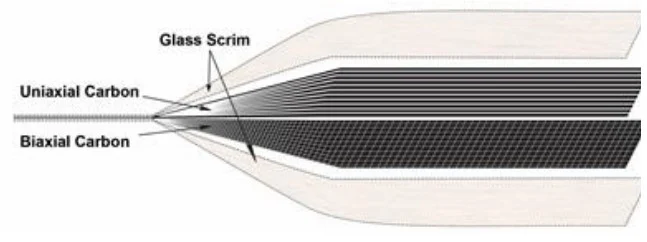
- Strength in both directions by combining unidirectional and biaxial fabrics.
- Thin: about 0.025 in. (0.66 mm), flexible enough to form into shapes in the field.
- Customizable: the number and pattern of layers can be tuned to each project.
| Type of fiber | Thickness | Tensile strength | Tensile modulus |
|---|---|---|---|
| Carbon | 0.026 in. (0.66 mm) | 156 ksi (1,080 MPa) | 13,800 ksi (95,500 MPa) |
| Carbon | 0.026 in. (0.66 mm) | 101 ksi (698 MPa) | 7,150 ksi (49,280 MPa) |
| Glass | 0.026 in. (0.66 mm) | 62 ksi (431 MPa) | 3,500 ksi (24,140 MPa) |
| Glass | 0.011 in. (0.28 mm) | 49 ksi (335 MPa) | 3,200 ksi (22,060 MPa) |
As published in 2015. Check the current SuperLaminate™ and product data sheets before design.
Glass was chosen for this job because it is non-conductive, which matters next to energized equipment. Carbon is conductive.
How the substation columns were repaired
The repair strengthened the lower 3 ft of each structure in five steps.
- Clean the columnRemove the corroded material that had separated inside the column, and clean off the rust over the lower 3 ft.
- Fill the baseCut a 3 in. access port 33 in. above the base, seal it temporarily with plywood and clamps, and pump non-shrink, high-strength grout inside. Four No. 5 U-shaped bars welded to the base plate add flexural capacity.
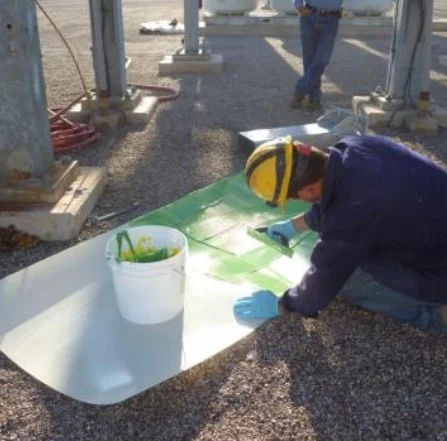
- Coat the laminateCut a 3 ft x 8.5 ft piece of glass laminate (62,000 psi, 0.026 in. thick) and trowel a two-component epoxy paste 20 to 30 mil thick onto about 5 ft of it.
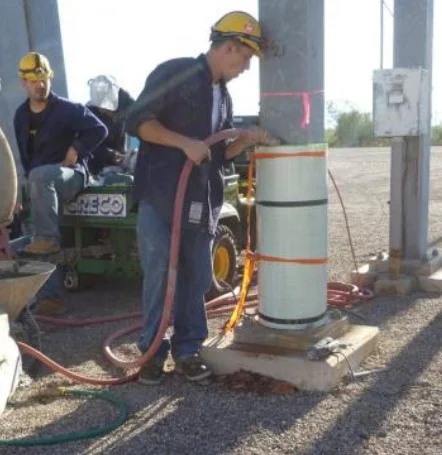
- Wrap the shellWrap the laminate loosely into a two-ply, 15 in. diameter shell with 8 in. of overlap and hold it with ratchet straps. Add a 1 in. PVC drain and tape the bottom edge to the base plate.
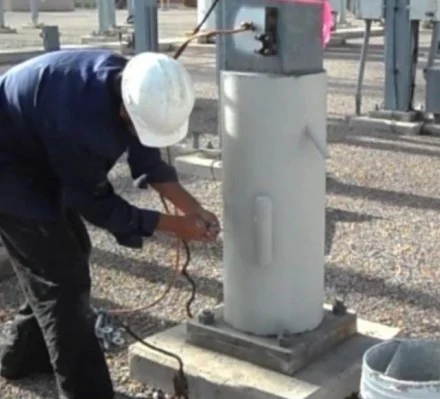
- Grout and coatFill the annulus with the same grout, consolidate it with a small vibrator and trowel the top. After several hours, remove the straps and paint the shell with a UV-protecting coating.
That last detail is clever. Before the grout sets, its hydrostatic pressure pushes the inner ply of the jacket outward against the outer ply, so the two plies of laminate are pressed tightly together without clamps.
What were the results?
The repaired structures now exceed their design strength. The grout fill and drain removed any place for water to collect inside the columns, and the paper reports that corrosion stopped on the repaired structures.
A main advantage was that no electrical outage was needed. With oversight by safety personnel, all of the work was done while the substations stayed fully operational. That matters because outages are a cost of their own. The NACE IMPACT study notes that through forced shutdowns, incidents and accidents, several industries have learned that poor corrosion management is very costly.
When does the foundation also need strengthening?
Only when the structure is strengthened beyond its original capacity. Here the goal was to restore the original capacity, so the foundations needed no work. To go beyond it, the base plate and foundation must also be checked, and anchor bolts may be needed to raise overturning capacity.
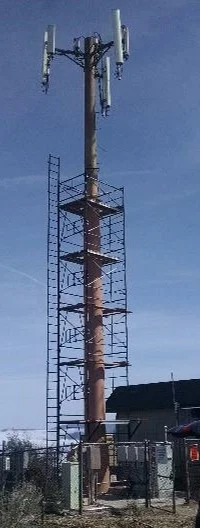
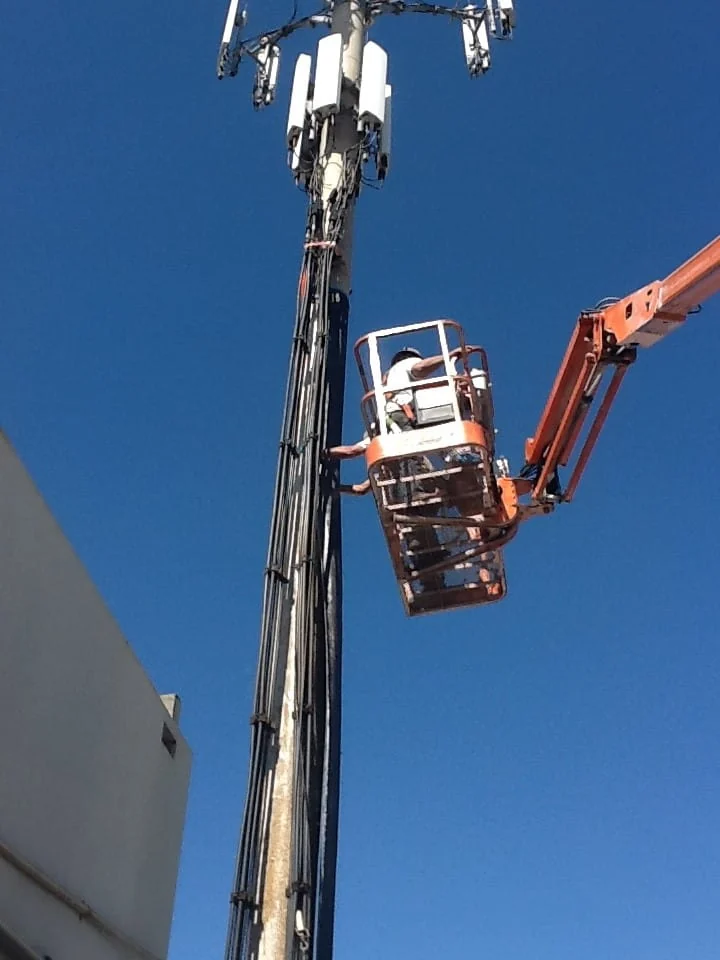
The same approach has been used to strengthen monopole cell phone towers. See utility poles and towers.
Plays from YouTube
Why this repair suits utility structures
- No outage: installed while the structure stays in service.
- Dielectric glass: non-conductive laminate near energized equipment.
- Light and hand-installed: no heavy collars to lift and fit around crowded equipment bases.
- One product, any size: laminate is cut to length in the field instead of fabricating a part for each column.
- Seals and drains: grout fill, a sealed jacket and a drain keep water from collecting again.
- Patented: the repair technique is protected by U.S. Patent 8,650,831.
The same jacket, with bolt-on load transfer, is used on steel building and bridge columns. Compare it with plates, collars and concrete in steel column repair methods, follow it in 11 steps, or price it with the steel column repair cost estimator.
Substation structure repair FAQs
Why do galvanized substation columns corrode?
In this case, the inside of the tubes near the base was likely never properly galvanized because the acid bath was not fully drained, and grout under the base plate trapped rainwater inside. Corrosion then worked from the inside out, where it is hard to see.
Can substation structures be repaired without an outage?
Yes. At the two TEP substations, all repairs were done with the substations fully operational, under the oversight of safety personnel.
Why use glass instead of carbon FRP near electrical equipment?
Glass laminate is non-conductive, and it was chosen for its dielectric properties near energized equipment. Carbon is conductive.
Will corrosion continue inside the repaired column?
The repair is designed to stop it. Grout fills the lower column, a sealed jacket encases the base and a PVC drain keeps rainwater from collecting. The paper reports that corrosion stopped on the repaired structures.
Does the foundation need strengthening?
Not when the goal is to restore the original capacity, as here. If the structure is strengthened beyond its original capacity, the base plate and foundation must be checked, and anchor bolts may be needed.
How long does each repair take?
The jacket is held with ratchet straps until the epoxy and grout set, and the straps came off after several hours. Total time depends on the number of structures and site access.
Were the bolted steel collars a good repair?
No. They were heavy, custom-made for each column, and hid corrosion that kept going inside, which the paper calls a false sense of security.
Sources
- M. Ehsani and G. McGhee, Repair of Corrosion-Damaged Substation Structures, ASCE Electrical Transmission and Substation Structures Conference, 2015.
- American Galvanizers Association, Rectangular and Square HSS Venting and Drainage Alternatives, A. Fossa, September 17, 2017.
- NACE International (now AMPP), IMPACT: International Measures of Prevention, Application, and Economics of Corrosion Technologies, 2016.
- ACI Committee 440, Guide for the Design and Construction of Externally Bonded FRP Systems for Strengthening Concrete Structures, ACI 440.2R-08, 2008 (as cited in the 2015 paper; now superseded by ACI PRC-440.2-23).
- M. Ehsani, FRP Super Laminates: Transforming the Future of Repair and Retrofit with FRP, Concrete International, March 2010.
Have Corroded Utility Structures?
Tell us about the structures and the damage. Our team will recommend the right QuakeWrap® system and provide specifications for your engineer.